Antiquity
Tarraco: The Coast Where Rome Still Sits in Place
The amphitheatre and Circ Romà belong to the UNESCO-inscribed ensemble of 2000 — fourteen components in and around the city, from the Pretori tower to the 217-metre Pont del Diable aqueduct. The Passeig Arqueològic traces 1.2 kilometres of city wall with the Mediterranean below, and each May the Tarraco Viva festival (11–24 May 2026, its 28th edition) stages the history inside the monuments themselves.
Mondmodel Intelligence ·
Capital of Hispania Citerior
Tarragona was Tarraco, capital of the Roman province of Hispania Citerior — Tarraconensis. It is the single classical-antiquity anchor in the entire Mondmodel portfolio; no other destination owns Roman heritage of this rank. UNESCO inscribed the ensemble in 2000, and its fourteen components sit not gathered on a museum plaza but embedded in the living city: the Pretori tower by the forum, the Circ Romà beneath the streets, the amphitheatre facing the sea, and further out the Pont del Diable aqueduct. To walk Tarragona's Part Alta is to pass through two thousand years without noticing the seam — an alley opens onto a Roman wall, a café leans against imperial-age stone. One thing is worth keeping clear: no Mondmodel property sits inside this UNESCO quarter. Tarragona is the destination's cultural anchor, not its hotel core; the three houses of the curated Tarragona & Camp de Tarragona area lie in La Canonja, La Selva del Camp and Montbrió del Camp, out on the surrounding plain, each carrying its own municipality. Anyone expecting a charter coast lined with hotel blocks meets instead a provincial capital that never quite abdicated.
Buy a combined ticket for the Roman monuments at the tourist office on Carrer Major — it covers the amphitheatre, Circ Romà and Pretori in one.
The Amphitheatre Against the Sea — and What You Actually See
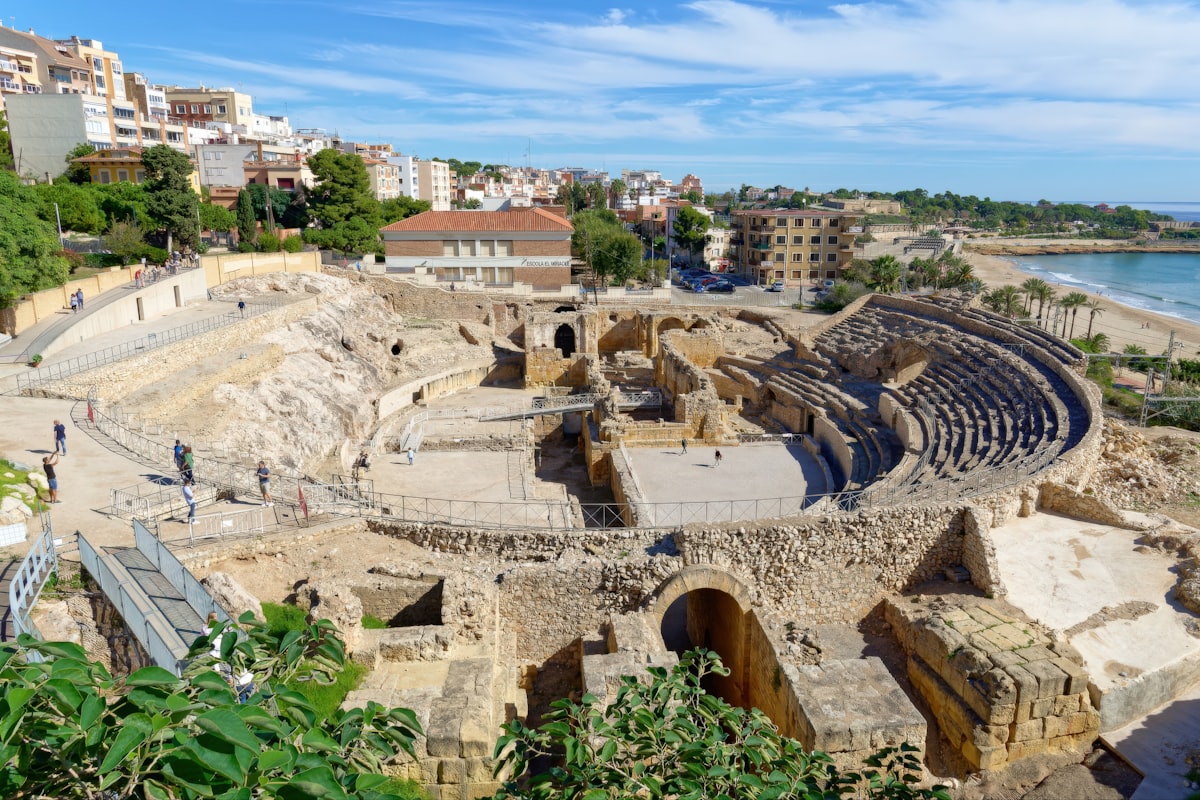
The amphitheatre dates from the 2nd century AD and sits where few Roman arenas do: with its back to the Mediterranean, the oval turned so the sea forms its fourth wall. Be honest about what the visit means in 2026 — the monument is open via guided visits, but the reconstructed Roman tiers, the gradas, are closed to climbing during ongoing restoration. You do not, then, step out onto the seating itself, and the prose about 'walking the arena' simply does not hold this year. The fullest view comes instead from above, from the Balcó del Mediterrani, where the whole oval lies framed in blue and the form of the entire structure becomes legible in a way it never is from ground level. It is a stricter experience than the brochure shot promises, but the historical density is real: martyrs were executed here during the persecutions, and a Visigothic church was later built straight into the arena, so that three epochs — Roman, early-Christian, medieval — lie layered in the same stone. To see it honestly, closed gradas and all, is to see more, not less.
Go to the Balcó del Mediterrani at sunrise. The amphitheatre lies backlit against the sea and the pressure of the guided visits has not yet begun.
The Walls, the Aqueduct and the Walk Around the City
The Passeig Arqueològic follows 1.2 kilometres of Tarraco's city wall, Roman at the foundation and built up through the Middle Ages, with the Mediterranean always below. It is one of the most complete defensive lines from Republican Rome preserved outside Italy, and for that reason the walk reads less as a museum visit than as a circuit around a city that never tore its walls down. A few kilometres north of the centre, the Les Ferreres aqueduct — the Pont del Diable — spans a ravine 217 metres long and about 26 metres high; the figure is 217 metres, not the 249 sometimes cited, and the height 26 metres, not 27. It once carried water to the city and in 2026 carries visitors along its upper channel, a double tier of arcades in pale sandstone set in a pine wood. Together, wall and aqueduct draw Roman Tarraco at full scale: not fragments in a case, but infrastructure you can walk on. That is the difference between reading about an empire and standing on its water supply. That both survive in comprehensible length makes Tarraco a place where the Roman can be walked at its own scale.
The aqueduct lies outside the centre in a pine wood — take the local bus or drive and combine it with a picnic; crossing the channel is free.
May, When the Monuments Wake: Tarraco Viva
Tarraco Viva runs its 28th edition from 11 to 24 May 2026, and that is when the Roman city stops being ruin and becomes stage. Legionaries march through the Part Alta, gladiators clash, Roman cooking is prepared over fire, and scholars lecture inside the monuments themselves. The festival is among Europe's most serious of its kind — historical reconstruction rather than theme park, built on source-reading as much as on spectacle. It also falls well in the calendar: May on the Costa Daurada is warm without being crowded, and the coast's charter rhythm has not yet struck, so the fourteen UNESCO components can be experienced without the press of summer. It is part of the destination's larger pattern — the inland and the historical run strongest precisely while the beach still sleeps. Note equally what May 2026 does not hold: the Tour de France Grand Départ is in Barcelona on 4 July, not Tarragona, and there is no free admission to the UNESCO sites tied to the race. Plan the trip around the bicycle and you plan around the wrong city; plan around Tarraco Viva and you arrive right.
Many of the festival's events are free but capacity-limited — check the programme at tarracoviva.com and arrive early for the legionary camp and gladiator school.