Gecko Hotel & Beach Club
Migjorn (Formentera), Ibiza · imperial
THE VIBE
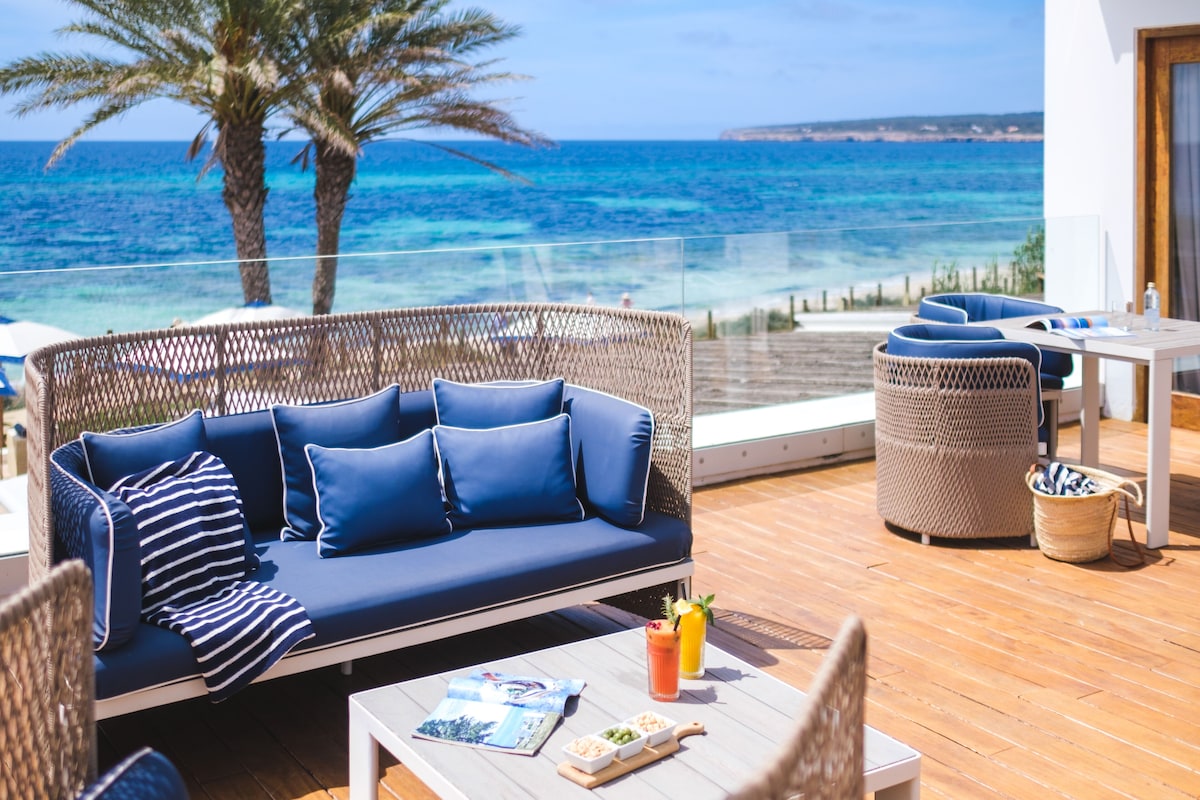
A beach hotel in fifties glamour right on the sand of Platja de Migjorn — white linens, houndstooth and a beach club where the day beds begin at the water's edge.
WHY NOW
With thirty rooms over two floors directly on Migjorn's long stretch of sand, Gecko is one of the few Small Luxury Hotels addresses on Formentera. The season runs only from May to October, which keeps the rooms scarce — the reason to book early rather than hope for a late cancellation.
THE ROOM
Ask for a room facing the sea rather than the inner garden; it is the sound of Migjorn's waves and the morning light over the water you come for. A room on the lower floor sits closer to the beach club's daytime life but further from the evening quiet.
THE TABLE
Espetada — grilled local fish on the skewer — Orilla. The hotel's beach restaurant Orilla grills the day's local catch at the water's edge; the espetada nights with live music are the house's summer signature.
THE NEIGHBORHOOD
Platja de Migjorn is Formentera's longest beach and runs for several kilometres along the south coast. The ferry from Ibiza docks at La Savina, about a half-hour crossing; from there it is around twenty minutes by car to the hotel. In summer the island's vehicle quota applies.
HONEST CAVEAT
Gecko closes for the winter half of the year, from November to April, and sits on an island with no airport — you reach it only by ferry, and in summer Formentera limits the number of vehicles. The beach club also draws day guests, so the pool area is livelier at midday than in the evening.
THE VERDICT
The strength is the setting: directly on Migjorn's sand with a beach club and a fifties feel, one of the few Small Luxury Hotels addresses on Formentera. The weakness is the season and the access — closed half the year, ferry-dependent and with day guests at the pool. Best for those who want a short, intense beach summer on the island's quietest coast.
THE FULL PICTURE
The first honest thing about Gecko is the inconvenience. You will not fly here. Formentera has no runway, no helipad, no shortcut. You take the ferry from Ibiza — thirty minutes across a channel that can turn the color of wet slate in a crosswind — and dock at La Savina, a harbor town that exists mainly to receive you and send you onward. Twenty minutes by car along roads narrowed by wild rosemary and fig trees, and then the hotel appears: low-slung, whitewashed, set directly on the sand of Platja de Migjorn like someone decided in 1955 that this was the exact right place to stop moving.
That inconvenience is the point. Formentera caps the number of vehicles allowed on the island each summer, which keeps the roads quiet and Migjorn's several kilometres of pale sand along the south coast something you hear rather than merely see. By midmorning on your first full day, you will understand why people return here with the compulsive loyalty of migratory birds.
Gecko trades on a fifties aesthetic that stops just short of costume. Houndstooth cushions on rattan daybeds. White linen that snaps in the breeze. Thirty rooms across two low floors, the design vocabulary restrained — clean lines, natural textures, the kind of considered simplicity that takes more effort than opulence. Ask for a sea-facing room. The garden-side quarters are fine, but you did not ferry across from Ibiza to wake to the sound of irrigation. On the sea side, open the shutters at seven and the Mediterranean is right there, close enough that the light off the water throws moving patterns across your ceiling. The lower floor puts you nearer the beach club's daytime rhythm; the upper floor buys you a longer sight line and more evening quiet once the day guests have caught their ferry back.
And yes, the day guests. This is the caveat that earns your trust: Gecko's beach club and pool draw visitors who are not staying at the hotel, and by midday the loungers nearest the water fill with a crowd that arrived by scooter from somewhere else on the island. The pool area at noon carries the energy of a well-curated party you didn't throw. If you want the sand to yourself, set your alarm. Before nine, the beach belongs to you, the gulls, and one or two silver-haired Italian women who have been coming to Formentera since before it had paved roads. By late afternoon the day visitors thin out, and by seven the beach club belongs to the overnighters — which is when the light turns the water the color of Campari and soda, and you wonder why anyone would voluntarily leave.
The crowd that books rooms — and they book early, because thirty rooms at one of Formentera's few Small Luxury Hotels addresses vanish fast — tends toward a particular species: European creatives between projects, fashion editors decompressing after the Milan shows, couples from Barcelona or Paris who treat this island as the antidote to the places they actually live. You will hear more French and Italian at the pool than English. The woman reading Ferrante in a wide-brimmed hat is an art dealer from Antwerp. The man doing laps at sunset owns a ceramics studio in Valencia. Nobody here is in a hurry, and nobody here is on their first island.
Orilla, the hotel's restaurant, sits close enough to the water that you taste salt on your lips between courses. The signature is the espetada — grilled local fish on the skewer, the catch dictated by whatever the boats brought in that morning. On espetada nights, when live music drifts across the sand and the kitchen works over open flame, the restaurant reaches a pitch that justifies the ferry and the vehicle quota and the five months of winter when the whole place simply does not exist. Order whatever the waiter suggests. Drink the local white cold enough to fog the glass. Let the smoke from the grill settle into your hair. This is the single evening you will remember longest from a summer of evenings, and you will not be able to fully explain why.
Because here is the other honest thing: Gecko closes. From November through April, the shutters go up, the daybeds get stacked, and Migjorn returns to the wind and the waves and the emptiness that makes Formentera feel, in the off-season, like a place the rest of the Mediterranean forgot. The season runs May to October, which gives the hotel the urgency of a summer affair — intense, finite, and better for the brevity. You cannot come whenever you want. You come when the island allows it.
Departure hits harder than you expect. The drive back to La Savina feels shorter than it should. The ferry pulls away, and Formentera flattens to a low line on the horizon, then to nothing. Across the channel, Ibiza's harbor opens up — the old walls of Dalt Vila rising above Marina Botafoch, the cathedral visible on the hill — and it all feels louder, busier, more constructed than what you just left. You sit on the upper deck with sand still in the seams of your bag and think about those thirty rooms and whether you remembered to book again for next year. You didn't. Fix that now.
FACTS
- Neighbourhood: Migjorn (Formentera)
- Stars: 5
- Tripadvisor: 4.3/5 (724)
- 38.685844, 1.460186
FAQ
When is the best time to visit?
With thirty rooms over two floors directly on Migjorn's long stretch of sand, Gecko is one of the few Small Luxury Hotels addresses on Formentera. The season runs only from May to October, which keeps the rooms scarce — the reason to book early rather than hope for a late cancellation.
Anything I should know before booking?
Gecko closes for the winter half of the year, from November to April, and sits on an island with no airport — you reach it only by ferry, and in summer Formentera limits the number of vehicles. The beach club also draws day guests, so the pool area is livelier at midday than in the evening.
What is the neighbourhood like around Gecko Hotel & Beach Club?
Platja de Migjorn is Formentera's longest beach and runs for several kilometres along the south coast. The ferry from Ibiza docks at La Savina, about a half-hour crossing; from there it is around twenty minutes by car to the hotel. In summer the island's vehicle quota applies.
MORE HOTELS IN Ibiza
- 7Pines Resort Ibiza — Cala Codolar, Sant Antoni
- Aguas de Ibiza — Santa Eulària des Riu
- BLESS Ibiza Cala Nova — Santa Eulària des Riu
- Can Lluc — Sant Rafel, Sant Joan
- Agroturismo Can Pere Sord — Sant Joan de Labritja
- Can Vistabella — Benimussa, Sant Antoni