Hotel 1898
La Rambla, Barcelona · heritage
THE VIBE
Colonial trading palace from 1881 — the former hub of the tobacco empire, transformed into one of La Rambla's most commanding addresses.
THE BACKSTORY
The property at La Rambla 109 was built in 1881 by Catalan architect Josep Oriol Mestres as a private residence for the López y López family, Marquesses of Comillas. A bust of Don Claudio López i Brus — carved by Josep Llimona — still stands in one of the hotel's Colonial rooms. The building subsequently passed to the Compañía General de Tabacos de Filipinas, the tobacco conglomerate that controlled trade between Spain and Southeast Asia, and was rebuilt for that purpose. In 2005, Grup Núñez i Navarro opened the property as Hotel 1898 — a name that is a story in itself: 1898 is the year Cuba and the Philippines, Spain's last colonies, formally broke free.
WHY NOW
La Rambla's renovation is underway in 2026 — the facade exposed in its most stripped-back form in decades. Hotel guests encounter the building without the usual curtain of kiosks and service carts tourists typically see.
THE ROOM
Deluxe on the fifth floor: private outdoor terrace with city views, without having to pay the Colonial Suite supplement.
WELLNESS
Spa Siargao is the Raval quarter's only spa housed in historic basement vaults: thermal circuit with heated pool and hydromassage, dry sauna and steam room in what was once the tobacco company's coal and strongroom. Organic and vegan profile. Open daily 10:30–20:30, access from age 16.
THE TABLE
Market dish based on La Boqueria ingredients — El Nido. Hotel-run restaurant on the ground floor with direct views over La Rambla — kitchen follows the season's offering from Boqueria, open 13:00–16:00 and 20:00–23:00 (October–May).
THE SERVICE
Spa Siargao is situated in the building's original basement vaults — the rooms that once served as coal storage and strongrooms for the tobacco company — with a heated indoor pool, hydromassage, sauna and steam room. Access from age 16. Open daily 10:30–20:30.
THE NEIGHBORHOOD
La Rambla 109 places the hotel at the centre of the promenade — the Gran Teatre del Liceu (La Rambla 51–59) lies approximately 500 metres south along the same street. La Boqueria market opens on the opposite side of La Rambla, a few minutes' walk away. Plaça de Catalunya is reachable in approximately 200 metres heading north. Liceu metro station (L3) serves the address directly.
HONEST CAVEAT
La Rambla is undergoing ongoing street reconstruction in 2026 — the outdoor environment directly in front of the hotel is periodically restricted. At night the boulevard remains heavily tourist-trafficked.
THE VERDICT
The building was erected in 1881 by Josep Oriol Mestres — originally as a private palace for the Marquess of Comillas, later converted into the headquarters of the Compañía General de Tabacos de Filipinas. The hotel opened in 2005 following restoration by Grup Núñez i Navarro, and the colonial proportions remain intact in volumes and ceiling heights that no new construction can manufacture. 169 rooms, four-star classification, and a name that is a historical verdict: 1898 is the year Cuba and the Philippines declared independence — Spain's last colonies.
THE FULL PICTURE
There is a specific moment of transaction when you choose to stay on La Rambla. You are trading tranquility for centrality, silence for the city’s thrumming aorta. Hotel 1898 understands this bargain better than any other establishment in Barcelona. It is not merely a hotel on the city’s most notorious thoroughfare; it is a corrective to it. You push through the heavy, slow-moving revolving doors and the sensory assault of the street—the shrill bird whistles from kiosks, the clatter of a thousand wheeled suitcases on paving stones, the low hum of human density—is instantly switched off. The air inside is cool, conditioned, and smells faintly of cedar and old money, a scent memory from its past life as the headquarters of the Philippines Tobacco Company. The lobby is a hushed, mahogany-paneled chamber where bellhops glide across polished marble floors. You won't find DJs or a see-and-be-seen cocktail scene here. Instead, you'll see discreet German couples who look like they own publishing houses and well-heeled American families who booked their corner suites a year ago, all sinking into buttery leather club chairs as if into a sigh of relief. This is a fortress of civility, a place you earn after a day spent in the beautiful, exhausting chaos outside.
The choice of room is paramount. While the Colonial Suites are the hotel’s calling card, the real intelligence lies in securing a corner Privilege room, specifically 504 or 506. Here, you get the dual-aspect balconies that act as your private viewing box for the grand theater of Barcelona. Throw open the shutters at 8 a.m. and the city rises to meet you. Below, the first delivery trucks are already making their way to La Boqueria, its iron-and-glass structure waiting just a two-minute walk away. You can hear the metallic screech of a vendor raising their persiana, smell the faintest hint of grilled sausage beginning to waft from a breakfast stall. This is the texture you came for. But let’s be brutally honest: the bargain has its terms. Even with heavy, double-glazed doors, the pulse of La Rambla is inescapable. If you are a light sleeper, avoid the third floor entirely. The late-night arguments of departing bar patrons and the pre-dawn hydraulic groan of the street-cleaning crews will become your soundtrack. The interior Deluxe rooms offer monastic silence, but to choose them is to miss the point; it’s like going to a concert and wearing earplugs.
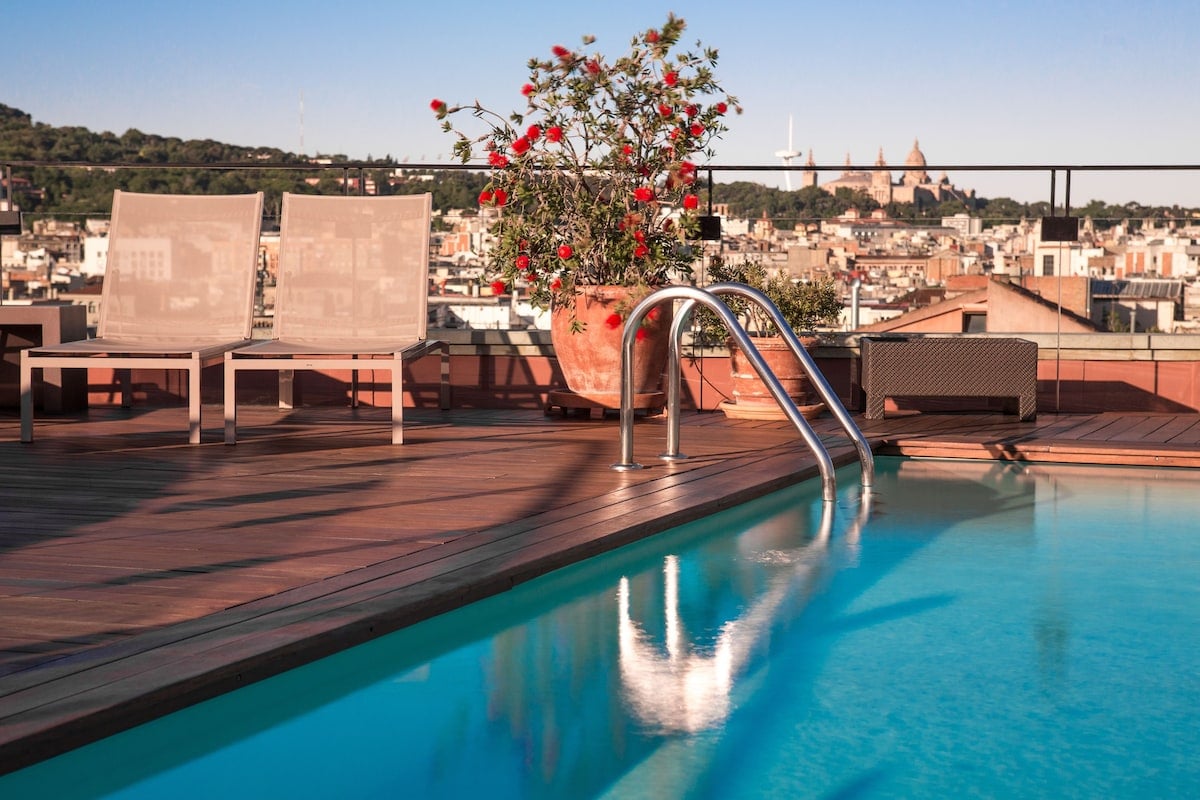
The hotel’s other compromise is tucked away in the basement. Set within an old stone vault, the pool is a dramatic, photogenic space that promises subterranean serenity. The reality is a chamber smaller than the pictures suggest, with acoustics that amplify a single splash into a tidal wave and a whispered conversation into a public address. It is a place for a quick, atmospheric dip, not for contemplative laps. The real sanctuary is found seven floors above the street. The ascent to the La Isabela rooftop terrace is a journey from the city’s clamorous heart to its quiet mind. The rooftop pool is a better Barcelona decision than most day trips.
Aim for that rooftop perch just before sunset, as the light softens and the spires of the distant Cathedral, a five-minute walk from the lobby, catch the last of the day’s gold. This is the hour for the ritual that defines a stay here. The crowd thins to a few in-the-know guests and locals who come for the work of mixologist Adal Márquez. You are here for something elemental. Order a glass of Raventós i Blanc, the local sparkling wine whose crisp, mineral attack feels engineered to cut through the day’s heat and fatigue. With it, you will have the Gilda 1898. It is nothing more than a high-grade Cantabrian anchovy, a tart guindilla pepper, and a plump olive, speared on a stick. But the intense, saline punch of the fish, balanced by the bright acid of the pepper and the smooth fat of the olive, is a perfect, potent distillation of Spanish flavor. As you take a sip of the wine, the sun slips behind the Tibidabo mountain, and the endless noise of La Rambla below becomes a distant, abstract murmur. From this vantage point, the city feels manageable, knowable. You are not in it; you are observing it. This is the perspective you paid for. It is from up here that you understand the tribe that chooses this hotel: architects who spent the afternoon arguing about the stark modernism of the MACBA, couples returning from a performance at the Palau de la Música, travelers who understand that true immersion requires a place of strategic retreat.
On your final morning, the 5 a.m. rumble of the cleaning crews will sound less like an intrusion and more like a farewell. As you pack, you’ll take one last look from the balcony at the river of humanity already beginning to flow. Stepping back through those revolving doors into the current of La Rambla, you don't feel like you are leaving a hotel. You feel like you are leaving an embassy, a sovereign territory of calm that allowed you to engage with the city on your own terms, armed with the knowledge that at any moment, you could retreat, ascend, and watch it all from above.
FACTS
- Neighbourhood: La Rambla
- Stars: 4
- From 220 EUR per night
- Tripadvisor: 4.7/5 (7019)
- 41.3811, 2.1733
FAQ
When is the best time to visit?
La Rambla's renovation is underway in 2026 — the facade exposed in its most stripped-back form in decades. Hotel guests encounter the building without the usual curtain of kiosks and service carts tourists typically see.
Anything I should know before booking?
La Rambla is undergoing ongoing street reconstruction in 2026 — the outdoor environment directly in front of the hotel is periodically restricted. At night the boulevard remains heavily tourist-trafficked.
What is the neighbourhood like around Hotel 1898?
La Rambla 109 places the hotel at the centre of the promenade — the Gran Teatre del Liceu (La Rambla 51–59) lies approximately 500 metres south along the same street. La Boqueria market opens on the opposite side of La Rambla, a few minutes' walk away. Plaça de Catalunya is reachable in approximately 200 metres heading north. Liceu metro station (L3) serves the address directly.
MORE HOTELS IN Barcelona
- ABaC Hotel & Restaurant Barcelona Monument — Sarrià
- Alenti Sitges Hotel & Restaurant — Sitges
- Alexandra Barcelona Hotel Curio Collection — Eixample
- Alma Barcelona GL — Eixample
- Almanac Barcelona — Eixample
- Arai Aparthotel — Barri Gòtic