Almanac Barcelona
Eixample, Barcelona · flagship
THE VIBE
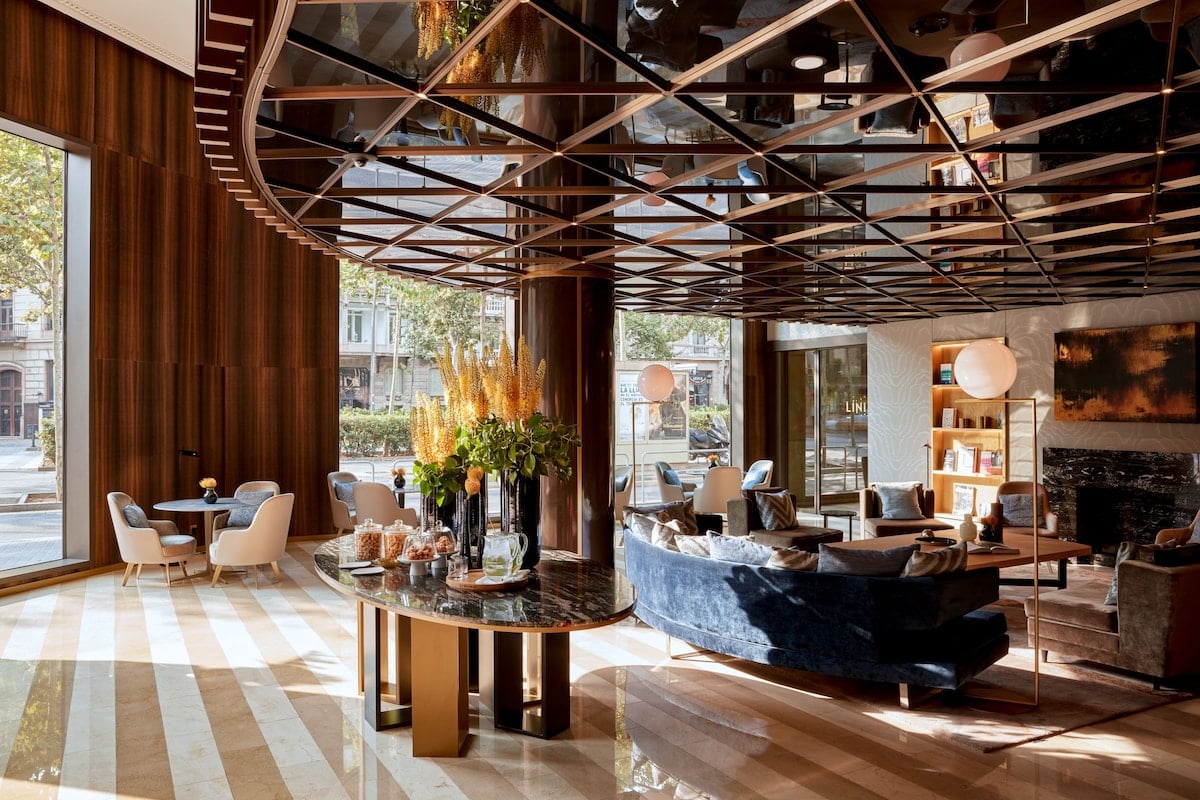
Two historic buildings merged by OAB into 91 rooms — boutique format with flagship ambitions.
THE BACKSTORY
Architecture firm OAB (Office of Architecture in Barcelona), founded by Carlos Ferrater, united two properties from different eras along Gran Via de les Corts Catalanes 619–621 in 2017. The interiors were designed by Jaime Beriestain Studio in a palette of grey, beige and gold with Ibiza marble, walnut and strategically placed antique mirrors. The hotel is owned by the Austrian family company WSF Group under Herbert Haselbacher.
WHY NOW
Virens, the hotel restaurant helmed by Michelin-starred chef Rodrigo de la Calle, focuses entirely on vegetable-based haute cuisine — a culinary choice that sets Almanac clearly apart from Barcelona's more conventional hotel kitchens in 2026.
THE ROOM
Cube Rooms with their curved window bay and sofa frame the Eixample grid as a permanent tableau — request a room facing Gran Via for the full boulevard proportions.
WELLNESS
The wellness floor houses a hydrotherapy pool, steam sauna and relaxation lounge exclusively for hotel guests. No external bookings. Personal training programmes via external coaches can be arranged through the concierge.
THE TABLE
Vegetable tasting menu with guisantes del Maresme — Virens. The hotel's own restaurant, led by Michelin-starred chef Rodrigo de la Calle — one of the few hotel restaurants in Barcelona with a genuine culinary identity rather than an all-day compromise format.
THE SERVICE
The sauna and hydrotherapy pool on the wellness floor are reserved exclusively for hotel guests — no advance booking required, and treatments can be arranged directly to the room.
THE NEIGHBORHOOD
The hotel sits at the intersection of Gran Via de les Corts Catalanes and Passeig de Gràcia — metro Passeig de Gràcia (L2/L3/L4) is at the same corner. The Modernisme buildings Casa Batlló and Casa Amatller are one block north along Passeig de Gràcia.
HONEST CAVEAT
Gran Via is a busy urban boulevard. Rooms facing the inner courtyard offer noticeably quieter nights.
THE VERDICT
OAB's transformation of two historic buildings into a cohesive 91-room hotel is architecturally credible. Virens sets the culinary standard for the entire property. Pricing is aggressive for a boutique hotel without a long track record — but the location at the Gran Via/Passeig de Gràcia intersection is difficult to argue against.
THE FULL PICTURE
You arrive not so much at a hotel lobby as into the antechamber of a private collection. Outside, the Gran Via de les Corts Catalanes thunders on, a six-lane artery of ambition and exhaust fumes that cleaves the Eixample district with unapologetic force. But the moment you cross the threshold, the city's roar is muted to a distant hum, replaced by the hushed reverence of a gallery. The air, cool and still, carries the faint, clean scent of polished stone and old paper. This is a sanctuary for the aesthetically rigorous: the Dutch product designer tracing the lines of a chair with her finger, the couple from Milan who flew in for a weekend at the opera, arguing in quiet, urgent Italian about the acoustics of the nearby Palau de la Música Catalana. They are not here for the beach clubs or the stag parties; they are here for a specific, intelligent conversation with Barcelona, and this hotel is their chosen salon. The check-in is less a transaction than a quiet consultation, a confirmation that you have found your tribe.
The elevator ascent is a silent glide. Your corner suite on the eighth floor is a study in restraint, a composition of textures—the cool weave of linen upholstery, the smooth grain of pale wood, the solid weight of the brass door handle. The true prize, however, is the view. Through one set of floor-to-ceiling windows, the Eixample unfolds in its relentless, elegant grid. Through the other, the perspective shifts, plunging into the chaotic medieval labyrinth of the Gothic Quarter, a dense tapestry of terracotta roofs and hidden courtyards. At 7 a.m., you slide open the glass door to the balcony, and the city enters: the metallic clang of a shop shutter rolling up, the aroma of diesel and strong coffee, the first sharp rays of sun glancing off the distant cathedral spire.
Let's be brutally honest: this privilege of space and perspective is not universal. The entry-level rooms are exercises in ship-cabin efficiency, their windows facing inner courtyards with all the charm of an air shaft. And if your room is below the fifth floor, the Gran Via is a constant, unavoidable roommate. The percussive sigh of bus brakes and the insistent wail of ambulance sirens become the soundtrack to your stay. For some, this is the city's vital pulse; for light sleepers, it is a non-negotiable dealbreaker. You must choose: the monastic quiet of an interior room, or the grand, noisy opera of a boulevard-facing suite. The hotel trusts you to know which you need.
By 3 p.m., when the Spanish sun is at its most punishing, the only sensible decision is to retreat upwards. The rooftop is the hotel's irrefutable argument. The pool itself is modest, more a plunge pool for cooling off than a basin for athletic laps, but to complain about its size is to miss the point entirely. You are not here to swim; you are here to command a panorama. From this vantage, perched above the urban fray, you can trace your day's pilgrimage: the five-minute walk to Gaudí's fever dream, Casa Batlló, its reptilian spine shimmering in the heat, and the manic energy of Plaça Catalunya, reduced from here to a silent, swirling diorama. A Negroni arrives, sweating onto the white marble table. As the sun dips, the chefs at the Azimuth rooftop kitchen begin service. The move is to order the Arroz meloso con bogavante, a creamy, umami-rich rice with Norway lobster that tastes of the nearby sea and justifies the decision to never leave the building.
When evening settles, the rooftop terrace transforms. The quiet contemplation of the afternoon gives way to a low murmur of conversation from architects and financiers dissecting the day over glasses of cava. This is the moment to descend back into the city, perhaps for a pre-dinner stroll past the modernista facades, or to join the queue of supplicants at a storied tapas bar in El Gòtic. But the smarter move is to stay put. Virens, the hotel's ground-floor restaurant, offers a different kind of quiet persuasion—a plant-forward menu that roots you in the season and in place, a deliberate counterpoint to the city's frenetic energy. Returning to your room, the view has transformed once more, the grid of the Eixample now a glittering circuit board, the Gothic Quarter a pool of mysterious darkness. You realize the stay has been an emotional arc: from the overwhelming chaos of arrival, to the elevated calm of the rooftop, to the deep, resonant satisfaction of a meal that speaks of its place. Leaving in the morning feels less like checking out and more like relinquishing a key to a private, more considered Barcelona.
FACTS
- Neighbourhood: Eixample
- Stars: 5
- From 450 EUR per night
- Tripadvisor: 4.7/5 (823)
- 41.3907, 2.1694
FAQ
When is the best time to visit?
Virens, the hotel restaurant helmed by Michelin-starred chef Rodrigo de la Calle, focuses entirely on vegetable-based haute cuisine — a culinary choice that sets Almanac clearly apart from Barcelona's more conventional hotel kitchens in 2026.
Anything I should know before booking?
Gran Via is a busy urban boulevard. Rooms facing the inner courtyard offer noticeably quieter nights.
What is the neighbourhood like around Almanac Barcelona?
The hotel sits at the intersection of Gran Via de les Corts Catalanes and Passeig de Gràcia — metro Passeig de Gràcia (L2/L3/L4) is at the same corner. The Modernisme buildings Casa Batlló and Casa Amatller are one block north along Passeig de Gràcia.
MORE HOTELS IN Barcelona
- Hotel 1898 — La Rambla
- ABaC Hotel & Restaurant Barcelona Monument — Sarrià
- Alenti Sitges Hotel & Restaurant — Sitges
- Alexandra Barcelona Hotel Curio Collection — Eixample
- Alma Barcelona GL — Eixample
- Arai Aparthotel — Barri Gòtic