Hotel Larios Málaga
Málaga, Costa del Sol · curated
THE VIBE
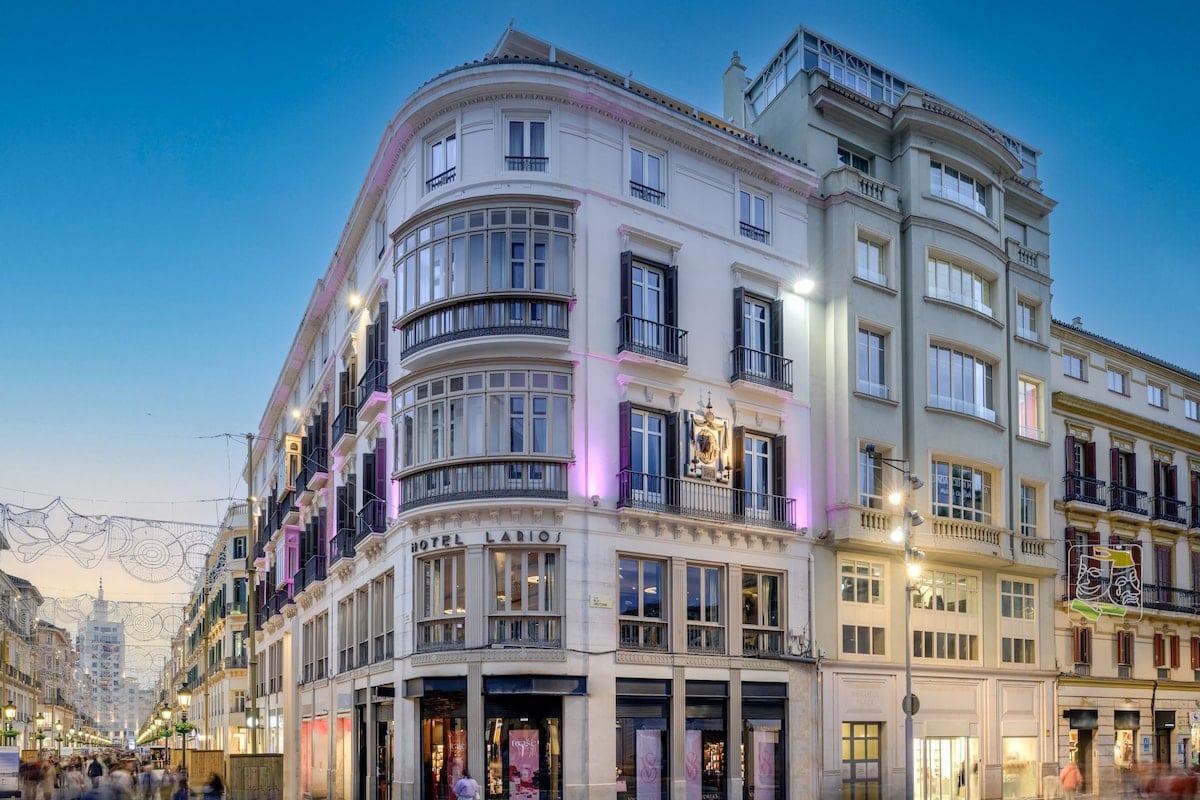
Four-star boutique at the heart of Málaga's most celebrated pedestrian thoroughfare — Art Deco in the living room, the Mediterranean on the horizon.
THE BACKSTORY
Calle Marqués de Larios was officially inaugurated on 27 August 1891, designed by engineer José María Sancha — the street's buildings were largely erected by architect Eduardo Strachan Viana-Cárdenas in a style influenced by the Parisian boulevards and the Chicago School. Hotel Larios occupies number 2 at the southern end of the street, one of the most prominent positions on the entire promenade. The building houses Art Deco decoration in its communal spaces; the precise construction date and original architect of this particular building are not publicly documented.
WHY NOW
La Terraza de Larios now serves until midnight on weekdays and 1 a.m. at weekends — the rooftop's views of the cathedral and Gibralfaro are at their finest during summer evenings' long, golden light. Book ahead: with only 41 rooms, the hotel fills early in high season.
THE ROOM
Rooms with a balcony facing Calle Marqués de Larios deliver the street as a backdrop — choose the upper floors to soften the pedestrian noise from the promenade below.
THE TABLE
Cocktail and tapas at sunset — La Terraza de Larios. The hotel's own rooftop bar serves cocktails and light bites with cathedral views — open to the public, but hotel guests skip the queues from the street below. Open until 01:00 at weekends.
THE SERVICE
Reception operates around the clock and can arrange airport transfers — a practical detail at a hotel where guests frequently arrive late on flights into Málaga-Costa del Sol.
THE NEIGHBORHOOD
The hotel sits at Calle Marqués de Larios 2 — the southern tip of the street where the promenade meets Plaza de la Marina. Málaga Cathedral La Manquita is approximately 200 metres to the west; the Picasso Museum is reached in roughly 500 metres heading north. The harbour and Muelle Uno are a short walk to the south. A further six apartments belonging to the hotel are located 120 metres away with balconies overlooking Plaza de la Constitución.
HONEST CAVEAT
Calle Larios is Málaga's busiest pedestrian street. Street noise during weekends and events is pronounced — light sleepers should request a courtyard-facing room or bring earplugs.
THE VERDICT
Four-star boutique at Málaga's finest address: 41 rooms, a rooftop terrace with cathedral views and a location no competitor on the street can match. No spa, no restaurant — but the rooftop bar La Terraza de Larios compensates with views and well-made cocktails. The right choice for those who want to sleep in the heart of the city rather than on its periphery.
THE FULL PICTURE
You don't check in here for a soft landing. You arrive as a tactical decision. Push through the heavy glass of the revolving door on Calle Larios and the city’s sound—a percussive mix of clicking heels on pale stone, street musicians, and vendors’ calls—is surgically removed. It’s replaced by the hushed, compressed air of the lobby, a blast of air-conditioning that carries the faint, clean scent of marble polish. The oppressive Andalusian heat is left outside like a coat you were desperate to shed. The light, sharp and bouncing off the pavement, becomes soft in here, absorbed by dark wood paneling and sedate armchairs that have witnessed decades of quiet, transactional importance. This is less a sanctuary and more a strategic outpost, the palpable feeling of being plugged directly into Málaga’s main artery. You are sharing the lift with a gallerist from Madrid closing a deal on an apartment in the regenerated Soho district, or a silver-haired couple from Seville who’ve been staying here for the Christmas light display every year since Franco died. The energy isn’t generated in the hotel; it’s just outside your window, and you’ve secured the best seat in the house.
This requires a specific demand upon booking. Insist on a ‘Doble Larios Vista Calle’ on the third or fourth floor. Rooms 304, 305, 404, or 405 are the prize, offering the most central, cinematic vantage points directly over the pedestrian thoroughfare. The Juliet balcony is non-negotiable; it is your private box for the theatre of Málaga life. From here you will witness the solemn, swaying processions of Semana Santa, or the joyous, unscripted chaos of a Saturday night that bleeds into Sunday morning. Anything lower and the noise is an overwhelming assault; any higher and you lose the intimacy, the satisfying voyeurism of it all. Under no circumstances accept an interior-facing room. They are sold as ‘quiet’ but are in fact deeply melancholic, with grim, sun-starved views of a narrow lightwell. To book one of these is to fundamentally misunderstand the purpose of staying here. You are not here for silence; you are here for the city’s glorious, intoxicating hum.
Let’s be brutally clear about the trade-off. You are paying an exorbitant fee for a postcode, not for inspired design. The interiors are a time capsule from the early 2000s, a corporate beige nightmare of heavy, generic wood furniture and uninspired art that feels chosen by a risk-averse committee. Service is efficient but anonymous; do not expect staff to remember your name or your coffee order. And from Thursday to Saturday, the noise from Calle Larios is a physical presence in the street-facing rooms, a layered composition of a lone saxophonist, roving hen parties chanting, and the distant, foundational throb of bass from a club that will last until 3 a.m. This is the price of admission.
The justification for this price is revealed at sunset. Take the lift to the revamped Larios Terraza, which has become the city's de facto open-air salon. Order a G&T made with local Larios gin, the condensation immediately beading on the cold glass. From this perch, you watch the final rays of sun illuminate the warm sandstone of the cathedral’s famously unfinished single tower, a monument to ambition that ran out of money. You are surrounded by the murmurs of the international creative class who have suddenly decided Málaga, not Lisbon, is the place to be. You are positioned for a serious art crawl—the Museo Carmen Thyssen is a three-minute stroll away, and the expanded Picasso Museum, a native son’s complicated homecoming, is just beyond that. In the distance, the stony ramparts of the Alcazaba fortress stand as a silent, millennium-old counterpoint to the city’s frenetic rebranding. This rooftop is the perfect perch from which to survey it all, feeling entirely in the right place at the right time.
When morning comes, you will commit a cardinal sin if you descend to the breakfast buffet. It is a cynical, overpriced affair of lukewarm eggs and weak coffee in stainless steel urns. You would be a fool to take it. Instead, you will walk five minutes to Casa Aranda, a tiled institution where the air is thick with the smell of fried dough and melting sugar, and order legendary churros with a cup of chocolate so thick your spoon stands up in it. For dinner, you will not even glance at the hotel restaurant menu. You will walk eight minutes to Bodega Bar El Pimpi, a glorious labyrinth of Andalusian history. Push past the tourists on the main terrace and find a worn wooden table deep inside, surrounded by enormous barrels signed by bullfighters and film stars. You are here for two things: the Fritura Malagueña, a heaping platter of impossibly fresh, lightly fried seafood—tiny squid, red mullet, and the city’s iconic anchovies, the boquerones—and a plate of their sharp, acidic cousins, boquerones en vinagre, glistening with olive oil and garlic. It’s a chaotic, deafeningly loud experience, best washed down with a small, ice-cold caña of Victoria beer. This isn't a meal; it's a foundational Málaga rite of passage. You leave not rested, but ratified. You chose geography over gentility, access over aesthetics. And from your Juliet balcony, watching the last of the city’s revellers head home as the street cleaners arrive, you know you made the right call.
FACTS
- Neighbourhood: Málaga
- Stars: 4
- From 120 EUR per night
- Tripadvisor: 4.5/5 (55)
- 36.7198, -4.4221
FAQ
When is the best time to visit?
La Terraza de Larios now serves until midnight on weekdays and 1 a.m. at weekends — the rooftop's views of the cathedral and Gibralfaro are at their finest during summer evenings' long, golden light. Book ahead: with only 41 rooms, the hotel fills early in high season.
Anything I should know before booking?
Calle Larios is Málaga's busiest pedestrian street. Street noise during weekends and events is pronounced — light sleepers should request a courtyard-facing room or bring earplugs.
What is the neighbourhood like around Hotel Larios Málaga?
The hotel sits at Calle Marqués de Larios 2 — the southern tip of the street where the promenade meets Plaza de la Marina. Málaga Cathedral La Manquita is approximately 200 metres to the west; the Picasso Museum is reached in roughly 500 metres heading north. The harbour and Muelle Uno are a short walk to the south. A further six apartments belonging to the hotel are located 120 metres away with balconies overlooking Plaza de la Constitución.
MORE HOTELS IN Costa del Sol
- AC Hotel Málaga Palacio — Málaga
- Alcazaba Premium Hostel — Málaga
- Amare Marbella Beach Hotel — Marbella
- Anantara Villa Padierna Palace — Benahavis
- Barceló Malaga Hotel — Málaga
- Hotel Best Triton — Benalmádena