Puente Romano Beach Resort
Marbella, Costa del Sol · imperial
THE VIBE
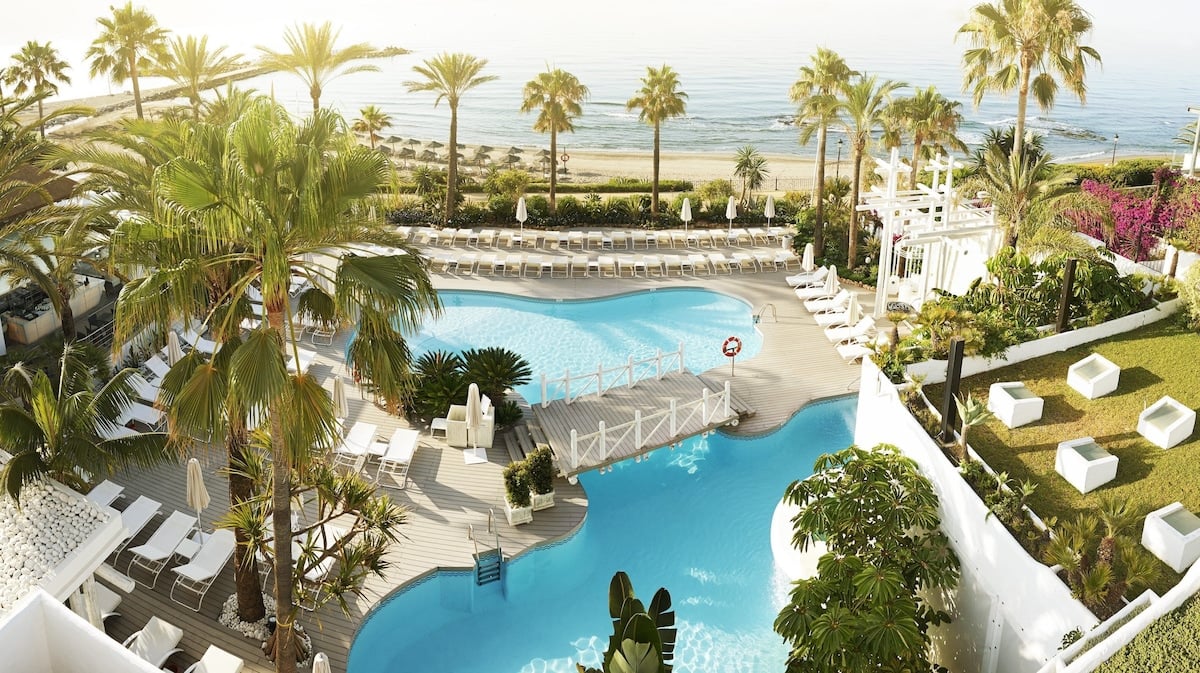
An Andalusian village from 1974 with a first-century bridge at its centre and Spain's first Nobu in La Plaza.
THE BACKSTORY
Melvin Villarroel, a Bolivian architect based in Marbella, designed in 1974 an exclusive residential complex for Prince Alfonso von Hohenlohe — whitewashed, arcade-lined and built around a first-century AD bridge restaurant that once carried Cádiz–Rome traffic along the Via Augusta. The hotel opened in 1979. In 1995 the property was acquired by the Shamoon family, who operate it today under Bursha Holdings.
WHY NOW
BiBo by Dani García closed in 2025 and Nobu expanded into the entire east side of La Plaza. Visit now to experience the new room layout and Leña — Dani García's steakhouse — which has replaced BiBo on the guest map.
THE ROOM
A 55 m² Junior Suite with a private terrace facing the subtropical gardens — orange blossom and jasmine without beach noise.
WELLNESS
Six Senses Spa has 9 treatment rooms — six on the ground floor, three on the upper floor with sea views — together with a hammam, steam room, sauna, cold plunge pool and hydrotherapy pool. Named Europe's Best Resort Spa 2023 by World Spa Awards.
THE TABLE
Black Cod Miso — Nobu Marbella. Nobu Marbella is Spain's first Nobu restaurant. Black Cod Miso is the house's canonical dish, served on hotel grounds since opening.
THE SERVICE
The tennis club, inaugurated in 1979 with Björn Borg as ambassador and led by Wimbledon champion Manolo Santana from 1983 to 1998, houses 8 clay courts, 2 hard courts and 4 padel courts — and hosted the 1988 Davis Cup Final.
THE NEIGHBORHOOD
Located on the Golden Mile — Bulevar Príncipe Alfonso von Hohenlohe, s/n — with Marbella Club as the nearest neighbour to the west and direct access to a private beach club. Marbella old town is reachable by car or taxi; walking distance is not documented.
HONEST CAVEAT
The property is expansive with 20-plus restaurants and a dining hall. Getting from suite to beach club takes time on foot, and during Spanish high season (July–August) the pool areas are under strain.
THE VERDICT
Costa del Sol's most layered resort property since 1979: a genuine Roman bridge, a tennis club with Davis Cup history and a Six Senses Spa that won Europe's best in 2023. Unrivalled breadth on the Golden Mile.
THE FULL PICTURE
You don't arrive at Puente Romano; you secede from the frantic pulse of the Costa del Sol. Your car turns off the Bulevar Príncipe Alfonso von Hohenlohe, and the world outside—a blur of sun-bleached billboards and Audis driving with impatient ambition—vanishes. The air changes instantly, the saline bite of the Alboran Sea replaced by the narcotic perfume of night-blooming jasmine and the damp, loamy scent of fifty-year-old gardens. You’ve entered a low-slung Andalusian village, established in 1979 and seemingly operating on its own serene time zone. The only sounds are the discreet crunch of your espadrilles on terracotta paths and the constant, hypnotic murmur of unseen fountains. This is a self-contained republic of leisure, populated by generations of the same Milanese families, London financiers who wear their Loro Piana linens with the ease of a second skin, and sun-burnished regulars who navigate the grounds with the proprietary air of homeowners.
The resort's greatest asset is its sprawling, village-like design; it is also its most maddening feature. The sheer scale means navigating the labyrinthine, bougainvillea-choked pathways from your suite to the Sea Grill for breakfast is a daily expedition under the mounting Andalusian sun. This is not a place for those with mobility challenges or a poor sense of direction. And be warned: by 9:30 AM, the central pools become a theatre of silent, passive-aggressive warfare for sun loungers, each one claimed by a ghost’s neatly folded towel and a paperback novel. It’s a place where you must understand the unwritten rules immediately or spend your day wandering in the heat. Let the uninitiated fight for the sea-facing rooms; they’ll pay a premium for the din of the beach club and a parade of passersby. Your destination is inside the botanical sanctuary. Insist on a ground-floor suite in the ‘Alhambra’ or ‘Persia’ sections, where private terraces are enveloped by such dense subtropical foliage that you feel as if you’ve stumbled upon a private estate. Here, you trade a sliver of blue for profound quiet, waking to the rustle of palm fronds and the scent of citrus blossoms, a world away from the clamour.
You soon learn that the resort is a gilded cage, a cashless ecosystem where a single gin and tonic at La Plaza, the central courtyard, can cost you €28. It subtly, masterfully discourages you from venturing out. After a day or two, you stop trying. Why would you, when Marbella’s entire culinary zeitgeist has been distilled and concentrated within these walls? To stay here is to undertake a gastronomic pilgrimage without ever hailing a taxi. The real reason you come to Puente Romano now is to eat. The central plaza transforms at dusk into a humming, atmospheric nucleus of choice. There is the seductive, fire-stoked drama of Leña, which holds the title for the world's most beautiful restaurant; the impossible-to-secure tables at Nobu Marbella; the polished Milanese elegance of Cipriani. You can spend a week here and dine at a different, internationally recognised restaurant each night, from the creative Greek plates by Eleni Manousou at Gaia to the Peruvian energy of COYA.
But your defining meal will be at BiBo. You come here for Dani García’s edible manifesto, a single bite that justifies the entire enterprise: the Oxtail Brioche. It arrives looking deceptively simple—a glistening, miniature bun. But the moment it touches your tongue, it dissolves into a profound depth of flavour. The core is a slow-braised oxtail stew of impossible richness, its velvet texture cut by an earthy layer of mushroom purée and the faintest whisper of truffle. It is a love letter to Andalusia, a distillation of tradition and technique that is both playful and deeply serious. To eat it is to understand García’s genius and the very soul of this resort’s culinary revolution. As you sit with a second glass of Albariño, the energy of the plaza swirling around you, you realize you haven’t thought once about the Roman ruins of Villa Romana de Río Verde just a short walk away, or the silhouette of the Mezquita del Rey Abdul Aziz al Saud on the horizon. This place has its own gravity. When it’s time to leave, the re-entry into the real world feels jarring, like waking from a vivid dream. You depart not just with a tan, but with the lingering taste of that brioche and the serene, jasmine-scented quiet of the gardens—memories from a luxurious, delicious, and utterly immersive state of secession.
FACTS
- Neighbourhood: Marbella
- Stars: 5
- From 550 EUR per night
- Tripadvisor: 4.6/5 (2812)
- 36.5059, -4.9698
FAQ
When is the best time to visit?
BiBo by Dani García closed in 2025 and Nobu expanded into the entire east side of La Plaza. Visit now to experience the new room layout and Leña — Dani García's steakhouse — which has replaced BiBo on the guest map.
Anything I should know before booking?
The property is expansive with 20-plus restaurants and a dining hall. Getting from suite to beach club takes time on foot, and during Spanish high season (July–August) the pool areas are under strain.
What is the neighbourhood like around Puente Romano Beach Resort?
Located on the Golden Mile — Bulevar Príncipe Alfonso von Hohenlohe, s/n — with Marbella Club as the nearest neighbour to the west and direct access to a private beach club. Marbella old town is reachable by car or taxi; walking distance is not documented.
MORE HOTELS IN Costa del Sol
- AC Hotel Málaga Palacio — Málaga
- Alcazaba Premium Hostel — Málaga
- Amare Marbella Beach Hotel — Marbella
- Anantara Villa Padierna Palace — Benahavis
- Barceló Malaga Hotel — Málaga
- Hotel Best Triton — Benalmádena