Living Heritage
Castells: Human Towers, UNESCO-Listed, Every Other Year at Tarraco Arena
A tradition from Valls and on UNESCO’s intangible-heritage list since 2010, castells rise higher with each generation of teams. The 30th Concurs de Castells is decided on 3–4 October 2026 at the Tarraco Arena Plaça — 18 colles on Saturday, the best 12 on Sunday — with a separate qualifying session in Torredembarra on Sunday 27 September.
Mondmodel Intelligence ·
What a Castell Is
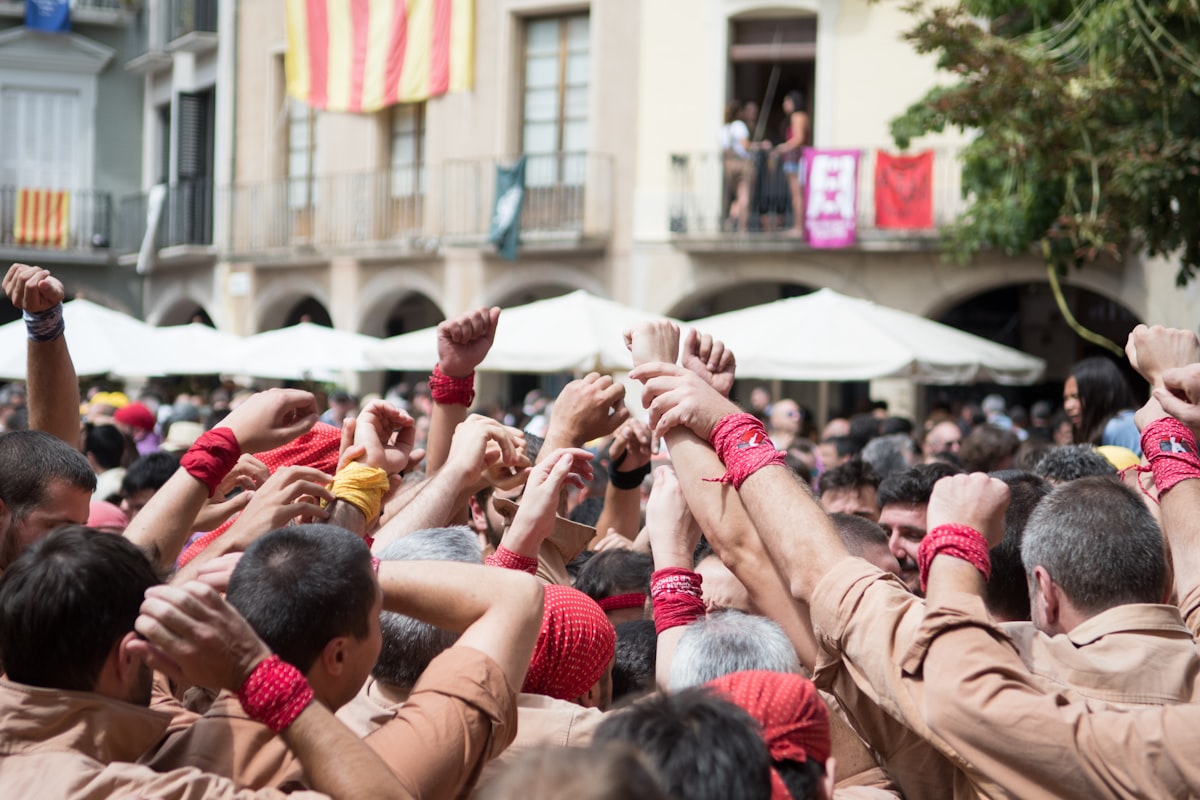
A castell is a human tower: rows of people climbing onto one another's shoulders until a child — the enxaneta — reaches the top and raises a hand to signal the tower is complete. The tower is built in layers over a wide base of interlocked backs, the pinya, which both bears the load and catches the fall if the tower collapses. The discipline demands hundreds of participants moving in exact unison; strength is not enough, it is coordinated weight, each back in the base taking precisely its share. The teams are called colles and wear coloured shirts as identity, bound tight at the waist so the climbers have a grip. It is not acrobatics for an audience but a collective trial of strength with roots in eighteenth-century Valls — a town that gave the coast both its towers and its calçotada, two gifts that share the same logic: many people together doing what no one alone can. To watch a castell rise and then dissolve layer by layer is to watch a whole community coordinated in a single movement.
Listen for the gralla — the shrill reed pipe — that marks the tower's phases. When the melody peaks, the enxaneta has reached the top; that is the moment to look up.
UNESCO Since 2010, Living Since the 1700s
Castells were inscribed on UNESCO's intangible-heritage list in 2010, and it is a different kind of inscription from Tarraco's Roman monuments, on the World Heritage list since 2000: this is a heritage that must be performed to exist. The tradition was born in Valls in the eighteenth century and has risen and fallen ever since — near extinction, then revived, and through the 2020s stronger than ever. The modern mark is that the towers are built higher with each generation of teams; technique, safety and the recruitment of children to the top have been refined year by year, and the hardest constructions of the present era would have been unthinkable only a few decades ago. To watch a castell is therefore to watch a heritage in ongoing development, not a preserved one. That sets it apart from the ruin and the museum — here there is no original version to restore back to, only the next tower to be raised a fraction higher. The Costa Daurada thus owns two UNESCO heritages of exactly opposite nature: one of stone that stands still and one of people that must be built anew each time.
To understand the tradition beyond the contest, visit Valls and its casteller museum El Pati — the town holds its own diada in alternating years, usually around Sant Joan.
Concurs de Castells: 3–4 October 2026
Every other year the best colles gather for the Concurs de Castells in Tarragona, and the 30th edition is decided on 3–4 October 2026 at the Tarraco Arena Plaça. Saturday fields 18 colles, and the top 12 go through to Sunday's final. It is the castell world's championship: the towers raised here are the tallest and hardest in the whole tradition, and the scoring rewards both height and difficulty, so a team can choose between a safer lower tower and a riskier higher one. A separate qualifying session is held in Torredembarra on Sunday 27 September, a week before. To book the trip around these dates is to see the heritage at its absolute peak — not a demonstration on a square, but the contest where the teams leave everything. That it is decided in Tarragona, the same city that carries Tarraco's Roman heritage, lays two layers of UNESCO history over one another across a single October weekend. The hush of thousands at the Tarraco Arena Plaça as a tall tower goes up is like no other crowd. It is a championship without an opposing team: each colla competes against gravity and its own limit.
Tickets for the Tarraco Arena go on sale well ahead and the Sunday final sells out first — buy early, and aim for a high seat to see the whole tower, not just the base.
An October Weekend Around Tarragona
The Concurs weekend falls in October, a month when the coast has already thinned but the interior still lives — the Priorat harvest is on, the weather mild, the monuments empty of summer crowds. That makes the contest the hub of a whole trip rather than a single event. Stay in the Camp de Tarragona — Mas La Boella on the olive estate at La Canonja, with its 13 room-suites across 110 hectares, or Mas Passamaner at La Selva del Camp, 24 keys in a Domènech i Montaner building — and combine Saturday's castells with a day among Tarraco's Roman monuments and an afternoon in the Priorat vineyards. Note that Tarragona city itself has no Mondmodel hotel; the three in the area sit in surrounding municipalities — La Canonja, La Selva del Camp and Montbrió del Camp — and the city is the destination's Roman and castell cultural hub, not its bed. It is exactly this division of labour that defines the trip: you sleep on the plain and drive into the city for the history, a geography that mirrors how the destination itself is built.
Mas La Boella sits on a 110-hectare olive estate at La Canonja with its own restaurant — eat there after Saturday's castells and taste the estate's own olive oil.