Mas La Boella
La Canonja, Costa Dorada · flagship
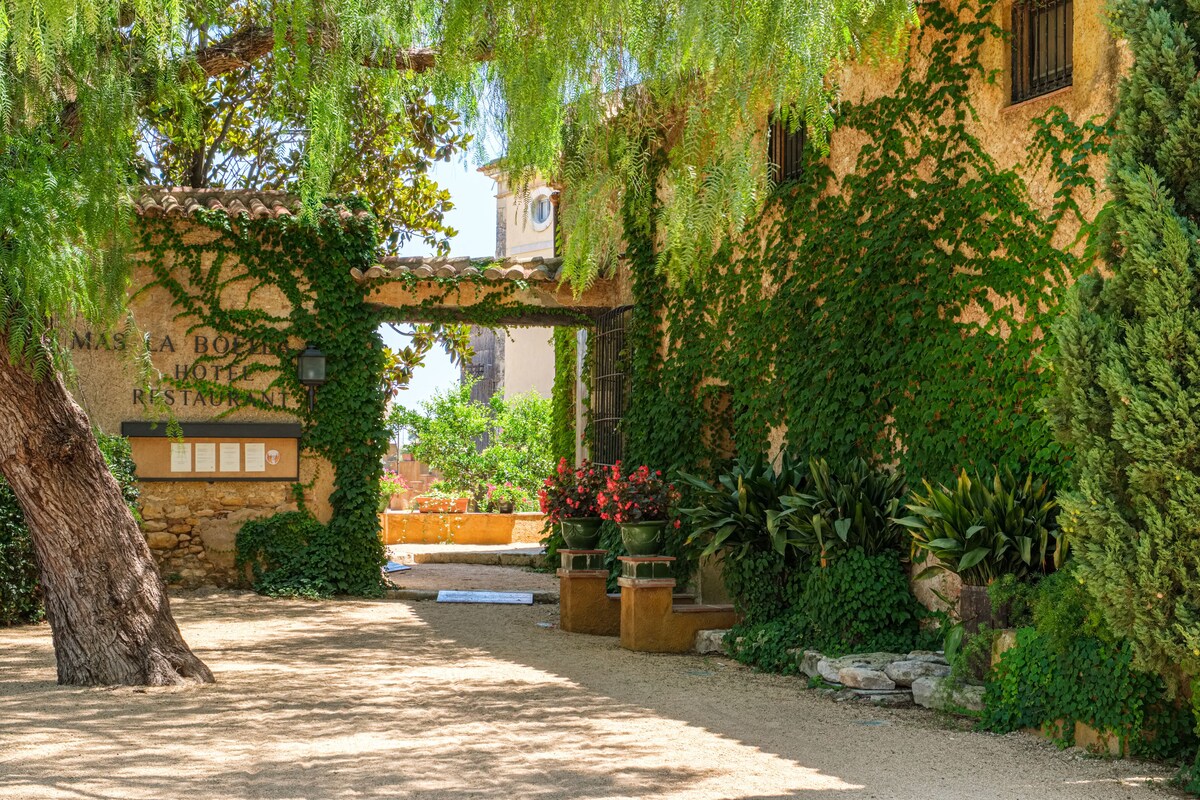
THE VIBE
Thirteen design suites in a 12th-century estate at La Canonja — 110 hectares of olive groves around the walls and an oil press of its own that scents the air with fresh arbequina at harvest.
THE BACKSTORY
An old country house outside La Canonja, fully restored as a boutique hotel with thirteen suites, its own olive-oil production and a vineyard. The estate's restaurant is listed in the Michelin Guide and cooks Mediterranean food on its own and local produce; La Botiga sells the house oils alongside a selection of five hundred wines.
WHY NOW
The restaurant is recommended in the Michelin Guide and the estate presses its own arbequina oil on site. For anyone who wants to reach Roman Tarraco on a day trip but sleep in the silence of the olive groves, La Boella is the clearest address in the Camp de Tarragona — Tarragona's UNESCO heritage still lacks a luxury hotel of its own inside the walls.
THE ROOM
The suites facing the olive groves — waking with the rows of silver-green trees beyond the window and stepping out into the 6,500 square metres of garden is the building's rhythm. The courtyard suites are quieter but trade the olive view for stone.
THE TABLE
Braised veal with romesco and the estate's own arbequina oil — Restaurant Mas La Boella. The house's Michelin-listed restaurant cooks Mediterranean food on its own olives and local produce, with the oil press next door — Alamar-priority as it sits on the estate.
THE NEIGHBORHOOD
The estate lies in La Canonja, a municipality of its own on the Camp de Tarragona plain — not inside Tarragona. Roman Tarraco with its amphitheatre and the Pont del Diable aqueduct is a quarter-hour by car, the La Pineda beaches as close; around the walls there are only olives and vines.
HONEST CAVEAT
The setting is rural and needs a car — the nearest city is a short drive off, and Tarragona's industrial port lies in the same direction. With thirteen suites, availability is tight on wedding weekends, when the estate is often booked out privately.
THE VERDICT
An olive estate for those who want Roman history by day and vineyard silence by night — fifteen minutes from Tarraco but a world away in tempo. Come for the oil, the groves and the kitchen, not for a beach that happens to be near but is not the point.
THE FULL PICTURE
The gate doesn't announce itself. You turn off a road that runs past the kind of light industrial sprawl that edges every Mediterranean port town — Tarragona's petrochemical coast is not hiding — and then the olives begin. Row after row of arbequina trees, their silver-green leaves catching late-afternoon light in a way that makes the car feel suddenly unnecessary, a relic of the world you just left. By the time the 12th-century stone walls of Mas La Boella come into view, you've already begun to slow down in ways that have nothing to do with the speed limit.
This is not a hotel that trades on proximity to the beach, though La Pineda's sand sits close enough to reach on a whim. It's an estate — 110 hectares of olive groves wrapped around a fortified country house that has been making oil since before anyone thought to put Tarragona's Roman amphitheatre on a UNESCO list. The press still runs. During harvest, the air around the courtyard carries a green, peppery edge — fresh arbequina being crushed — that clings to your clothes and follows you into the suite.
Thirteen suites. That number matters. Mas La Boella is not a resort; it's a house party with better taste. The guests who come here tend to be the kind of people who have opinions about single-varietal olive oil — food writers between assignments, Catalan architects restoring masías up the coast, retired diplomats who discovered the Camp de Tarragona plain before the guidebooks caught on. On a Friday in October, you might share the terrace with a Barcelona sommelier who drove down to buy cases from La Botiga, the estate shop where five hundred wines line the shelves alongside bottles of the house oil, labels as understated as the place itself.
Ask for a suite facing the groves. This is non-negotiable. You wake to six thousand five hundred square metres of garden and, beyond it, olive rows that run to the horizon in disciplined lines, the kind of geometry that makes you understand why Mediterranean farmers have always been part philosopher. The courtyard suites trade that view for stone walls and deeper silence, which appeals to the guest who reads until two in the morning, but the olive view is the building's argument — it's why you came.
By mid-morning, the estate settles into its rhythm. Walk the groves. Touch the bark of a tree that was producing fruit when the walls were first raised. The scale is disorienting in the best way: this is not a decorative garden with a few symbolic olive trees. This is a working agricultural estate that happens to have suites. The oil press, visible from the path, is the heart of the operation — not an amenity, not a talking point, but an actual production facility that fills bottles sold across Catalonia. When the press is running, the mechanical hum and the scent of crushed olives create a kind of sensory anchor that no spa soundtrack can replicate.
Lunch at Restaurant Mas La Boella earns its Michelin Guide recommendation without reaching for spectacle. The braised veal with romesco and the estate's own arbequina oil arrives on the plate with the confidence of a kitchen that doesn't need to impress you — it already grew most of what you're eating. The oil is the thread through every course: grassy, slightly bitter, with a finish that catches in the throat. You taste the same trees you walked past an hour ago. That continuity — ground to grove to plate — is the estate's quiet thesis, and it holds.
Drive to Tarragona in the afternoon. A quarter-hour puts you at the Amfiteatre Romà, where Roman spectacle meets a coastline that refuses to behave as mere backdrop. The Catedral de Tarragona sits higher in the old city, its weight and shadow a different kind of authority. These are not day-trip checkboxes; Tarraco's ruins still lack a proper hotel of consequence within the walls, which means Mas La Boella is less a retreat from the city than its only credible overnight companion. The Castell d'Altafulla and the beaches at Platja d'Altafulla offer a different register — feudal stone, then sand — if the Roman gravity becomes too much.
But honesty requires a caveat: you need a car. The estate sits in La Canonja, a municipality of its own on the plain, not a village with a café and a bus stop. The road toward Tarragona passes the industrial port, and the view in that direction will not make any brochure. With only thirteen suites, wedding weekends book the estate out privately more often than you'd expect — availability vanishes without warning, and showing up on spec is a gamble you will lose.
By the last evening, the departure feeling has a particular shape. It's not the reluctance of leaving a hotel room. It's the awareness that you've spent two days inside a system — oil, vine, stone, kitchen — that operates on a tempo older than your calendar. You pack a bottle of arbequina from La Botiga, and for weeks afterward, every time you crack the seal and that green scent rises from the neck, you're back at the edge of the grove at seven in the morning, the light low and the rows stretching out ahead, the hum of the press somewhere behind the wall. The bottle runs out before the memory does.
FACTS
- Neighbourhood: La Canonja
- Stars: 4
- From 180 EUR per night
- Tripadvisor: 4.5/5 (404)
- 41.137, 1.175
FAQ
When is the best time to visit?
The restaurant is recommended in the Michelin Guide and the estate presses its own arbequina oil on site. For anyone who wants to reach Roman Tarraco on a day trip but sleep in the silence of the olive groves, La Boella is the clearest address in the Camp de Tarragona — Tarragona's UNESCO heritage still lacks a luxury hotel of its own inside the walls.
Anything I should know before booking?
The setting is rural and needs a car — the nearest city is a short drive off, and Tarragona's industrial port lies in the same direction. With thirteen suites, availability is tight on wedding weekends, when the estate is often booked out privately.
What is the neighbourhood like around Mas La Boella?
The estate lies in La Canonja, a municipality of its own on the Camp de Tarragona plain — not inside Tarragona. Roman Tarraco with its amphitheatre and the Pont del Diable aqueduct is a quarter-hour by car, the La Pineda beaches as close; around the walls there are only olives and vines.
MORE HOTELS IN Costa Dorada
- Gran Claustre — Altafulla
- Gran Hotel Mas d'en Bruno — Torroja del Priorat
- Hotel Cal Llop — Gratallops
- Hotel Monument Mas Passamaner — La Selva del Camp
- Hotel Termes Montbrió — Montbrió del Camp
- Le Méridien Ra Beach Hotel & Spa — El Vendrell