Gran Claustre
Altafulla, Costa Dorada · heritage
THE VIBE
Forty rooms in a former 18th-century Teresian convent in Altafulla's walled old town — old cloister walls, an orangery courtyard, and the Tamarit castle for a neighbour.
THE BACKSTORY
The hotel lives in the former residence of Teresian nuns, an 18th-century building beside the castle of the marquises of Tamarit. The forty rooms spread across two buildings where the convent walls meet a careful modern interior; the Gaudium restaurant, listed in the Michelin Guide, is led by chef Jaume Drudis.
WHY NOW
The Gaudium restaurant under chef Jaume Drudis is listed in the Michelin Guide, and the hotel sits a kilometre from the beach in one of the Costa Daurada's best-preserved medieval villages. For anyone who wants both coast and history within walking distance, Altafulla is the destination's most complete position.
THE ROOM
The rooms in the original convent building — the thick walls and the orangery courtyard give a stillness the newer rooms lack. Ask for a room facing the Pati dels Tarongers; the annexe rooms are more comfortable but miss the convent atmosphere.
THE TABLE
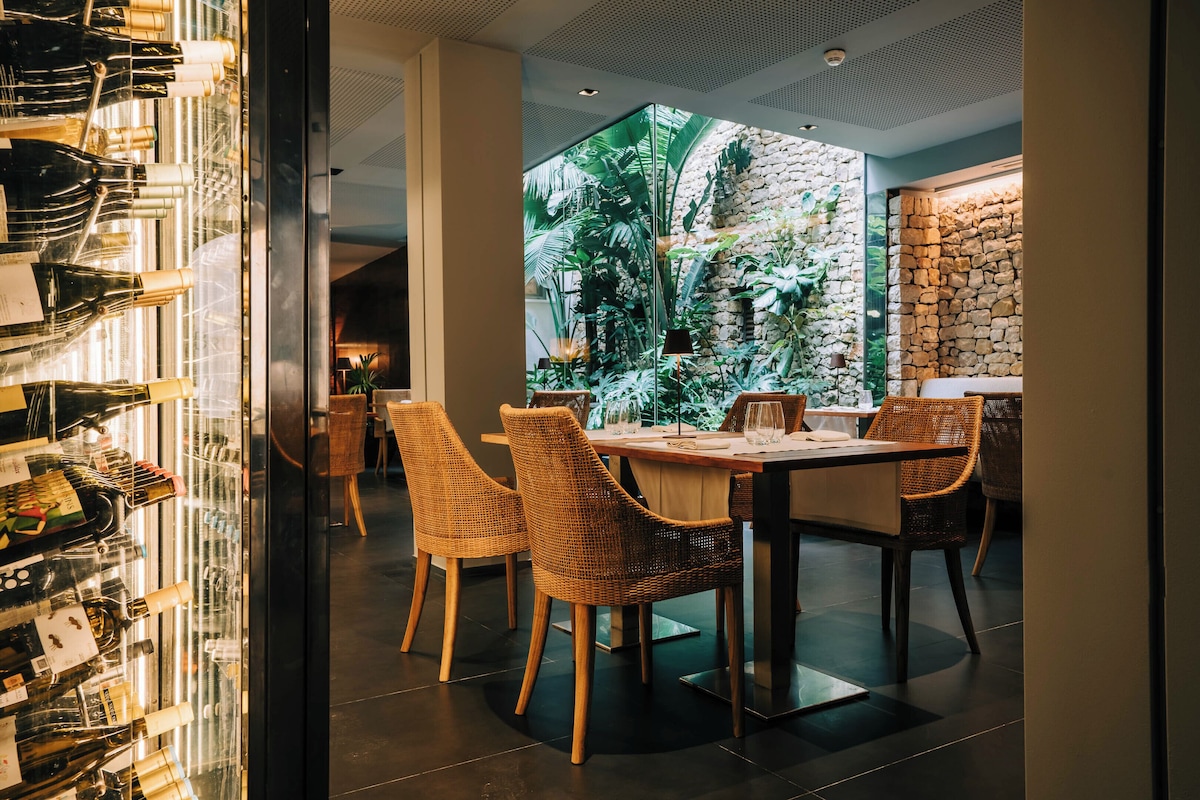
Local fish with romesco and the season's vegetables, by Jaume Drudis — Gaudium. The house's Michelin-listed restaurant under Jaume Drudis cooks contemporary Catalan on local produce — Alamar-priority as it sits in the hotel.
THE NEIGHBORHOOD
Altafulla is a walled medieval village with the Tamarit castle and a beach a kilometre off. The Roman villa of Els Munts lies on the edge, Tarragona's UNESCO heritage fifteen minutes by car — the village's own lanes are reached on foot.
HONEST CAVEAT
The medieval village core means narrow lanes and limited car access — expect to step out of the car at the village gate rather than a hotel drive. The beach is a kilometre off, not at the foot of the building.
THE VERDICT
A convent hotel that joins coast, history and a kitchen in the Michelin Guide — unusually complete for the Costa Daurada. Come for the walled village, the Tamarit castle and Gaudium, not for a beachfront that is a short walk away.
THE FULL PICTURE
You arrive on foot. There is no other way. The car stops at the village gate — Altafulla's walled old town does not accommodate the fantasy of pulling up to a lobby — and you walk the last stretch through lanes so narrow your rolling suitcase announces you to every window above. This is the first honest thing the hotel tells you: it is not trying to make your arrival easy. It is making you earn the quiet.
The convent reveals itself in pieces. A heavy wooden door. A vestibule where the temperature drops five degrees in three steps. Then the Pati dels Tarongers — the orangery courtyard — where orange trees stand in the same soil the Teresian nuns tended two centuries ago, and the light at six in the evening turns the old cloister walls the color of raw honey. Forty rooms spread across two buildings: the original 18th-century convent and a more recent annexe that offers comfort at the cost of atmosphere. Ask for the convent side. The thick walls hold a silence that no modern insulation replicates, and waking at seven to push open shutters onto that courtyard, the orange trees still holding the night's damp, is the kind of morning that recalibrates your nervous system.
The crowd here is not the Costa Daurada's usual cast. No families hauling inflatable flamingos from PortAventura. No cruise passengers counting Tarragona's amphitheatres. The people at Gaudium on a Tuesday evening are Catalan architects who drove from Barcelona with opinions about the Tamarit castle restoration, food writers who came for Jaume Drudis and stayed for the village, the occasional British couple who read about Altafulla in a regional guide and arrived expecting quaint only to find something more considered. This is a hotel for people who treat the Costa Daurada as a serious destination rather than a cheaper Costa Brava — and who are right to.
Gaudium earns its Michelin Guide listing without theatrics. Drudis cooks contemporary Catalan that respects the produce corridor between Tarragona's fishing port and the Camp de Tarragona's farms. The local fish with romesco and the season's vegetables arrives with the confidence of a dish that needs no foam or tweezer to justify itself. The romesco — ground almonds, roasted peppers, the particular sweetness the Tarragona coast gives its tomatoes — does more work than most sauces in more decorated kitchens. Eat in the courtyard if the evening allows it. The orange trees overhead and the castle wall visible beyond give the meal a setting no dining room could manufacture.
The Tamarit castle itself sits on private grounds — the former estate of the marquises — but its presence shapes every sightline from the hotel's upper windows and the village lanes. It is the kind of neighbor that lends gravitas without asking anything in return. Walk south for a kilometre and you reach the beach, a stretch of sand backed by low pines that feels dislocated from the tower-block coastline farther along. But the distance between hotel and sea is Altafulla's honesty: this is a village that happens to have a beach, not a beach resort that happens to have a village. Anyone expecting a barefoot-to-lobby commute should recalibrate.
Beyond the walls, the hinterland earns its own days. The Roman villa of Els Munts sits at the village edge, its mosaics proof that this coast was prime real estate long before the hotels arrived. Tarragona — fifteen minutes by car — offers the Amfiteatre Romà overlooking the Mediterranean and the Aqueducte de les Ferreres standing in the hills beyond the city with the casual engineering confidence that made Rome possible. The Gaudí Centre in nearby Reus gives you the architect's early imagination before Barcelona claimed him entirely. These are not excursions. They are the reason this corner of Catalonia rewards anyone willing to look past the package-holiday reputation.
Back at the convent, the afternoons belong to the courtyard. The shade under the orange trees, a book, the particular quiet of thick stone walls that have absorbed two centuries of silence. The convent guests understand that the finest room in the house is not a room at all but the Pati dels Tarongers at four in the afternoon when the heat has settled and the stone gives back its warmth. By evening, the village lanes carry the smell of wood smoke from the restaurants below, and the castle turns the color of terracotta against the last light.
You leave the way you arrived — on foot, suitcase rattling over cobblestones, the car waiting beyond the gate. The convent does not follow you to the threshold. It stays where it has stayed for two hundred years, holding its quiet, indifferent to your departure. That indifference is the highest compliment a hotel can pay: it was not performing for you. You were simply allowed in.
FACTS
- Neighbourhood: Altafulla
- Stars: 4
- From 160 EUR per night
- Tripadvisor: 3.7/5 (749)
- 41.1425, 1.3785
FAQ
When is the best time to visit?
The Gaudium restaurant under chef Jaume Drudis is listed in the Michelin Guide, and the hotel sits a kilometre from the beach in one of the Costa Daurada's best-preserved medieval villages. For anyone who wants both coast and history within walking distance, Altafulla is the destination's most complete position.
Anything I should know before booking?
The medieval village core means narrow lanes and limited car access — expect to step out of the car at the village gate rather than a hotel drive. The beach is a kilometre off, not at the foot of the building.
What is the neighbourhood like around Gran Claustre?
Altafulla is a walled medieval village with the Tamarit castle and a beach a kilometre off. The Roman villa of Els Munts lies on the edge, Tarragona's UNESCO heritage fifteen minutes by car — the village's own lanes are reached on foot.
MORE HOTELS IN Costa Dorada
- Gran Hotel Mas d'en Bruno — Torroja del Priorat
- Hotel Cal Llop — Gratallops
- Hotel Monument Mas Passamaner — La Selva del Camp
- Hotel Termes Montbrió — Montbrió del Camp
- Le Méridien Ra Beach Hotel & Spa — El Vendrell
- Mas La Boella — La Canonja