Costa Dorada — Hotels
Hand-picked hotels in Costa Dorada, Costa Daurada, Spain. Mondmodel's magazine-grade reporting: verified imagery, no paid placement, honest caveats.
Llicorellans Ryggrad
Torroja del Priorats vertikala llicorellaterrasser reser sig kring Mas d'en Bruno — krossad skiffer som tvingar rötterna djupt och pressar fram Garnatxa ur berget. Rytmen stillnar när vägen klättrar mot Escaladei, där Cartoixans ruiner minns munkarna som planterade de första vinstockarna år 1263.
Från Escaladeis klosterstillhet lossnar landskapet och faller stadigt mot kusten — Montsants branta sluttningar viker undan för de öppna slätterna kring La Canonja, där Mas La Boellas tolvhundratalsmurar vilar mitt i Camp de Tarragona. Skifferns vertikalitet upplöses gradvis i Tarracos vidsträckta romerska horisont vid havet.
The hotels
- Gran Claustre — Altafulla · 4★
A convent hotel that joins coast, history and a kitchen in the Michelin Guide — unusually complete for the Costa Daurada. Come for the walled village, the Tamarit castle and Gaudium, not for a beachfront that is a short walk away. - Gran Hotel Mas d'en Bruno — Torroja del Priorat · 5★
The only internationally rated luxury anchor in the Priorat wine country, and good enough to justify the drive south on its own. Come for the wine, the slate terraces and the silence — not the beach, which is an hour off and a wholly different holiday. - Hotel Cal Llop — Gratallops · 3★
Ten rooms in a restored 18th-century house in Gratallops — lime-white walls, a terrace over the rooftops, and the Priorat vines starting where the village street ends. - Hotel Monument Mas Passamaner — La Selva del Camp · 5★
A modernista monument you get to sleep in — a rarity in the Camp de Tarragona. Come for Domènech i Montaner's architecture and the calm of the plain, not for the beach, which belongs to another part of the destination. - Hotel Termes Montbrió — Montbrió del Camp · 4★
A thermal bath set in a four-hectare botanical garden at Montbrió del Camp — century-old trees, springs between 41 and 81 degrees, and the steam rising from the stone pools at dawn. - Le Méridien Ra Beach Hotel & Spa — El Vendrell · 5★
A beach resort with history in its walls — the sanatorium building gives Ra a weight standard resorts lack. Come for the beach, the spa and family life, not for an intimate boutique feel, which belongs on the inland estates. - Mas La Boella — La Canonja · 4★
An olive estate for those who want Roman history by day and vineyard silence by night — fifteen minutes from Tarraco but a world away in tempo. Come for the oil, the groves and the kitchen, not for a beach that happens to be near but is not the point. - May Altafulla Beach Boutique Hotel — Altafulla · 4★
Twenty-six rooms on Altafulla beach with a rooftop terrace over the sea — grill smoke from Pinxo & Brasa, the Mediterranean directly below, and the walled old town as a backdrop up on the hill. - Ora Hotel Priorat — Torroja del Priorat · 4★
A design hotel for those who want to stay inside a Priorat village, not above it — stone, wine and a short walk to the cellars. Come for the rhythm of the village and the wine, not for spa or pool, which are not the house's business. - Terra Dominicata — Escaladei · 5★
A winery hotel for those who want to understand Priorat from the inside — slate, monastery and cellar in one building. Come for the wine and the Montsant silence, not the beach, which is another world an hour away.
Curated areas
Tarragona & Camp de Tarragona
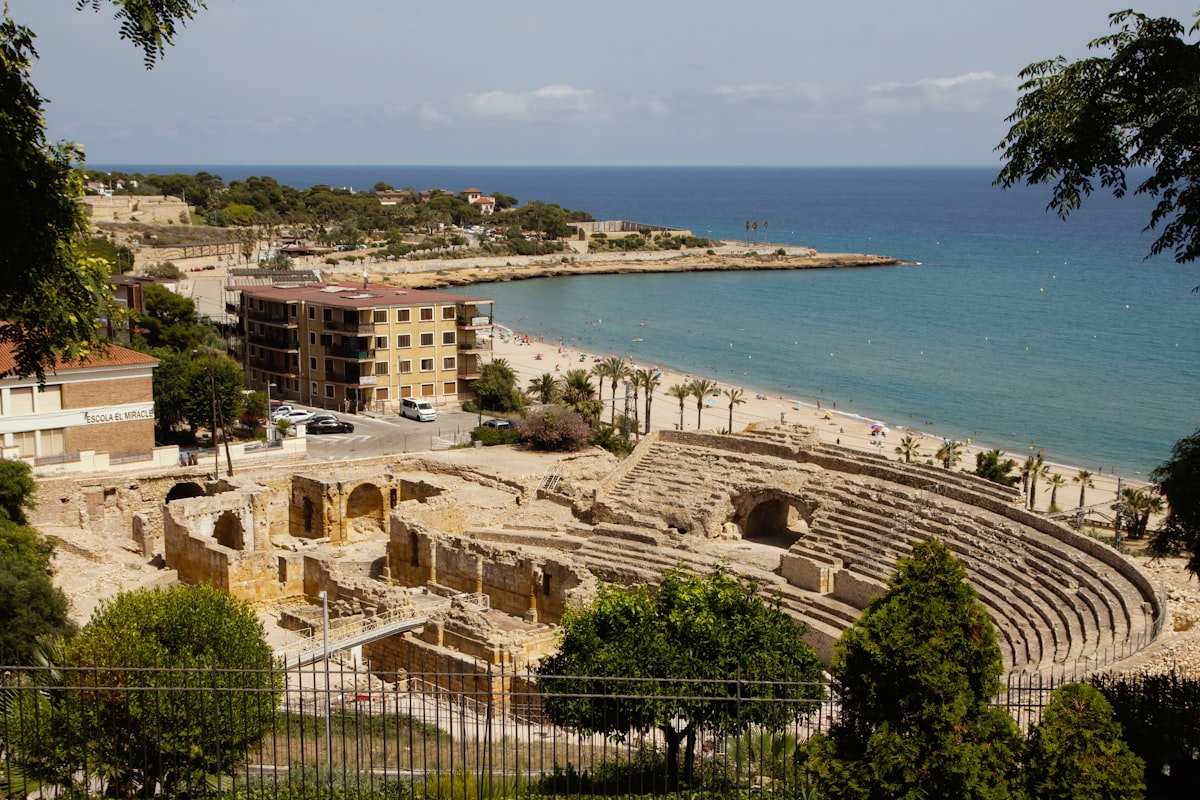
Tarraco’s amphitheatre and Circ Romà have held UNESCO status since the year 2000. The Passeig Arqueològic follows 1.2 km of Roman wall above the sea, before a suquet in the Serrallo fishing quarter.
Cambrils
The harbour of Cambrils gathers two Michelin stars — Can Bosch and Rincón de Diego — on a working fishing quay. The morning llotja delivers llagostí straight to the harbour tables.
Salou / La Pineda / Vila-seca
PortAventura World and the volume of the charter beach define Salou. The coves of Cap de Salou on the headland stay quieter than the main strip — the exception that proves the resort rule along the coast.
Altafulla / Torredembarra
Altafulla’s walled old town rises above the beach — the only stretch of this coast with architectural structure. The Villa romana dels Munts carries the same UNESCO inscription from 2000.
El Vendrell / Calafell
The Museu Pau Casals in El Vendrell preserves the cellist’s archive; he was born here in 1876. Calafell’s Iberian citadel and Le Méridien Ra bind culture and coast together.
Reus
Casa Navàs by Domènech i Montaner, from 1908, stands on the Plaça del Mercadal, among the finest Modernisme interiors outside Barcelona. Reus is the historic capital of Spanish vermouth.
Priorat / Montsant
The vertical llicorella terraces of Gratallops carry Garnatxa and Carinyena from hundred-year-old vines. Priorat DOQ is one of Spain’s two top classifications; Mas d’en Bruno sits at 400 metres of altitude.
The Cistercian Route (Poblet, Valls, Montblanc)
The Monestir de Poblet has held UNESCO status since 1991 and holds the royal pantheon of Aragon. Valls is the capital of the calçotada and the origin of the castell tradition, with the medieval walls of Montblanc.
The table
Can Bosch (Catalan seafood). A Michelin star on the working fishing harbour of Cambrils, awarded in 1984. The Bosch family runs the kitchen in its current generation, building the menu around llagostí del Camp and a suquet from the morning llotja — destination cooking with no city behind it.
Rincón de Diego (Modern Catalan). A Michelin star in Cambrils since 2005 under Diego Campos, whose son Rubén brings in an Asian accent. The kitchen rests on the harbour’s shellfish but turns the Catalan inheritance toward the present — destination dining on a fishing quay.
Quatre Molins (Modern Catalan). A Michelin star in Cornudella de Montsant, in the heart of Priorat’s wine country. The kitchen builds a tasting menu around the mountain’s terroir and its DOQ wines; a Michelin star that, under the Alamar Protocol, qualifies as geofence-exempt destination cooking for the estate hotels Mas d’en Bruno and Terra Dominicata (some 14 km away, outside the 3 km radius).
Deliranto (Modern Catalan). A Michelin star in Salou with a theatrical, narrative-driven format that breaks with the resort coast’s charter profile. Every course is staged around a story; the restaurant is destination cooking embedded in the mass market’s core and requires booking ahead.
Mas La Boella (Mediterranean). A restaurant on a 110-hectare olive estate in La Canonja, where Siurana DOP olive oil from the estate’s own arbequina groves carries the kitchen. Estate dining in a restored twelfth-century finca, barely 3 km outside Tarragona’s Roman Tarraco skyline.
What to do
Tarraco’s Roman legacy — amphitheatre and archaeological walk
Seven elements carry Tarraco’s UNESCO inscription from the year 2000, from the 2nd-century-AD amphitheatre to the 217-metre aqueduct of the Pont del Diable. You walk along Roman wall with the Mediterranean below you and end in the Serrallo fishing quarter.
Start at the Passeig Arqueològic at 09:00 before the heat; the Fòrum de la Colònia is closed for works in 2026. A new arena entrance to the amphitheatre is under construction during 2026.
Priorat DOQ — llicorella terraces and harvest wine tasting
Priorat DOQ is one of Spain’s two top classifications alongside Rioja, with vines at 100 to 600 metres of altitude. You walk between vertical slate terraces, taste Garnatxa from hundred-year-old vines and see the slate that forces the roots deep.
Book a harvest visit in Gratallops in September–October directly with cellars such as Clos Mogador; the T-710 is a single-lane serpentine road, so do not drive after tasting — arrange a driver through the hotel.
Cartoixa d’Escaladei — the Carthusian ruin that planted Priorat
The Cartoixa d’Escaladei was founded in 1194 as Iberia’s first Carthusian monastery, and the monks brought viticulture to Priorat. You wander among twelfth-century ruins in the Montsant natural park, the slate slopes rising behind the abandoned cells.
Combine Escaladei with lunch in the village of Scala Dei; the monks planted the first vines in 1263, and Terra Dominicata lies 1.5 km away for a cellar round afterwards.
Monestir de Poblet — the royal pantheon of Aragon
The Monestir de Poblet has held UNESCO status since 1991 and is both a working Cistercian monastery and the royal burial place of Aragon. You walk through nave and cloister where the monks still live by the monastic rule, surrounded by the medieval walls of Montblanc.
Poblet is an active Cistercian monastery; respect the monks’ rhythm of silence and combine it with Santes Creus the same day. In January–February the Valls calçotada is 30 minutes away.
Reus — Casa Navàs, Modernisme and the vermouth ritual
Casa Navàs by Lluís Domènech i Montaner, from 1908, ranks among the finest Modernisme interiors outside Barcelona. Reus is also the historic capital of Spanish vermouth; you follow the aperitif ritual where Gaudí, according to most sources, was born in 1852 — though he himself referenced the neighbouring village of Riudoms — but never built anything.
Book a guided tour of Casa Navàs ahead — the interior is privately owned and the furniture original. Finish with l’hora del vermut at Vermuts Rofes before a market lunch.
Castells and calçotada — the living UNESCO heritage of Valls
Castells were inscribed on UNESCO’s list of intangible cultural heritage in 2010, originating in Valls. You watch human towers rise at the Concurs de Castells and share a calçotada — grilled spring onions dipped in salvitxada — during the winter season.
The Concurs de Castells is held 3–4 October 2026 at the Tarraco Arena Plaça, biennially. The calçotada season runs November–April; book the Gran Festa de la Calçotada in Valls for late January.