Bordoy Mostatxins Hotel Boutique
Alcúdia Old Town, Mallorca · heritage
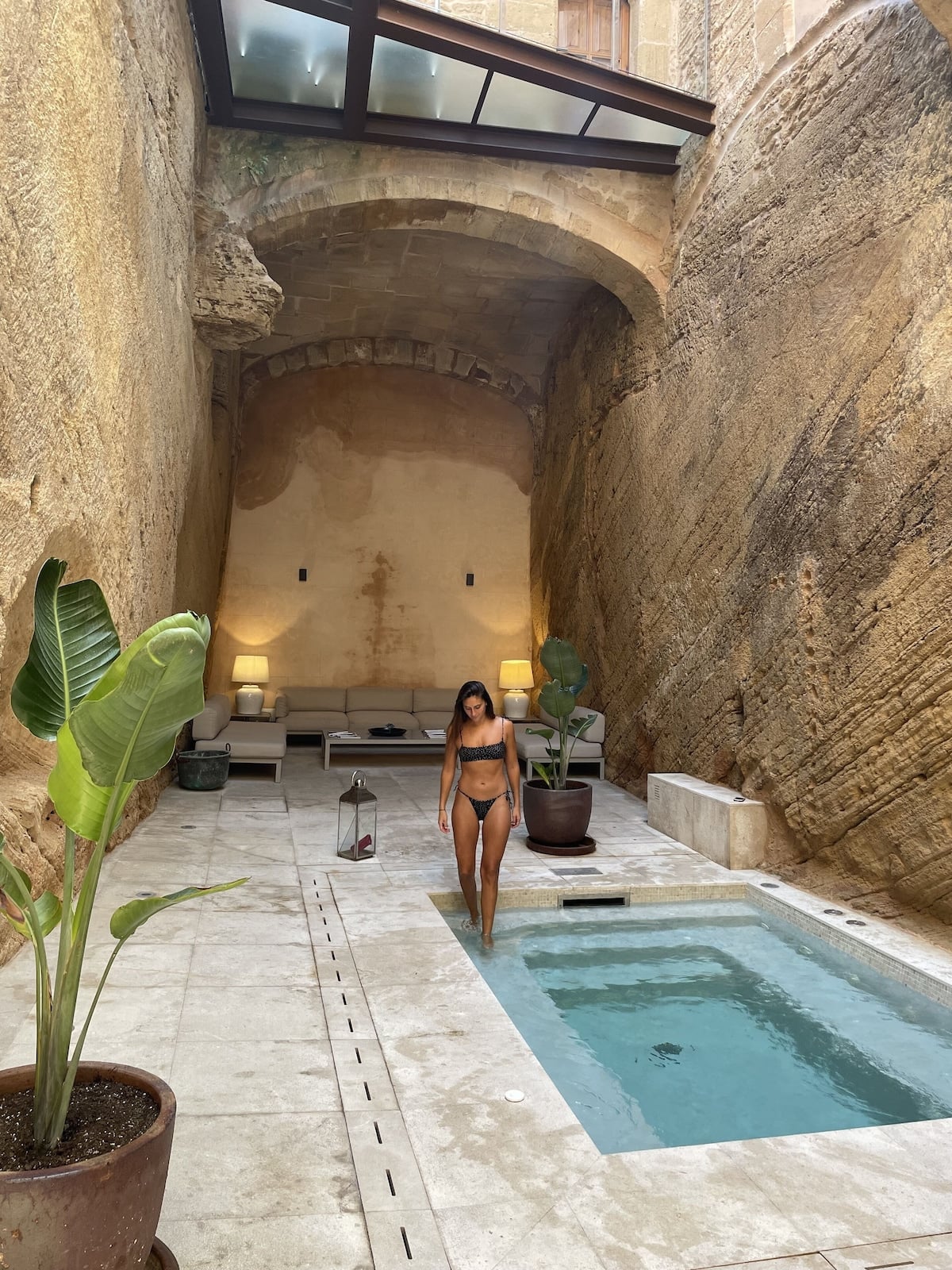
THE VIBE
A nineteen-room hotel housed in two restored historic buildings inside Alcúdia's walled medieval town — a 15th-century tower and an 1882 Spanish modernist manor house.
THE BACKSTORY
The block served as a watchtower and a butcher's shop before the current owner began a six-year restoration under archaeological supervision. During the renovation a Roman olive press was uncovered in the basement — it is preserved and visible today. The building's name derives from mostatxins, the Mallorcan word for moustache: a nickname for the legendary butcher who once ran the business here.
WHY NOW
Bordoy Hotels is now run by a team carrying forward founder Mark Worthington's vision following his passing in 2019 — and has kept the boutique scale intact. Summer crowds land in Port d'Alcúdia, not inside the walled old town; May and early June bring quiet streets, an open pool and breakfast service without queues.
THE ROOM
The Quinze building has 8 rooms set within the original 15th-century masonry; the Tower Suite in the 14th-century tower is the room type with the greatest historical substance and glass corridor access. The Frare house's 11 rooms reflect the late Spanish modernist colour palette and larger floor plans.
WELLNESS
The treatment room is located beside the preserved Roman olive press in the basement — massages, facials and body treatments at one of the boutique hotel's few dedicated spaces. Book directly with the hotel; capacity is limited.
THE TABLE
Seasonal Mallorcan lunch — Frare (Bordoy Mostatxins in-house dining, Carrer del Lledoner 15). The hotel's only meal service beyond breakfast: hotel-operated lunch in a preserved 19th-century dining salon with stone floors and original staircase.
THE SERVICE
Breakfast and lunch are served in the Frare house's stone-floored salon with its preserved original staircase and 19th-century window glass — meals are hotel-operated and based on seasonal Mallorcan produce.
THE NEIGHBORHOOD
The Roman ruins of Pollentia — ancient Mallorca's capital, founded in the 2nd century BC — are a five-minute walk from the old town centre. Plaça de la Constitució hosts the weekly open market on Tuesdays and Sundays from 08:30 to 13:30. Port d'Alcúdia and its sandy beach are approximately 2 km away; bus 302 runs the route every 30 minutes.
HONEST CAVEAT
The spa is a single treatment room, not a full-scale facility — massages and facials must be booked in advance and capacity is limited. No dinners are served on site.
THE VERDICT
Boutique scale and archaeological substance in combination are rare; Bordoy Mostatxins delivers both. Calibrate expectations around spa capacity and dinner service, and you will find one of Mallorca's most materially honest boutique hotels.
THE FULL PICTURE
You learn the first rule of Alcúdia before you even check in: the taxi can only take you so far. It idles at the Porta del Moll, the great medieval gate, leaving you to pull your luggage over cobblestones that have been worn smooth by centuries of footsteps, cartwheels, and conquest. The air inside the 14th-century walls is different—thicker, scented with baked stone, sea salt, and the faint, sweet perfume of night-blooming jasmine climbing a sun-bleached facade. Finding the hotel is part of the experience, a treasure hunt through a labyrinth of ochre-toned alleys where the only landmark is the soaring bell tower of Sant Jaume d'Alcúdia. When you arrive, the entrance, in a 15th-century house, is so discreet that you might walk past it twice.
This is not a place for those who measure a stay by the square footage of the lobby. This is a hotel as an act of architectural preservation, an intimate dialogue between the present and a very distant past. The crowd it draws understands this implicitly. They are not here for sprawling resort amenities; they are here for texture. You’ll find them on the small terrace at dusk: the London-based classicist who has just spent the afternoon at the nearby Pollentia Roman Ruins, tracing the outlines of the ancient forum, and the Berlin gallerist sketching the interplay of shadow and light on the sandstone ramparts. They speak in low tones, debating whether to book a table for the tasting menu at Andreu Genestra or to stay within the walls for a *bullit de peix* in the old town, a fisherman’s stew so potent it feels like a historical document in a bowl.
Your room is less a designed space and more a negotiation with history. A beam of raw, splintered wood holds up a ceiling above a bed dressed in immaculate white linen. The floor is cool underfoot, and the old stone of the house shows behind the bed. You open the shutters at 7 a.m. and the sound that fills the room is not the surf, but the metallic rattle of a shopkeeper’s gate lifting in the street below, followed by the murmur of Mallorquín dialect. And here is the essential trade-off, the piece of intelligence that earns your trust: you are sleeping inside a fortress. Space is a modern indulgence, and the most affordable rooms sacrifice it for character. Your window may not frame the distant shimmer of the bay, but the beautifully indifferent stone of a neighboring facade, a few feet away. Privacy was a different concept in the Middle Ages. This is the pact you make for the privilege of inhabiting the walls.
The stay unfolds as a series of sensory vignettes. The afternoon is for the short drive, about seven minutes, that takes you out of the walled city and into another world entirely—the long stretch of pale, soft sand at Port d’Alcúdia that shelves gently into turquoise water. The transition is gloriously jarring, from the cool, narrow shade of the alleys to the vast, brilliant openness of the beach. You feel the fine grit of sand between your toes and taste the salt on your lips, knowing the stone fortress waits for your return. Evening is a slow migration back inside the gates, showering off the sea, and stepping out into the golden hour when the entire city seems to glow from within. You wander, without agenda, past artisan workshops and delis selling wedges of Mahón cheese and strings of dark red *sobrassada*. The choice for dinner is never simple. This is an island of profound culinary ambition, and while the old town offers an authentic taste of place, the siren call of a table at Zaranda or Marc Fosh, where chefs spin local produce into art, is a powerful one for the kind of traveler who plans their itinerary around reservations.
The final morning offers one last immersion. You wake early, before the day-trippers arrive, and walk the perimeter of the ramparts as the sun rises, casting long shadows across the tiled roofs. The whole of the old town is laid out below you, a medieval town laid out beside the Roman city of Pollentia. You can feel the layers of time under your feet. Leaving is not a simple act of checking out. It’s a feeling of temporal dislocation, of stepping back through the gate and into the 21st century. You leave not with the transient satisfaction of a beach holiday, but with the resonant feeling of the stones, the weight of the history, and the understanding that the most memorable places are never the most straightforward. They demand a little of you, and in return, give you a story to tell that goes far beyond sun and sand.
FACTS
- Neighbourhood: Alcúdia Old Town
- Stars: 4
- From 300 EUR per night
- Tripadvisor: 4.9/5 (576)
- 39.8531, 3.1218
FAQ
When is the best time to visit?
Bordoy Hotels is now run by a team carrying forward founder Mark Worthington's vision following his passing in 2019 — and has kept the boutique scale intact. Summer crowds land in Port d'Alcúdia, not inside the walled old town; May and early June bring quiet streets, an open pool and breakfast service without queues.
Anything I should know before booking?
The spa is a single treatment room, not a full-scale facility — massages and facials must be booked in advance and capacity is limited. No dinners are served on site.
What is the neighbourhood like around Bordoy Mostatxins Hotel Boutique?
The Roman ruins of Pollentia — ancient Mallorca's capital, founded in the 2nd century BC — are a five-minute walk from the old town centre. Plaça de la Constitució hosts the weekly open market on Tuesdays and Sundays from 08:30 to 13:30. Port d'Alcúdia and its sandy beach are approximately 2 km away; bus 302 runs the route every 30 minutes.
MORE HOTELS IN Mallorca
- AluaSoul Mallorca Resort — Adults Only — Cala Egos / Cala d'Or
- Barefoot Hotel Mallorca — Portocolom
- Bikini Island & Mountain Hotel Es Trenc — Adults Only — Colonia Sant Jordi
- Bikini Island & Mountain Hotel Port de Sóller — Port de Sóller
- Blau Colònia Sant Jordi Resort & Spa — Colonia Sant Jordi / Ses Salines
- Bordoy Alcúdia Port Suites — Port d'Alcúdia