Mallorca — Hotels
Hand-picked hotels in Mallorca, Balearic Islands, Spain. Mondmodel's magazine-grade reporting: verified imagery, no paid placement, honest caveats.
Tramuntana-axeln
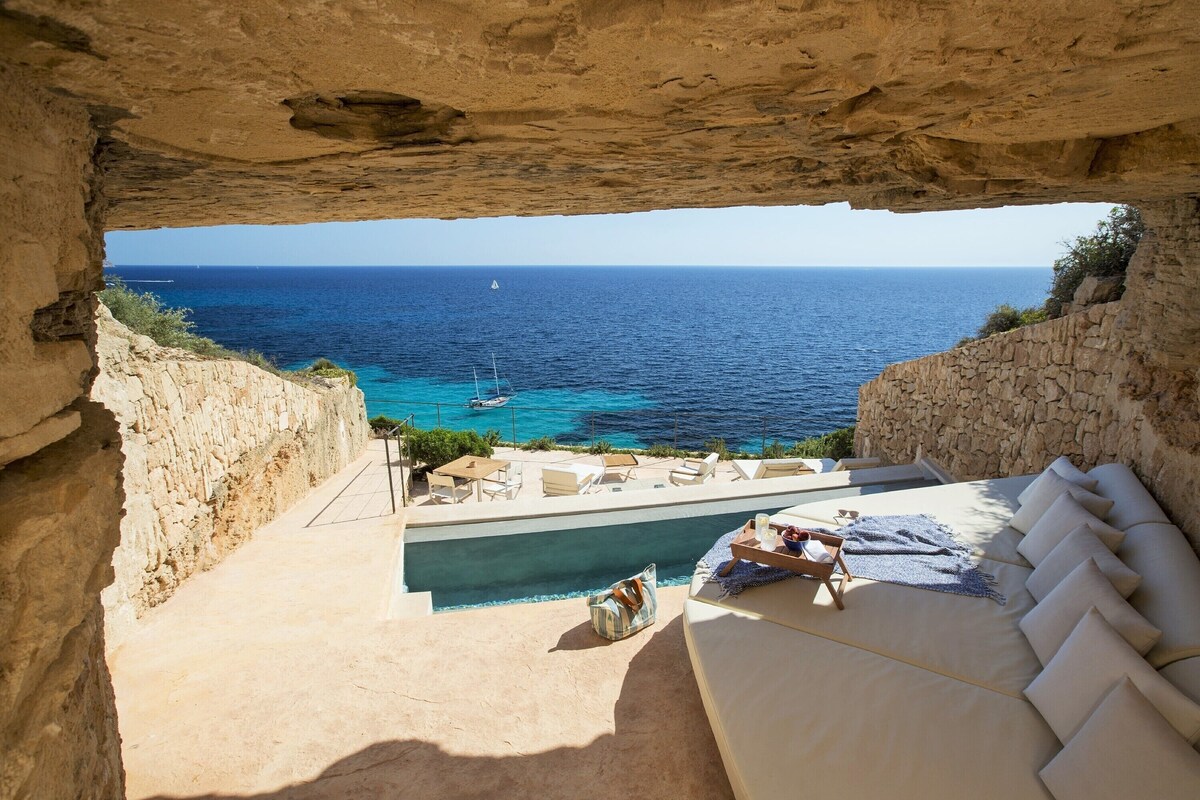
Tramuntanas terrasserade olivlundar slutar abrupt vid Deiàs klippkant — Belmond La Residencias trädgård hänger över Medelhavet 200 meter rakt ned. Rytmen skiftar när öns geologi vänder söderut, mot Cala Blava där Cap Rocat — en konverterad 1800-talsfästning — möter horisonten med samma stenighet.
Från Cap Rocats klippfäste rullar kustlinjen västerut mot Palmas hamn — där modernismen möter den gotiska katedralen. Sant Francesc Hotel Singular sitter i en restaurerad palats från 1700-talet, hörnet till La Llonja. Stadens textur stramar in: Tramuntanas tystnad utbyts mot kyrkklockor och tapas-bord.
The hotels
- AluaSoul Mallorca Resort — Adults Only — Cala Egos / Cala d'Or · 4★
A functional resort with a clear profile: adults, beach, Hyatt points. Mare Nubium raises the culinary floor above the segment average. The right choice for those who know that quiet and points earning outweigh hotel architecture. - Barefoot Hotel Mallorca — Portocolom · 5★
Arcona delivers a consistent boho-luxury concept in a harbour that still smells of salt and diesel. The intentionality of the scale — 60 rooms, no conference halls — holds. Schweiger's brand adds a cultural recognition that can irritate as much as it attracts. To choose Portocolom is to choose authenticity over infrastructure. - Bikini Island & Mountain Hotel Es Trenc — Adults Only — Colonia Sant Jordi · 4★
Studio Dreimeta's rehabilitation of a condemned 1960s complex into a Design Hotels-affiliated adults-only property delivers on its promise: serious materiality, the NENI kitchen, a Santaverde spa, and an artist's lounge with a professional recording studio. Aimed at those seeking the south coast's stillness rather than the pool bar's spectacle. - Bikini Island & Mountain Hotel Port de Sóller — Port de Sóller · 4★
The only Design Hotels option on the Tramuntana coast delivers Armin Fischer's 1969-inspired interior, Haya Molcho's NENI kitchen and Mallorca's first Santaverde spa in a location without direct competition on the north-west coast. Port de Sóller is 30 mountain minutes from Palma — factor that into your planning. - Blau Colònia Sant Jordi Resort & Spa — Colonia Sant Jordi / Ses Salines · 4★
Blau Colònia Sant Jordi delivers scale and nature-park positioning in a combination that is difficult to match in southern Mallorca: 395 rooms, an established spa facility and an à la carte kitchen with genuine ambition, all within a 900-metre walk of one of the island's last long undeveloped beaches. The spa surcharge is the only structural weakness — choose Suite Select if wellness is a priority. - Bordoy Alcúdia Port Suites — Port d'Alcúdia · 5★
Bordoy Alcudia Port Suites is the logical choice on the north coast for couples seeking five stars, proximity to the beach and a functioning spa without compromising on the Bordoy group's design line. The resort character of the surroundings is evident — but the hotel's filter holds. - Bordoy Mostatxins Hotel Boutique — Alcúdia Old Town · 4★
Boutique scale and archaeological substance in combination are rare; Bordoy Mostatxins delivers both. Calibrate expectations around spa capacity and dinner service, and you will find one of Mallorca's most materially honest boutique hotels. - Boutique Hotel Calatrava — La Calatrava / Old Town · 5★
Sixteen rooms are enough to hold service at a level that large hotels cannot replicate. La Calatrava's seafront position and the Huguet bathrooms are materially genuine — but the 30-euro breakfast supplement and the absence of a pool are real trade-offs to factor in. - Boutique Hotel H10 Blue Mar — Adults Only — Camp de Mar · 4★
The 1970 property carries its age visibly in the standard rooms, but the location — frontline on one of Mallorca's least visited bays — and a spa included in the price compensate. Choose a Junior Suite if the budget allows; the rest is about the bay. - BQ Can Picafort Hotel — Can Picafort · 4★
BQ Can Picafort is a well-renovated four-star family hotel in the right position for the Bay of Alcúdia — 250 metres from the beach, with a clearer gastronomic offer than the region's buffet-dominated competitors. Well-calibrated pricing for what is delivered. - BQ Paguera Boutique Hotel — Adults Only — Paguera · 4★
BQ Paguera delivers what it promises: quiet, a functioning pool terrace and an uncomplicated walk to the beach — without charging for more than that. The right choice for couples seeking the south-west coast's sunny position without the family-resort format. - Brondo Architect Hotel — Old Town Palma / Cathedral · 4★
Brondo is Palma's clearest design hotel in its price bracket — a genuine architectural project, not a themed concept. El Bandarra's arrival in 2024 raised the bar considerably. - Ca's Xorc Luxury Retreat — Sóller Mountains · 4★
Ca's Xorc is what happens when a historic olive finca is converted with respect for the original dry-stone structure and not scaled up. 15 rooms, adults-only without exception, head chef Pep Lluís 'Barretes' Mayol with his own garden supply — it is a rare match for those seeking absolute silence and prepared to drive a winding mountain road to reach it. - Cala Millor Garden — Adults Only — Cala Millor · 4★
A well-run chain product in the Garden Hotels group: the adults-only logic holds, the pool structure (outdoor, indoor, jacuzzi) works and the 2026 renovation is visible in the rooms. Design ambitions are limited but the promises are kept — calm, beach and a functioning wellness centre. - Can Alomar Urban Luxury Retreat — Old Town Palma · 5★
Can Alomar is the right choice for travellers who want Palma's finest address, a genuinely accomplished kitchen and a wellness tower with cathedral panoramas — but who can live without a full-size pool and the company of children. - Can Bordoy Grand House & Garden — Old Town Palma · 5★
Can Bordoy is La Lonja's most concentrated address: an architectural restoration that won the INSIDE World Architecture Festival 2019 and has held a Michelin Key since 2024. Twenty-four suites, no compromises, no scale expansion — and a restaurant concept at Botànic that is reason enough to book even without an overnight stay. - Can Cera Hotel — Old Town Palma · 5★
Can Cera delivers what Palma's larger hotels cannot: scale. Fourteen rooms, exclusive spa booking, a Michelin-noted restaurant at the entrance — and discreet enough that the cathedral is better seen on the walk there than from the roof. - Can Ferrereta — Santanyí · 5★
Can Ferrereta earns its two Michelin Keys without reservation — but if you are buying it for its beach, this is the wrong hotel. The right choice is Santanyí for Santanyí's own sake. - Can Simoneta Hotel — Canyamel · 5★
Can Simoneta earns its five-star classification through location, ownership structure and the culinary project — not through room count. Right for couples who prioritise seclusion over infrastructure. - Cap Rocat — Cala Blava · 5★
Fort de Cap Enderrocat was built in 1898 and never used in combat; Antonio Obrador's fifteen-year conversion project (Europa Nostra Prize laureate) has made the military architecture the hotel's central argument rather than its background scenery. For those who prioritise architectural radicality and complete seclusion over a beach holiday, there is nothing comparable on the island. - Cap Vermell Grand Hotel — Capdepera / Cala Ratjada · 5★
Cap Vermell Grand Hotel is an unusually coherent north-eastern Mallorca address: the DSA architecture, VORO's two Michelin stars and a landscape designed by AECOM featuring 300-year-old olive trees mean the hotel delivers more than it promises. The scale of 142 rooms is too large for intimate boutique luxury, but for the right guest — one seeking north-eastern Mallorca, a gastronomic anchor and an alternative to the Palma corridor — there is barely a sharper option on the island. - Cases de Son Barbassa — Capdepera · 4★
Cases de Son Barbassa is agroturismo with substance: historic buildings with traceable food production, a working farm and a setting within the Parc Natural de Llevant that keeps mass mobility at a distance. Choose it for the east coast of Mallorca — not for luxury. - Castell Son Claret — Es Capdellà / Calvia Mountains · 5★
Castell Son Claret is one of western Mallorca's strongest arguments for staying in a single place: 132 hectares, an on-site Michelin star, and a seclusion that is geographical rather than manufactured. The isolation is the premise, not a compromise. - Castillo Hotel Son Vida — Son Vida · 5★
Castillo Son Vida is Mallorca's oldest five-star hotel and the only adults-only option in Palma — a medieval estate opened in 1961, with Arabella Golf's three 18-hole courses within shuttle distance and a 900 m² spa. If you consciously opt out of city life, the hilltop position delivers exactly what it promises. - CM Mallorca Palace Hotel — Adults Only — Sa Coma · 5★
CM Mallorca Palace is a well-run adults hotel in an eastern-coast neighbourhood otherwise dominated by family resorts. Without swim-up suites or a sea view from the rooms, the dramatic location argument is absent — but Es Molí and the stable operation under CM Hotels make it a credible choice for couples who prioritise calm over geography. - Concepció by Nobis — Old Town Palma · 5★
Wingårdhs' five-year restoration of a sixteenth-century complex at Carrer de la Concepció 34 is Nobis Group's purest architectural thesis outside Scandinavia. With 31 rooms, Chef Álvarez in the kitchen and a hidden courtyard pool, the compromises number exactly two: capacity runs out, and there is no parking garage. For design-conscious travellers without a car who book ahead — one of Mallorca's most precise hotel arguments. - Convent de la Missió — Old Town Palma · 5★
Convent de la Missió is the only 5-star GL hotel in Palma's old town with a Michelin star under the same roof — a combination that rarely holds in this segment. The hotel's 27 rooms are few and the suite ratio high; book a Junior Suite or above to avoid interior atrium rooms without natural light. For culture-driven travellers who prioritise gastronomic integrity over pool palaces, this address is without equal in Palma. - Es Princep — The Leading Hotels of the World — Passeig Marítim / Seafront · 5★
Es Princep is Palma's only Leading Hotels of the World member and the hotel positioned closest to the intact Renaissance wall Baluard del Príncep. Zaranda strengthens the proposition for the traveller for whom gastronomic precision is as central as architecture. Best in class in the Sa Calatrava segment. - Finca Serena Mallorca — Montuiri · 5★
Sergi Bastidas's restoration of a 13th-century farmstead and Único Hotels' stewardship have created by far the most carefully considered rural hotel in Es Pla. Único Spa's twofold national distinction is not decorative — the facility is reason enough to stay. Independent travellers with a car; not intended for those who want a beach within walking distance. - Finca Son Palou — Orient · 4★
The Colom family has owned the land for over 90 years and converted the estate into a hotel in 1999 — it shows in how the place is run. Twelve rooms across 150 hectares produce a scale that demands genuine engagement, not industrial hospitality. That is the point. - Fontsanta Hotel, Thermal Spa & Wellness — Campos · 5★
Fontsanta sells a geological fact no competitor can replicate: the thermal spring beneath Campos is unique in the entire Balearic archipelago. The trade-off is clear — isolated location, car required, and the aesthetic is deliberately subdued. The right choice for those seeking hydrotherapeutic depth rather than pool-terrace aesthetics. - Four Seasons Mallorca at Formentor — Formentor · 5★
The property's heritage is genuine and weighted — Churchill, Hepburn, Chaplin — and the Four Seasons renovation is materially credible: Estudio Lamela, Gilles & Boissier, seven restaurants, a full-scale spa. The driving restrictions on MA-2210 are neither rumour nor a disadvantage unique to the hotel; they apply to the entire peninsula and are a logistical fact to plan around, not to sidestep. The right address for those prepared to commit to the peninsula for the duration of their stay. - Gran Hotel Sóller — Sóller · 5★
The Can Cremat palace of 1880 on Carrer de sa Romaguera is Sóller's architectural anchor — Pavía Birmingham's original proportions intact, facilities updated in stages since the 2004 reopening. Alvotel's management since 2016 maintains the boutique scale: 38 rooms, a fully equipped basement spa and Ca'n Blau as its own restaurant. No outdoor spa in sunlight, no anonymous hotel scale — the right choice for those who want to stay inside Sóller's history, not beside it. - Grand Hotel Son Net — Puigpunyent · 5★
A manor dating from 1672 with Lorenzo Castillo's interiors, Sergi Olmedo's Malvasia-driven kitchen, and a spa of over 1,000 square metres — Son Net delivers historical substance and design integrity that coastal hotels cannot match. The trade-off is geography: an unmarked mountain road past Puigpunyent eliminates car-free living and turns spontaneous excursions into a project. - Grupotel Alcudia Suite — Playa de Muro / Port d'Alcúdia · 4★
122 apartments with fully equipped kitchens and balconies, 200 metres from one of northern Mallorca's longest sandy beaches, at a price that stays below the regional mid-market. Not a design hotel — a logistical decision rarely regretted. - Grupotel Los Príncipes & Spa — Playa de Muro · 4★
Grupotel Los Príncipes is a well-organised beachfront hotel with a genuinely strong spa offer — a water-jet circuit, laconium and ice fountain at no extra cost is unusual in the four-star segment. The family-friendliness (kids' club, children's pool) is real but not the primary proposition. The right choice for guests combining beach and recovery who do not require a strictly adult environment. - Grupotel Parc Natural & Spa — Playa de Muro / S'Albufera · 5★
The only full-service resort on Playa de Muro with S'Albufera literally as a neighbour. The buffet format is a genuine drawback — but no other address on the bay combines ornithology and a full-scale spa within the same property logic. - HM Palma Blanc — Santa Catalina / Marina · 4★
HM Palma Blanc is a well-executed four-star city hotel with a credible sustainability programme and an unusually strong kitchen for its category. Aromata with Andreu Genestra's cooking is the real trump card. The weakness is room size in the base category — book up a level. - Hospes Maricel & Spa — Cas Catala · 5★
Hospes Maricel is a historically well-grounded five-star alternative to Palma's beach hotels — with a verifiable architectural history, a functioning spa and a gastronomic programme under a named head chef. Well suited to couples and wellness seekers who value substance and calm over walking distance to restaurants. - Hotel Basílica — Old Town Palma · 4★
38 rooms, family-owned since 1700, with a 14th-century Gothic arch in the breakfast room — the architectural substance is genuine and unusual in Palma's boutique category. A complimentary minibar with continuous restocking is a concretely generous touch. Car-free cobblestone lanes require that vehicular transport happen at a distance, and breakfast costs extra. - Hotel Born — Old Town Palma / Born · 4★
The Marquises of Ferrandell's 16th-century palace, restored in 1993 from a hostel to a hotel with minimal intervention in the original fabric. No coddling amenities — no lift, no oversized bathrooms — but the courtyard and the stone staircase deliver the authenticity that newly built boutique hotels pay five times more to simulate. - Hotel El Llorenç Parc de la Mar — La Calatrava / Parc de la Mar · 5★
El Llorenç delivers a rare combination: 33 rooms with a Michelin-starred restaurant in-house, a rooftop infinity pool oriented towards the cathedral, and a spa with a 14-metre indoor pool. The adults-only profile is entirely consistent with the gastronomic positioning. The right hotel for a couple who book the table as carefully as the room. - Hotel El Vicenç de la Mar — Cala Sant Vicenç · 5★
El Vicenç de la Mar is the rare north-Mallorcan address where gastronomy, design and geography converge at precisely the right point: Santi Taura's kitchen, Magnus Ehrland's 1950s sensibility and the crystal-clear coves of Cala Sant Vicenç — in a place that did not exist four years ago. - Hotel Es Port — Port de Sóller · 4★
Hotel Es Port is what Port de Sóller looked like before the destination was invented: a family estate that happens to let out rooms. 147 rooms, private gardens, a kitchen that takes its produce seriously and no chain logic. The season's one weakness — thin walls in the newer building sections — is documented and manageable. For those seeking northern Mallorca's best combination of sea, mountain and rail connection without five-star pricing, this is the right address. - Hotel Finca Son Gener — Son Servera countryside · 4★
Toni Estever's 2008 restoration of an abandoned 18th-century farmhouse at km 3 on the old Son Servera–Artà road produced one of the island's more coherent finca hotels: fifteen suites, three saltwater pools, a spa with hammam and steam room, and a kitchen garden that genuinely supplies the dinner menu. Nothing here is invented. - Hotel Illa d'Or — Port de Pollença · 4★
Hotel Illa d'Or opened in 1929 and is today the oldest hotel in operation along Pine Walk, with 120 confirmed rooms and a TripAdvisor rating of 4.7 across 3,215 reviews. The Agatha Christie connection from 1932 is documented; restaurant La Terrassa with Cyril Vanrell in the kitchen and Caldereta de Langosta as signature dishes is hotel-run and open March–November. It is a hotel for returnees — not for those seeking a design hotel. - Hotel Salino Port Soller — Port de Sóller · 4★
Treguer Collection's latest Mallorca venture delivers a coherent product — 42 rooms with sea views, a spa, and an Asian-Mediterranean restaurant concept in a hotel with fewer than two seasons behind it. The limited review base is the real uncertainty; the hotel is worth watching. - Hotel Saratoga — Passeig Mallorca / City Centre · 4★
The substance is genuine: a family history from 1962, a chef with external validation, and a jazz venue that fills on its own merits. Boulevard noise and variable room quality on the lower floors hold it back, but nothing here has been engineered to impress. - Hotel Tres — Old Town Palma · 4★
Petit Palace Hotel Tres is not a design hotel that happens to be well located — it is a location hotel with enough history to justify the premium. 41 rooms means limited category choice; the rooftop terrace and sauna deliver more than the price suggests. Choose it for Palma logistics, not for service theatre. - Hotel Valldemossa — Valldemossa · 4★
One of Mallorca's most accomplished boutique openings in recent years — 12 rooms, a considered spa and a restaurant with a distinctive culinary voice. The distance from the village centre is real; allow for a five-minute walk and no drop-in service along the streets. - Hotel Victoria Gran Meliá — Passeig Marítim / Marina · 5★
Hotel Victoria Gran Meliá delivers a well-verified premium offering along Palma's seafront: a historic 1920s origin, a comprehensive 2025 renovation under ASAH's direction, Red Level service and a direct panorama of the marina and La Seu. The chain's scale and the boulevard's traffic noise are real trade-offs — but for the well-travelled couple seeking Palma's finest seafront location after a total property renovation, the timing is right. - Iberostar Selection Es Trenc — Ses Salines / Es Trenc · 5★
For a hotel that has only lived through its first full season, Iberostar Selection Es Trenc maintains a remarkable level of consistency: sea views in every room, a credible gastronomic profile and a natural setting against Ses Salines that delivers without needing to overstate it. Factor in a realistic expectation — Es Trenc beach requires a walk, not a one-step excursion. - Iberostar Selection Playa de Muro Village — Playa de Muro · 5★
Iberostar Selection Playa de Muro Village is a classic all-inclusive choice for north-eastern Mallorca — a beachfront position on 6 km of Blue Flag shore, a fully functioning spa with 20+ treatments, and Gust as a genuine à la carte alternative to the buffet. The scale is resort, not boutique; the price reflects that. - Iberostar Waves Playa de Muro — Playa de Muro · 4★
One of few large beach resorts where the sustainability commitment is group-wide and measurable rather than marketing copy. The scale is real — and it is a trade-off one should make consciously before booking. - Ikos Porto Petro — All Inclusive — Portopetro · 5★
Ikos Porto Petro delivers the all-inclusive model without the compromises the concept normally implies: six restaurants with Michelin-chef menus, a 1,049-square-metre spa, and a protected cove. The former Blau Porto Petro hotel underwent a €110-million renovation and opened in 2023 as an entirely new resort. The right choice for those who want frictionless ease without surrendering gastronomic richness. - Jumeirah Mallorca — Port de Sóller · 5★
Jumeirah Mallorca is the right choice for the traveller seeking dramatic cliff terrain, a serious wellness concept and a Michelin-listed table without changing address. The mountain pass to Palma is a built-in brake — choose the hotel for what it is, not for the convenience of its location. - Kimpton Aysla Mallorca — Santa Ponsa · 5★
Kimpton Aysla is at its strongest as a wellness hotel and gastronomic destination in one. Saba Restaurant's omakase programme and the CODAGE spa's salt cave carry the stay; the surroundings of Santa Ponsa do not. Know that going in, and the experience works entirely on its own terms. - L'Avenida Hotel — Sóller · 4★
Twelve rooms in Sóller's most distinctly modernist house — an address for those who wish to inhabit the city's history without setting foot in a chain-format hotel. The right choice if the Tramuntana valley is the goal; the wrong one if a pool and spa are expected to be the property's core. - La Residencia, A Belmond Hotel, Mallorca — Deia · 5★
La Residencia is Deià rather than Mallorca — the right choice for those who value artistic density and Belmond's unhurried service excellence over the pool-bar scene. The price is among the island's absolute highest, but the breadth of the arts programme and El Olivo's MICHELIN-listed kitchen justify it. - Lindner Hotel Mallorca Portals Nous, part of JdV by Hyatt — Portals Nous · 4★
Lindner Portals Nous is a dependable four-star golf resort with a well-curated African aesthetic and a spa that genuinely delivers — 500 square metres, indoor and outdoor pools, steam bath and seven treatment zones. For those who prioritise accessible greens and a functional wellness structure over boutique personality or a beachfront position, it is a thoroughly considered choice. - Mandarin Oriental Punta Negra — Calvià / Punta Negra · 5★
Mandarin Oriental Punta Negra replaces H10 Punta Negra with a hotel in an entirely different weight class: 131 rooms designed by Laura Gonzalez, six restaurants with named chefs, a spa with nine treatment rooms and direct access to two private coves. The opening period means service and operational sharpness are still being calibrated — but the headland setting and the cross-disciplinary culinary brief justify an early visit. - Mardavall Mallorca Hotel — Portals Nous · 5★
The St. Regis Mardavall is Costa d'en Blanes' strongest address: Es Fum's Michelin star (since 2011) and the 4,700 sqm Arabella Spa — the Balearics' first thalasso centre — justify the rate. Note that the hotel has no sandy beach; the rocky coastline is accessible but not swimmable. Best suited to gastronomy-focused guests seeking butler service and spa depth rather than beach life. - Meliá Cala d'Or Boutique Hotel — Cala d'Or · 5★
Meliá's smallest Mallorca property delivers boutique density — under 50 rooms in four garden pavilions 200 metres from Cala Gran — with a functioning wellness floor and Es Llaüt for evening à la carte. The right choice for couples who prioritise quiet over footprint. - Meliá Calviá Beach — Magaluf Beachfront · 4★
Meliá Calviá Beach is the most structured option along Magaluf's beachfront strip: The Level section effectively separates guest profiles, Cape Nao delivers genuine à la carte dining with sea views, and YHI Spa with Turkish bath and sauna functions as a real wellness facility. Magaluf's surrounding nightlife is a geographical reality that no pool view changes. - Meliá South Beach — Magaluf · 4★
Meliá South Beach delivers a well-considered beach hotel package — 512 rooms, six pools, YHI Spa and Cape Nao — on one of Mallorca's liveliest beaches. The price point is right for what is offered; Magaluf's ambiance is included regardless of room category. - MiM Mallorca — Adults Only — S'Illot / Cala Millor · 4★
MiM Mallorca is a consistently executed boutique project — Arquitectura GMM's building formula delivers on its promise: architecture with Mediterranean logic, adult tranquillity and a spa with substance. The buffet restaurant is the project's weakest link. Ideal for couples and solo travellers with a design sensibility and a preference for the eastern coast's lower pulse. - Mon Port Hotel & Spa — Port d'Andratx · 4★
Mon Port Hotel & Spa delivers on what its Port d'Andratx location promises: terrace views over the marina, a proper spa and well-maintained pool surfaces. Set against that is the limited opening window and a room rate that feels tightly justified for four-star standards. Choose the right room and the right month and the return is high. - Nakar Hotel — Passeig de la Rambla / Born · 4★
Nakar delivers Palma's strongest combination of design integrity and location: 57 rooms in a carefully converted 1950s building, a rooftop pool with La Seu views and a hotel-driven kitchen worth a separate reservation. Book direct for complimentary spa access. - Nixe Palace Hotel — Cala Major · 5★
Hotel Santos Nixe Palace is a privately owned five-star beachfront hotel that, since the Santos family took over in 1996, has consistently chosen continuity over repositioning. The room renovation completed in March 2024 strengthens the product without altering its character. The right choice for the traveller seeking Palma access with a genuine beachfront position — but book a sea-facing room and expect morning traffic on Avenida Joan Miró. - Nobis Hotel Palma — La Calatrava / Old City · 5★
Nobis Palma is not a hotel that happens to occupy a historic building — the building is the point. Wingårdhs' reversible steel intervention against 900 years of sandstone, Gothic and Baroque makes a rare architectural case for a hotel stay. Book before summer-season occupancy turns securing a room into a project. - Palacio Ca Sa Galesa — Old Town Palma · 5★
Twelve rooms, a palace dated to 1576, original art by Miró and Calder on the walls, and La Seu visible from the rooftop terrace. For those who seek a palace's intimacy over a resort's scale, the address in Palma's Gothic heart is hard to rival. - Pleta de Mar — Canyamel · 5★
Pleta de Mar is the quietest property in the Torre de Canyamel group — 30 suites, a wood-fired restaurant by a Michelin-pedigreed chef, and a private rocky cala 500 metres away. No sandy beach on site and closed November–March are real limitations, not editorial gloss. Suits the adult couple who prioritises stillness, gastronomic substance and a secluded coastal setting over mobile resort infrastructure. - Portixol Hotel — Portixol · 4★
Johanna and Mikael Landström purchased the property in 1996 and reopened in June 1999. It holds: 25 rooms, Scandinavian discipline and a position in Portixol's fishing harbour that no other address in Palma can replicate. - Principal Son Amoixa — Manacor countryside · 4★
16 rooms on a 16th-century finca 5 km east of Manacor: Restaurant Principal welcomes outside diners, earned a Guide Michelin recommendation in 2019 and a HolidayCheck Gastronomy Award. The solar panels have covered the property's majority electricity needs since 2023. The right choice for travellers with a car who prioritise gastronomic substance and rural quiet over proximity to the beach. - Pula Suites Boutique Resort — Costa de los Pinos / Son Servera · 5★
Pula Suites combines a 16th-century manor house with José María Olazábal's redesigned course — 68 suites, three hotel restaurants and a spa with a water circuit. It is Mallorca's eastern inland alternative to coastal beaches: quiet, golf-centred and reliant on your own vehicle. - Pure Salt Port Adriano Hotel & SPA — Adults Only — El Toro / Port Adriano · 5★
Pure Salt Port Adriano is a well-refined five-star adults hotel with one of southern Mallorca's finest spa offerings and a geographic position that makes marina views a consistent design element throughout. Shoreline access requires a shuttle — that is the hotel's only genuine limitation. - Puro Hotel Palma — Old Town Palma · 4★
Puro is neither a resort nor a status hotel in the Grand Hotel sense, but its La Lonja address, fifteen years of design continuity and the hotel-operated Beatnik terrace still justify the price point for travellers seeking Old Town anchorage and nightlife without a taxi ride. - Reads Hotel — Santa Maria del Camí · 5★
Reads is not a vineyard hotel in the conventional sense — the wine region is the surrounding landscape, not a brand of its own. The strongest argument for the address is the tranquillity, the spa facilities and a history that gives substance to the high price. - S'Hotel d'Es Puig — Deia · 4★
S'Hotel d'Es Puig is not a spa hotel or a full-service property — it is one of Mallorca's oldest operating hotels, with a historical guest list few rivals can match and a position in Deià that speaks entirely for itself. Eight rooms and no pretensions. - Sa Bassa Rotja — Porreres · 4★
Sa Bassa Rotja is a genuine finca hotel with no beach ambitions: 38 rooms in historic buildings on a 100-hectare estate, spa included in the rate and a kitchen that changes its menu daily according to what the estate produces. Suited to couples and solo travellers who prioritise quiet and rural depth over pool bars and transfer distances. - Sa Pedrissa Agroturismo — Deia · 4★
Sa Pedrissa is nine rooms on a declared heritage estate — olive mill, vantage point, and adults-only hotel in one. Es Pi delivers kitchen quality that far exceeds what the address's scale might suggest. The absence of a pavement to Deià and the lack of a conventional spa are genuine limitations; this is a hotel for those who wish to inhabit a landscape, not merely stand beside it. - Sant Francesc Hotel Singular — Old Town Palma · 5★
The Soldevila family's restoration of the Alomar palace, opened March 2015, is Palma's densest combination of historic fabric and contemporary comfort in an SLH format free of conference traffic. Pricing is the market's highest; no room is more than ten minutes' walk from the Cathedral. - Son Brull Hotel & Spa — Pollença · 5★
Son Brull is northern Mallorca's most fully realised rural retreat: history, working farmland and a gastronomic identity entirely clear of mass-tourism pressure. The beach requires a car and Restaurant 365 is closed three evenings a week — that is the price of staying on the right side of the Tramuntana. - Son Bunyola Hotel & Villas — Banyalbufar · 5★
Son Bunyola is Mallorca's only combination of an 810-acre UNESCO-protected estate, a medieval defensive tower, Mallorcan architecture signed by GRAS Reynés and a culinary programme built around the estate's own harvest calendar. Rates start from around $870 per night including breakfast; the isolation is a feature, not a problem. - Ten Mallorca — Sineu · 4★
Ten Mallorca is not a hotel one ends up in by accident — it is a deliberate choice of inland Mallorca over the coastal strip. Nine rooms, clear ownership, no anonymous service. Right for those who want Sineu within walking distance and the beach as a car journey. - Valentin Playa de Muro — Playa de Muro · 3★
Valentin Playa de Muro is a functional and well-positioned bungalow hotel with one of the Bay of Alcúdia's strongest beach locations — the right choice for families who prioritise natural proximity and sandy seabed over design ambitions and à la carte. - Zafiro Can Picafort — Can Picafort · 4★
Zafiro Can Picafort delivers what the all-inclusive contract actually promises: nine pools, drinks without time gaps, and a renovated suite portfolio. Not a design hotel — but a resort that understands what families with children need from a week in northern Mallorca. - Zafiro Mallorca & Spa — Can Picafort / Playa de Muro · 4★
Zafiro Mallorca delivers what a family resort is meant to: separate zones that allow children to be children and adults to decompress. The aesthetic is functional without being generic, and Rita's raises the restaurant profile to something genuinely worth anticipating. The right choice for those who want logistical peace of mind without surrendering all-inclusive comfort. - Zafiro Palace Andratx — Camp de Mar / Andratx · 5★
Mare Nostrum as signature restaurant with avant-garde technique, Tastes & Sushi as à-la-carte Japanese, Caliu Steakhouse with tomahawk — the all-inclusive concept holds for a full week without repeating a single meal. The Camp de Mar location, 27 kilometres west of Palma, delivers the stillness a densely built beach resort can never match. - Zoetry Mallorca Wellness & Spa — Costa d'en Blanes · 5★
Sa Torre's 700-year history, Michelin kitchen and Natura Bissé spa combine to deliver a package that the all-inclusive format rarely achieves elsewhere. Llucmajor's rural seclusion is a genuine asset — but requires you to be content staying on the property.
Curated areas
Alcúdia
Walled medieval town on the Bay of Alcúdia. Restored 14th-century walls enclose a network of narrow streets with palaces, markets, and rooftop terraces.
Cala Ratjada
Active fishing harbour turned low-key resort on the northeast coast. Lobster straight off the boat, Saturday market, and trails to the lighthouse on the Artà peninsula.
Can Picafort
Low-key northern beach resort with a promenade along the Bay of Alcúdia. Family-friendly sandy beach, pine forest, and cycling distance to the Albufera wetland.
Deià
Artists' village on the slope of the Tramuntana mountains where Robert Graves settled in 1929. Stone villas among olive groves, sunsets over Cala Deià, and one of the island's most expensive postcodes.
Magaluf / Calvià
Large-scale sun-and-sea resort under repositioning. The municipality of Calvià is investing in the luxury segment — new boutique hotels and beach clubs gradually replacing party tourism.
Mallorca Interior
Ancient fincas, almond groves, and stone villages in the centre of the island. The Es Pla plain offers rural calm, vineyards, and Sunday markets without the coast's crowds.
Palma de Mallorca
The island's capital — Gothic cathedral by the water, Arab baths from the 10th century, and the Paseo del Borne as a shopping promenade. The restaurant scene in the Santa Catalina quarter rivals Barcelona.
Playa de Muro
White-sand dunes on the Bay of Alcúdia with shallow turquoise water. A Natura 2000-protected beach stretching six kilometres — the island's most family-friendly stretch of coast.
Pollença
Roman-founded town with a 365-step Calvary staircase and an international music festival running since 1962. Sunday market on Plaça Major, artists' studios along the narrow alleys.
Santanyí
Artistic southeast corner — ceramic workshops, Saturday market on Plaça Major, and honey-coloured sandstone. Cala Santanyí and Cala Llombards within cycling distance.
South (Es Trenc)
Five kilometres of white sand, transparent water, and no beach shacks. Mallorca's most untouched beach — Natura 2000-protected, with salt flats from Roman times.
Southeast Coast
Rugged limestone cliffs and hidden coves on the eastern side of the island. Porto Colom, Cala Figuera, and Cala Llombards — dramatic coastline without mass tourism.
Southwest Coast
Glamorous arc from Port d'Andratx to Camp de Mar — superyacht marina, Michelin terraces, and sunsets towards Sa Dragonera. The island's most expensive property market.
Sóller
Valley town surrounded by orange groves with a historic tram down to the harbour (running since 1913). Serra de Tramuntana hiking starts here — Can Prohom serves lamb from its own farm.
Valldemossa
Medieval monastery village at 400 metres' altitude where Chopin and George Sand wintered in 1838. The Carthusian monastery, coca de patata, and panoramic views over the Tramuntana.
Campos
Agricultural plain and gateway to Es Trenc beach. Sunday market, bodegas, and the island's best slow-roasted lamb. A quieter alternative to the coast.
Canyamel
Small pine-fringed bay with ancient cave systems. Coves d'Artà impress with 25-metre stalactites — the beach below is one of the island's calmest.
Llucmajor
Southern municipality near Es Trenc with rural character. Local wine producers, quarry caves, and direct access to the island's finest untouched beaches.
Northwest (Tramuntana)
UNESCO-protected mountain landscape — dramatic cliffs, terraced olive groves, and the GR-221 long-distance trail. The Sa Calobra serpentine road and the Torrent de Pareis ravine.
The table
VORO (Mediterranean avant-garde). Álvaro Salazar picks the fish from Cala Ratjada harbor that same morning — under four hours old when it hits your plate. Two Michelin stars that taste of cliff edge and salt, not of prestige.
DINS Santi Taura (Mallorcan historical). Santi Taura digs into 18th-century monastery kitchens and serves Mallorca as Mallorca forgot itself. Every dish has a story — ask, because that's half the experience.
Béns d'Avall (Mediterranean permaculture). Three generations of Vicens, a cliff between Sóller and Deià, the Mediterranean fifty meters below. Green Star and one star. Since 1971 — and it shows. In the best possible way.
Andreu Genestra (Zero-kilometre biodynamic). Zero-kilometer as a lifestyle, not marketing. A 2,000 square meter biodynamic garden, everything you eat grows within sight. Ask for a tour before dinner — it changes every bite.
What to do
Serra de Tramuntana — Cycling the UNESCO road
200,000 cyclists a year generate 150 million euros — Mallorca is the Mediterranean's cycling capital. The MA-10 from Andratx to Pollença offers 100 km through UNESCO-protected mountain terraces, cliffs plunging towards the sea.
Start from Port de Pollença towards Cap de Formentor at dawn. Traffic opens at 9 AM in summer — until then the road is yours.
Binissalem DO — Wine tasting through three centuries
DO Binissalem has regulated wine production since 1990 — the Manto Negro grape dominates the central Es Pla plain. Ànima Negra, 4 Kilos Vinícola, and Mesquida Mora (Demeter-certified in 2007) represent a new generation of Mallorcan wine.
Begin at Bodega Ribas (since 1711, Spain's third-oldest winery). Their biodynamic Sió red is barely available outside the island.
Coves del Drac — Underground concert at Lago Martel
25 metres beneath Porto Cristo a cave system formed over 10 million years opens up. The highlight: a string quartet performing classical music from boats gliding over the mirror-still underground lake.
Book the last tour of the day. Fewer visitors, and the lighting at Lago Martel (177 metres long, Europe's largest underground lake) is most dramatic in twilight.
Sineu — Mallorca's oldest market
Every Wednesday since the 14th century, farmers gather in Sineu — Mallorca's oldest market. Flor de Sal d'Es Trenc, local DO-certified olive oil, and ensaïmada straight from the oven draw both locals and chefs.
Wednesdays at 8 AM. Walk past the textiles to the livestock section — it's the last living livestock market on the island. Finish with pa amb oli and sobrassada in the square.
Sunset sail from Port d'Andratx
Port d'Andratx holds 450 berths and Mallorca's most expensive property prices (€8,924/m²). At sunset the cliffs glow orange while Sa Dragonera cuts a silhouette against the horizon.
Skip the group boats. Private skippers at the marina offer 2–6-person tours with a stop at the cave on Sa Dragonera.
Ruta de Pedra en Sec — Walking the dry stone walls
GR 221 — the 167 km trail through UNESCO-protected Serra de Tramuntana, from Port d'Andratx to Pollença. You walk on centuries of dry-stone terraces through olive groves and limestone ravines.
Stage 4 (Tossals Verds to Cúber) gives the best ratio of effort to view. Stay overnight in the refuges — book through IBANAT.