Cases de Son Barbassa
Capdepera, Mallorca · heritage
THE VIBE
Cases de Son Barbassa — a 16th-century watchtower ringed by 125,000 square metres of olive groves, almond trees and carob — the east coast in earnest.
THE BACKSTORY
The estate has been known since the 16th-century watchtower, built to defend against Berber pirate raids along Mallorca's east coast. The fortification's original kitchen and tower are preserved in the interior. The hotel operation began in 2003 following renovation of the original building volumes, and the grounds contain the remains of a talayotic settlement some 3,000 years old. The olive grove still produces extra virgin oil with denominación de origen.
WHY NOW
The season reopens in late March after the winter closure. April and May offer lingering almond blossom along the edges and full pool access without the occupancy pressure of high summer.
THE ROOM
Request a room in the original finca building with exposed stone walls and ceiling beams — these preserve the tower's character far better than the annexe's more contemporary junior suites.
WELLNESS
The spa area beside the pool offers a heated whirlpool, sauna and massage treatments including hot stone and Thai massage — advance booking directly with the hotel is advisable.
THE TABLE
Seasonal à la carte with the estate's own olive oils — Cases de Son Barbassa Restaurant. The hotel's restaurant is open to external guests and uses the estate's own olive oils throughout, sourced from three DO-certified varieties — one of the few agroturismos on the island with full traceability from grove to plate.
THE SERVICE
The restaurant — set beneath a glass-roofed terrace with panoramic views of the nature park — serves dinner à la carte or a two-course menu every evening from 19:00 to 21:30, using the estate's own olive oils from three varieties: Mallorquina, Arbequina and Picual.
THE NEIGHBORHOOD
Cases de Son Barbassa sits 3 kilometres from the coast, within the Parc Natural de Llevant on Mallorca's north-east coast. Capdepera's medieval castle is reachable by car, as are the beaches of Cala Mesquida and Cala Agulla — both among the island's least developed.
HONEST CAVEAT
The hotel welcomes families with children — it is not an adults-only property despite the remote finca atmosphere. The pool is shared by all guests during high season.
THE VERDICT
Cases de Son Barbassa is agroturismo with substance: historic buildings with traceable food production, a working farm and a setting within the Parc Natural de Llevant that keeps mass mobility at a distance. Choose it for the east coast of Mallorca — not for luxury.
THE FULL PICTURE
The gravel crunches under your tires for the last kilometre, a sound that signals a deliberate disconnection from the coastal road. You’ve left the harbour bustle of Cala Ratjada behind, climbing inland where the island’s true pulse is not the sea, but the soil. Before you, spread across a gentle slope, are not one but three distinct structures: a stoic, 16th-century stone farmhouse, a sharp contemporary wing of glass and steel, and a solitary hilltop villa. This is the first choice you’ll make, a declaration of intent. Do you want the anchor of history, the clarity of the modern, or the utter seclusion of the villa with its own pool? Between them, almond and olive groves unfold, a working landscape that hums with a quiet, agricultural purpose. On the western ridge, the crenellations of Capdepera's medieval castle hold their vigil, a constant reminder of the island’s deep history.
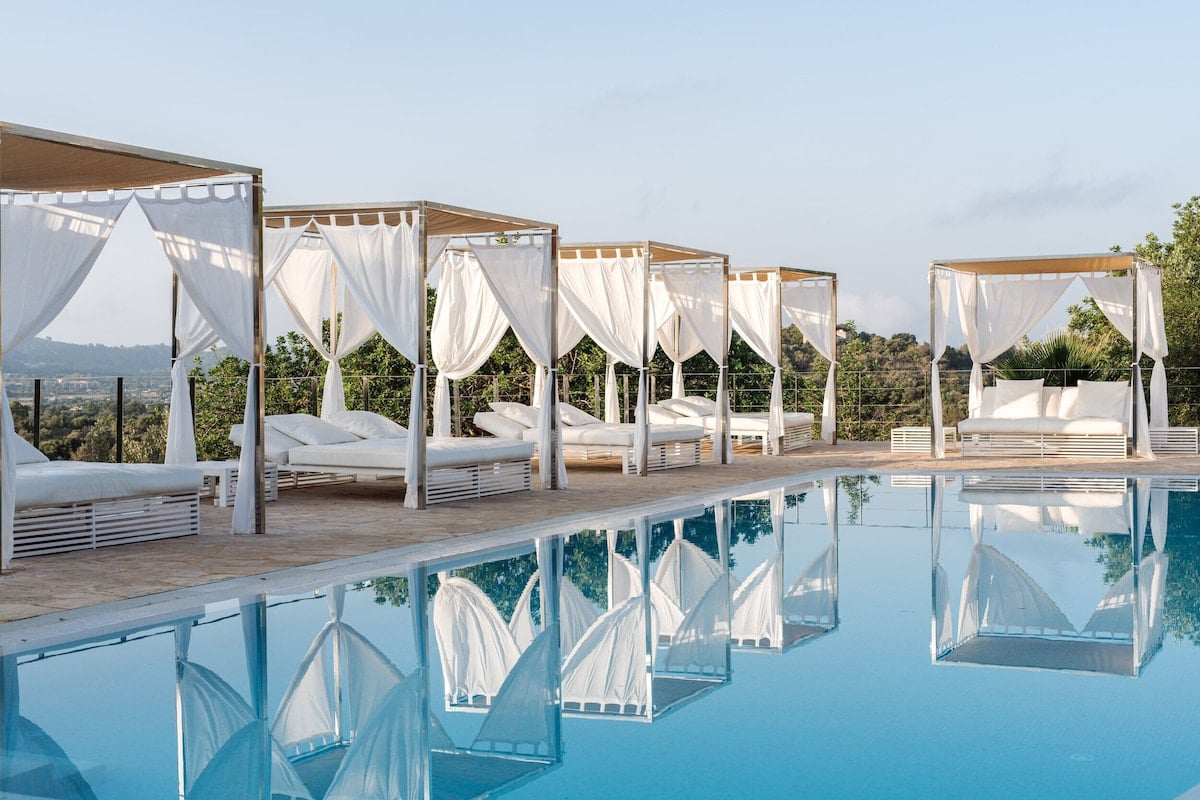
This is a place of profound, intentional silence. With only twenty rooms and an adults-only spa, the loudest sound is often the rustle of wind through the olive leaves or the distant bleating of sheep. It draws a specific tribe: the Berlin gallerist and her partner who book their table at Andreu Genestra before their flights; the couple from Zurich who spend their afternoons debating the merits of Mallorcan olive varietals. They are refugees from the see-and-be-seen beach clubs, people who understand that true restoration is not about distraction, but its absence. They come for the whitewashed spa, not for a scene, but for a lomi-lomi massage that unknots the tension of a thousand emails, followed by an afternoon spent motionless on a muslin-draped daybed by the infinity pool.
The estate's restaurant is where the philosophy of the place crystallizes. Many Mallorcan agroturismos gesture towards a connection to the land; here, it’s an unbroken circuit. The hotel’s own extra-virgin olive oil comes from this land. You taste its peppery, assertive character on breakfast toast, in the foundation of the kitchen’s dishes, and you understand the difference between marketing and agriculture. Dinner shifts with the season: in summer, it’s a terrace affair under a theatre of stars, the tables set with flickering candles; in the cooler months, the service moves inside the glass-walled dining room, framing the groves like a living painting. The meal should end with one thing: the lemon sorbet laced with cava. It’s not an afterthought but a thesis statement—a bright, sharp expression of the island’s citrus that speaks a more honest language than any imported chocolate fantasy.
Let’s be clear: this is not a beach hotel. The coast is three kilometres away, and the nearest stretches of untamed sand, Cala Torta and Cala Mesquida, require a car. This is the essential trade-off. You are exchanging walk-to-the-beach convenience for an authentic immersion in the island’s rural heartland. Your rental car is not an option; it is a lifeline, your key to the wild coves and the constellation of culinary temples nearby. The evening’s debate is not if you’ll eat well, but where you will make your pilgrimage. Will it be Andreu Genestra’s tasting menu, or the challenging, brilliant one at Zaranda? The hotel is a serene launchpad for a gastronomic tour of the island’s most formidable kitchens.
Your days fall into a rhythm governed by light. You wake early, the air still cool, and walk up to the walls of Capdepera’s castle to watch the sun burn the morning mist off the sea. The afternoon is for the pool, for reading a book from cover to cover without interruption. As dusk settles, painting the sky in shades of apricot and lavender, you feel the decompression complete. You are no longer just a visitor. You are a quiet observer of the land, a participant in its cycles. On your last morning, as you pack your bags, the memory that lingers is not of a grand view or a lavish amenity, but of the taste of that olive oil and the feeling of that immense, restorative silence. You are leaving not just a hotel, but a piece of functioning, breathing Mallorca that most people will never find.
FACTS
- Neighbourhood: Capdepera
- Stars: 4
- From 180 EUR per night
- Tripadvisor: 4.4/5 (249)
- 39.7101, 3.468
FAQ
When is the best time to visit?
The season reopens in late March after the winter closure. April and May offer lingering almond blossom along the edges and full pool access without the occupancy pressure of high summer.
Anything I should know before booking?
The hotel welcomes families with children — it is not an adults-only property despite the remote finca atmosphere. The pool is shared by all guests during high season.
What is the neighbourhood like around Cases de Son Barbassa?
Cases de Son Barbassa sits 3 kilometres from the coast, within the Parc Natural de Llevant on Mallorca's north-east coast. Capdepera's medieval castle is reachable by car, as are the beaches of Cala Mesquida and Cala Agulla — both among the island's least developed.
MORE HOTELS IN Mallorca
- AluaSoul Mallorca Resort — Adults Only — Cala Egos / Cala d'Or
- Barefoot Hotel Mallorca — Portocolom
- Bikini Island & Mountain Hotel Es Trenc — Adults Only — Colonia Sant Jordi
- Bikini Island & Mountain Hotel Port de Sóller — Port de Sóller
- Blau Colònia Sant Jordi Resort & Spa — Colonia Sant Jordi / Ses Salines
- Bordoy Alcúdia Port Suites — Port d'Alcúdia