Hotel Tres
Old Town Palma, Mallorca · flagship
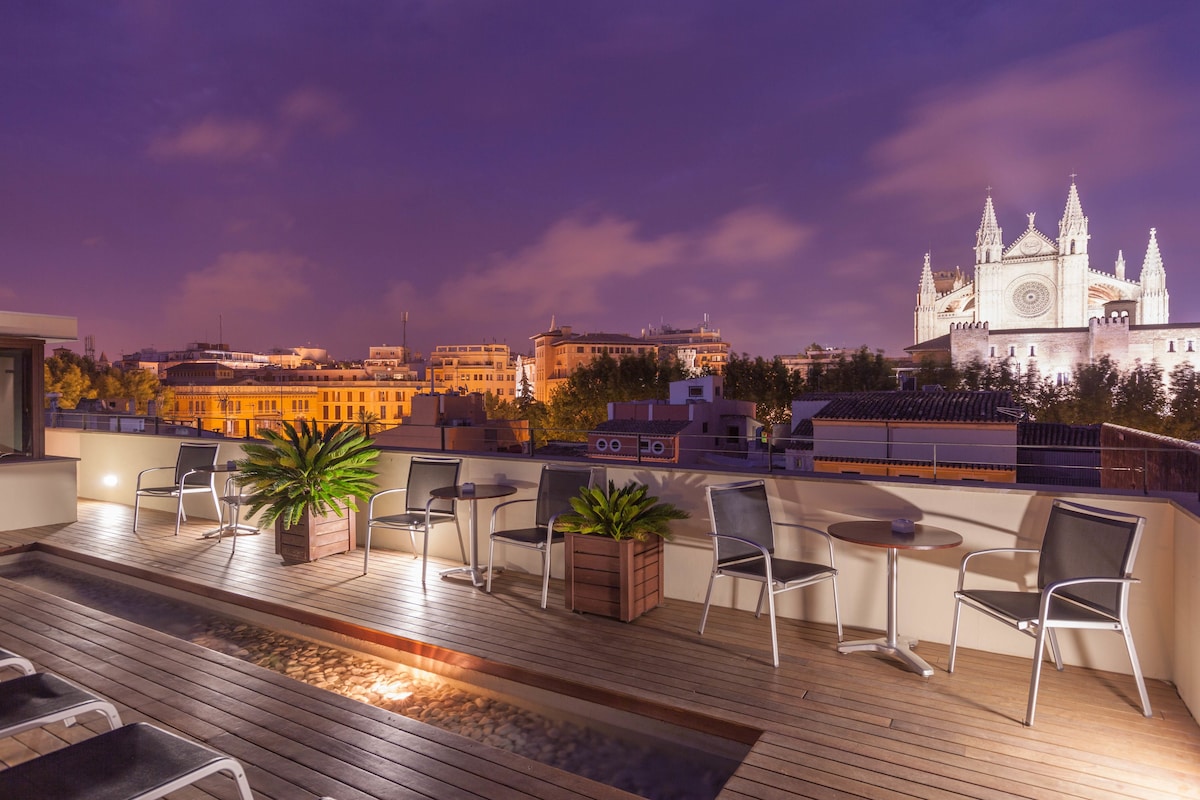
THE VIBE
The sixteenth-century palace Can Mayol in La Llotja — sandstone arches, an open courtyard and 41 rooms in the block where Palma's most serious restaurant scene congregates.
THE BACKSTORY
Can Mayol was built in the sixteenth century as a Mallorcan noble palace in the blocks surrounding La Llotja — the Gothic exchange hall that still dominates the waterfront. The property was later joined with a neighbouring 1960s building and underwent a complete renovation in 2015 under the Petit Palace group. The original elements — open-beam ceilings, a cortile courtyard with palm trees and sandstone arcade arches — have been preserved and woven together with contemporary interiors.
WHY NOW
The Petit Palace group completed a full renovation of the property in 2015 and has kept the profile sharp ever since. La Llotja is the city's gastronomic centre in 2026, with three Michelin stars within walking distance — Marc Fosh, DINS Santi Taura and Zaranda.
THE ROOM
Luxury Suite with rooftop terrace — private terrace with jacuzzi and hammocks on the top floor.
WELLNESS
Sauna with views over Palma Cathedral and a sun terrace with pool on the rooftop. A fitness centre is located within the property.
THE TABLE
The hotel's own restaurant in the historic palace room — serving breakfast and dinner — Restaurante Tres. Hotel-run and situated in the palace's original rooms; the easiest option for late arrivals.
THE SERVICE
The Petit Palace group's standard package includes free WiFi, a MiFi device to take out, and bicycle hire — including e-bikes — at no extra charge.
THE NEIGHBORHOOD
La Llotja is Palma's most concentrated neighbourhood for restaurants and wine bars. The hotel sits at Carrer dels Apuntadors 3 — the street leads directly down to the Gothic exchange hall La Llotja at the harbour. Marc Fosh (1 Michelin star) is at Calle de la Missió 7A; Zaranda (1 Michelin star, Hotel Es Princep) at Carrer Bala Roja 1.
HONEST CAVEAT
Carrer dels Apuntadors is a narrow cobblestone street with no car access all the way to the door. A rolling suitcase and cobblestones are not a happy combination — book a transfer or pack light.
THE VERDICT
Petit Palace Hotel Tres is not a design hotel that happens to be well located — it is a location hotel with enough history to justify the premium. 41 rooms means limited category choice; the rooftop terrace and sauna deliver more than the price suggests. Choose it for Palma logistics, not for service theatre.
THE FULL PICTURE
Arriving at Hotel Tres is a process of reduction, a shedding of layers. The taxi negotiates the final metres with the surgical precision required in Palma’s Old Town, where streets narrow from avenues to whispers. You step from the sun-bleached, honeyed heat of the Carrer de la Apuntadors across a worn threshold and into a coolness that feels ancient. This is not a lobby in the conventional sense; there is no grand reception plinth or a superfluous concierge. It is, instead, a receiving room, a *sala*, where 16th-century sandstone arches meet the clean lines of a Scandinavian design ethos. A single Børge Mogensen chair stands sentinel, a silent invitation to pause. Check-in is handled at a discreet, dark-wood desk, a conversation rather than a transaction. The air is still, scented with the subtle perfume of dry stone, beeswax, and perhaps the faintest clean note of lavender drifting from the central patio. It’s here that you grasp the hotel’s intent: this is not a place to be seen, but a place to be. A place where the weight of history has been deliberately lightened, not erased, to create a canvas for quiet, contemporary existence.
The interiors are a masterclass in restraint. The 41 rooms are split between the original palace building and a more modern wing, but the transition is almost seamless. My room, facing the quiet interior courtyard, is a study in texture. The original timber ceiling beams, dark and saturated with centuries, are set against the white linen curtains that billow softly in the slight breeze. The floors are polished concrete, cool underfoot, and the walls are of local Marès stone, their porous surface catching and softening the particular Mallorcan light. The lighting is deliberate, with fixtures from Santa & Cole casting warm, focused pools that highlight a curated book or a piece of sculptural hardware. The crowd that moves through these spaces is as curated as the decor. These are the kind of travellers who have graduated from ostentatious logos; architects from Antwerp, gallerists from Berlin, a Copenhagen couple who own a furniture store. They are dressed in muted linens and cottons, their conversations low and conducted over glasses of local Verdejo in the shade of the patio’s palm trees. They are here for the fabric of the city, to visit the Fundació Miró or get lost in the Gothic alleyways, and Hotel Tres is their discreet, architecturally-minded base.
But the rooftop terrace is the hotel’s climax, its elevated manifesto. The journey to it is part of the experience, up a narrow staircase that winds past the uppermost floors, each step a removal from the muted hum of the city. When you emerge into the open, you are met not with a blast of noise, but with space. The view is a revelation. La Seu Cathedral dominates the skyline, not as a distant postcard icon, but as a tangible, breathing presence. You are close enough to discern the intricate detail on its Gothic buttresses, to see the way the sunlight fractures through the vast rose window. By day, the terrace is a sun-drenched pocket with a small plunge pool, its cobalt water shimmering against the terracotta tiles. The soundscape is a mosaic of city life: the distant thrum of the port, the rhythmic clang of a church bell, and the sharp, piercing cry of the swifts as they dive and wheel against the azure sky. At dusk, the space transforms. The light turns soft and amber, casting long shadows across the rooftops. The cathedral is illuminated from within, a golden vessel sailing on a sea of twilight. It is up here, with a glass of chilled Hierbas de Mallorca in hand, that you feel the city’s pulse in a way that is profound and personal.
Yet no place is without its quirks, and Hotel Tres is no exception. Let’s be frank: the heart of the hotel is its central, light-filled courtyard, an architectural necessity that brings light and air into the inward-facing rooms. It is where breakfast is served, where guests gather for coffee or an aperitivo. This communal nature, while beautiful, means that sound has a tendency to travel. The low murmur of a late-night conversation from a table, the discreet clink of cutlery on porcelain in the early morning—these sounds can drift into the courtyard-facing rooms. For the ultra-sensitive sleeper, this might register as a slight disturbance, a small tear in the otherwise serene cocoon. It is not a flaw, but rather an inherent characteristic of a building designed to breathe and live. It is the trade-off for the intimate, almost village-like atmosphere. Those seeking absolute, sound-proofed seclusion might request a room on the outer wing. For me, however, it was part of the charm, a subtle reminder that I was in a living, breathing building in the heart of a living city.
Leaving Hotel Tres feels less like checking out and more like being let go from a well-kept secret. I spent my final morning on the rooftop, watching the first light hit the cathedral’s sandstone, a daily ritual that felt both monumental and deeply private. As I rolled my suitcase over the uneven cobblestones outside, back into the city’s vibrant embrace, it wasn’t the memory of a room or a meal I carried with me. It was the palpable sense of the place. The feeling of cool stone underfoot, the sound of swifts cutting through the air, the sight of a Gothic spire framed by a modern casement window. Hotel Tres is not a destination in itself; it is a lens, a perfectly calibrated instrument through which to experience the soul of Palma. You don’t leave feeling like you were a tourist, but with the quiet satisfaction of having been a temporary resident, a part of the city’s texture, if only for a few, well-designed days.
FACTS
- Neighbourhood: Old Town Palma
- Stars: 4
- From 320 EUR per night
- Tripadvisor: 4.6/5 (1134)
- 39.57, 2.651
FAQ
When is the best time to visit?
The Petit Palace group completed a full renovation of the property in 2015 and has kept the profile sharp ever since. La Llotja is the city's gastronomic centre in 2026, with three Michelin stars within walking distance — Marc Fosh, DINS Santi Taura and Zaranda.
Anything I should know before booking?
Carrer dels Apuntadors is a narrow cobblestone street with no car access all the way to the door. A rolling suitcase and cobblestones are not a happy combination — book a transfer or pack light.
What is the neighbourhood like around Hotel Tres?
La Llotja is Palma's most concentrated neighbourhood for restaurants and wine bars. The hotel sits at Carrer dels Apuntadors 3 — the street leads directly down to the Gothic exchange hall La Llotja at the harbour. Marc Fosh (1 Michelin star) is at Calle de la Missió 7A; Zaranda (1 Michelin star, Hotel Es Princep) at Carrer Bala Roja 1.
MORE HOTELS IN Mallorca
- AluaSoul Mallorca Resort — Adults Only — Cala Egos / Cala d'Or
- Barefoot Hotel Mallorca — Portocolom
- Bikini Island & Mountain Hotel Es Trenc — Adults Only — Colonia Sant Jordi
- Bikini Island & Mountain Hotel Port de Sóller — Port de Sóller
- Blau Colònia Sant Jordi Resort & Spa — Colonia Sant Jordi / Ses Salines
- Bordoy Alcúdia Port Suites — Port d'Alcúdia