Hotel Born
Old Town Palma / Born, Mallorca · heritage
THE VIBE
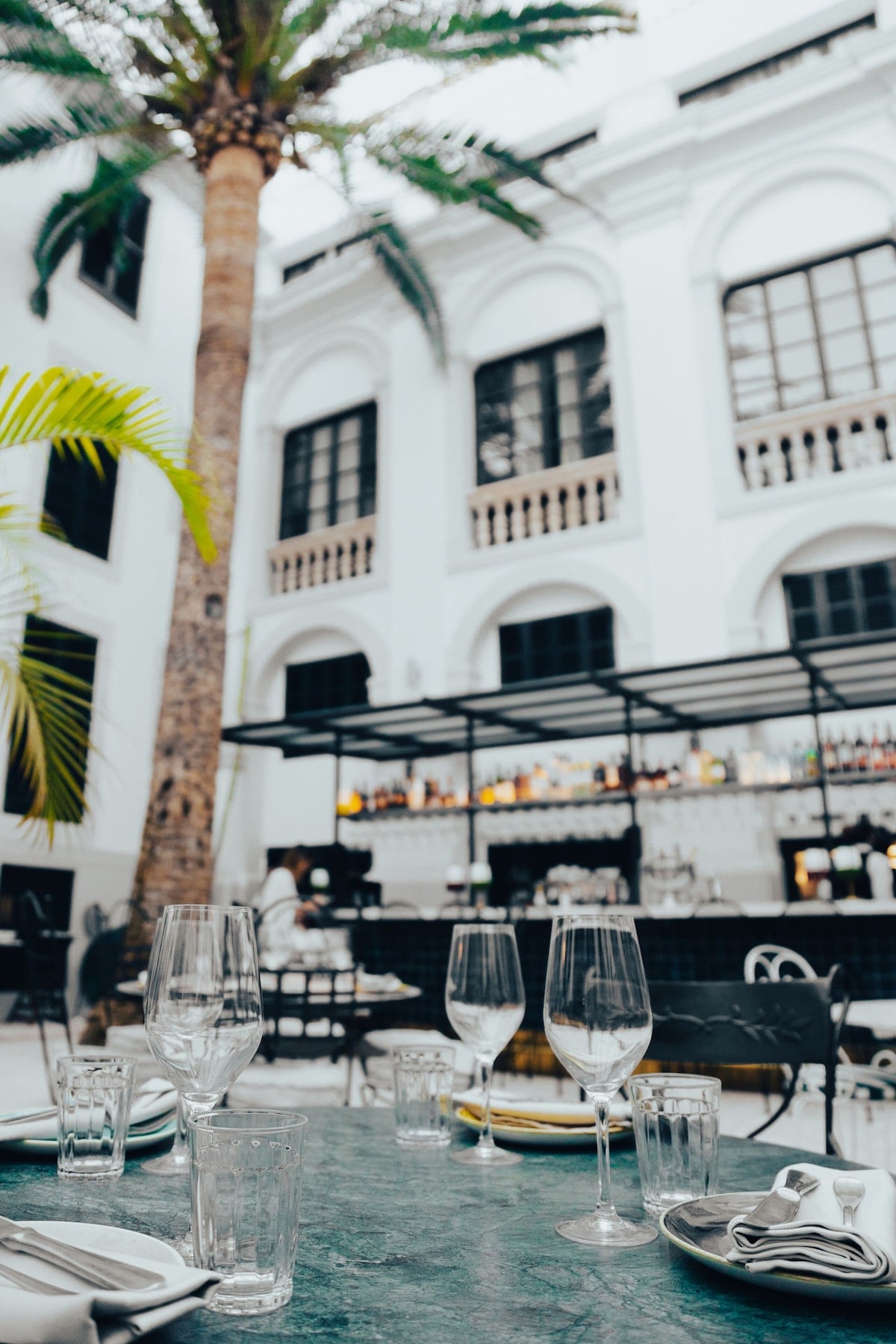
A 16th-century palace in Palma's old town: an arcaded courtyard, red marble columns and a breakfast served beneath ancient palms.
THE BACKSTORY
The palace at Carrer de Sant Jaume 3 was built in the 16th century as the seat of the Marquises of Ferrandell and is also known as Can Maroto. An 18th-century restoration added the enclosed courtyard in the Mallorcan patio style. In 1993 the property underwent a complete transformation from hostel to hotel — a process that kept the original structure and the arcade of red marble columns intact.
WHY NOW
Autumn 2026 gives Hotel Born its finest hour — sun without summer heat, empty lanes and reasonable rates. The palace courtyard acts as its own microclimate: calm when the street outside is buzzing.
THE ROOM
Ask for a room facing the courtyard on the upper floors — daylight reaches in and the palm canopies are visible from the window. The hotel has no lift; avoid the ground floor if you prefer natural light.
THE TABLE
Chargrilled dishes with seasonal Spanish produce — La Bodeguilla. Independent wine restaurant (Grupo Amida) in the same building — Carrer de Sant Jaume 3 — since 1986. Recommended in the Michelin Guide 2026, no star but recognised for over 300 Spanish and international wine references and produce-driven Spanish-Mediterranean cooking.
THE SERVICE
The breakfast buffet is served in the courtyard beneath the palms — not room service, not a buffet hall, but an actual square within the palace walls. It is the closest you will get to old Palma without renting a private residence.
THE NEIGHBORHOOD
Carrer de Sant Jaume, Old Town, Palma. Passeig des Born within a short walk to the north. The cathedral La Seu and the Almudaina Palace reachable on foot. Narrow stone lanes thin out tourist traffic at night.
HONEST CAVEAT
No lift in the palace, and the historic masonry does not keep out sound — the courtyard's atmosphere drifts into the rooms late in the evening.
THE VERDICT
The Marquises of Ferrandell's 16th-century palace, restored in 1993 from a hostel to a hotel with minimal intervention in the original fabric. No coddling amenities — no lift, no oversized bathrooms — but the courtyard and the stone staircase deliver the authenticity that newly built boutique hotels pay five times more to simulate.
THE FULL PICTURE
You don’t check into Hotel Born; you slip through a crack in time. From the clamor of Palma’s Old Town, you push open an anonymous wooden door on Carrer de Sant Jaume and the 21st century falls away. The air changes first. It’s cooler here, carrying the scent of old stone and the faint, green perfume of the plants in the central courtyard. This is the hotel’s heart and its lung, an arcaded space of profound calm that organizes the entire experience. Your arrival is not a transaction at a reception desk but a slow decompression as your footsteps echo on the worn flagstones, your eyes adjusting to the dappled light falling into the patio.
This was once the town mansion of the Marquis of Ferrandell, built in the 16th century and remodelled in the 18th, and it feels less like a hotel and more like you’ve been given a key to a private residence that has gracefully surrendered to age. There is no renovation gloss. The grand stone staircase that sweeps up from the courtyard is meant for hands to trace its cool, smooth rail. The stone columns are not polished to a contemporary sheen; they hold the gravitas of centuries. The crowd here understands this. They are architects from Antwerp, quietly sketching the courtyard’s arches into Moleskine notebooks; they are novelists from Edinburgh who have come to finish a difficult chapter and appreciate that the wi-fi is merely adequate. They are couples who find romance not in a rose-petal turndown, but in the shared silence of a space that has outlasted generations. They choose this place precisely because it lacks a rooftop pool or a thumping lobby bar.
The rooms continue this monastic narrative. Parquet floors creak with a reassuring authority underfoot. The furniture is dark, solid, Mallorcan, built for purpose, not for a design magazine. There is no art on the walls because the view from the window—of a sun-bleached wall opposite, of a slice of terracotta roof against a cobalt sky—is the intended focus. At 7 a.m., you open the wooden shutters not to a grand sea view, but to the intricate, intimate theatre of Palma’s medieval lanes waking up.
And here is the necessary caveat, the trade-off for this immersion. The hotel’s serenity is an internal state. The rooms facing the street are not immune to the city. You will hear the rumble of a delivery cart over cobblestones before dawn, the animated debate from the wine bar across the lane just after midnight. To stay here is to accept the pulse of the living city as part of the soundtrack. The prize is a room facing the courtyard, where the only sound is the murmur of the patio. If your definition of quiet requires hermetic sealing, look elsewhere.
Breakfast is the daily ritual that grounds you in the hotel’s history. Served in the courtyard, it’s an unhurried affair. The clink of a silver spoon against a porcelain cup, the murmur of Italian and French, the aroma of strong coffee and toasted ensaimada. It is a buffet, but an unhurried one that feels like a private morning meal hosted by the long-gone marquis. This moment alone justifies the stay. From here, the day unspools. A short walk brings you to the glorious chaos of the Mercat de l'Olivar, a sensory assault of glistening fish, pyramids of oranges, and the sharp scent of sobrassada. A four-minute stroll in the other direction and you’re on the Passeig del Born, Palma’s elegant promenade, a prelude to the seven-minute pilgrimage to La Seu Cathedral. You don’t just see the cathedral; you feel its immense, sandstone weight pull you in, a reckoning with faith and ambition that dwarfs the postcard snapshots.
When evening descends, the narrow lanes around the hotel, which felt congested by day, empty out into a conspiratorial quiet. The city is yours now. Forget the Michelin-starred tasting menus for a night. Under 100 metres from the hotel’s door is La Bodeguilla, a long-standing institution where the real Palma congregates. You go for a plate of grilled octopus with aromatic herbs, glistening with olive oil, and let the staff guide you through a flight of local wines from a long list. This is not a meal; it is a conversation with the island. You return to Hotel Born, the taste of salt and wine still on your tongue, push open that heavy door, and re-enter the stillness. The departure feeling is not one of leaving a hotel, but of being gently expelled from a dream. You carry the memory of the courtyard’s quietude with you, a small, preserved pocket of time against the noise of the world you’re returning to.
FACTS
- Neighbourhood: Old Town Palma / Born
- Stars: 4
- From 200 EUR per night
- Tripadvisor: 4.2/5 (745)
- 39.5703, 2.6527
FAQ
When is the best time to visit?
Autumn 2026 gives Hotel Born its finest hour — sun without summer heat, empty lanes and reasonable rates. The palace courtyard acts as its own microclimate: calm when the street outside is buzzing.
Anything I should know before booking?
No lift in the palace, and the historic masonry does not keep out sound — the courtyard's atmosphere drifts into the rooms late in the evening.
What is the neighbourhood like around Hotel Born?
Carrer de Sant Jaume, Old Town, Palma. Passeig des Born within a short walk to the north. The cathedral La Seu and the Almudaina Palace reachable on foot. Narrow stone lanes thin out tourist traffic at night.
MORE HOTELS IN Mallorca
- AluaSoul Mallorca Resort — Adults Only — Cala Egos / Cala d'Or
- Barefoot Hotel Mallorca — Portocolom
- Bikini Island & Mountain Hotel Es Trenc — Adults Only — Colonia Sant Jordi
- Bikini Island & Mountain Hotel Port de Sóller — Port de Sóller
- Blau Colònia Sant Jordi Resort & Spa — Colonia Sant Jordi / Ses Salines
- Bordoy Alcúdia Port Suites — Port d'Alcúdia