Cap Rocat
Cala Blava, Mallorca · imperial
THE VIBE
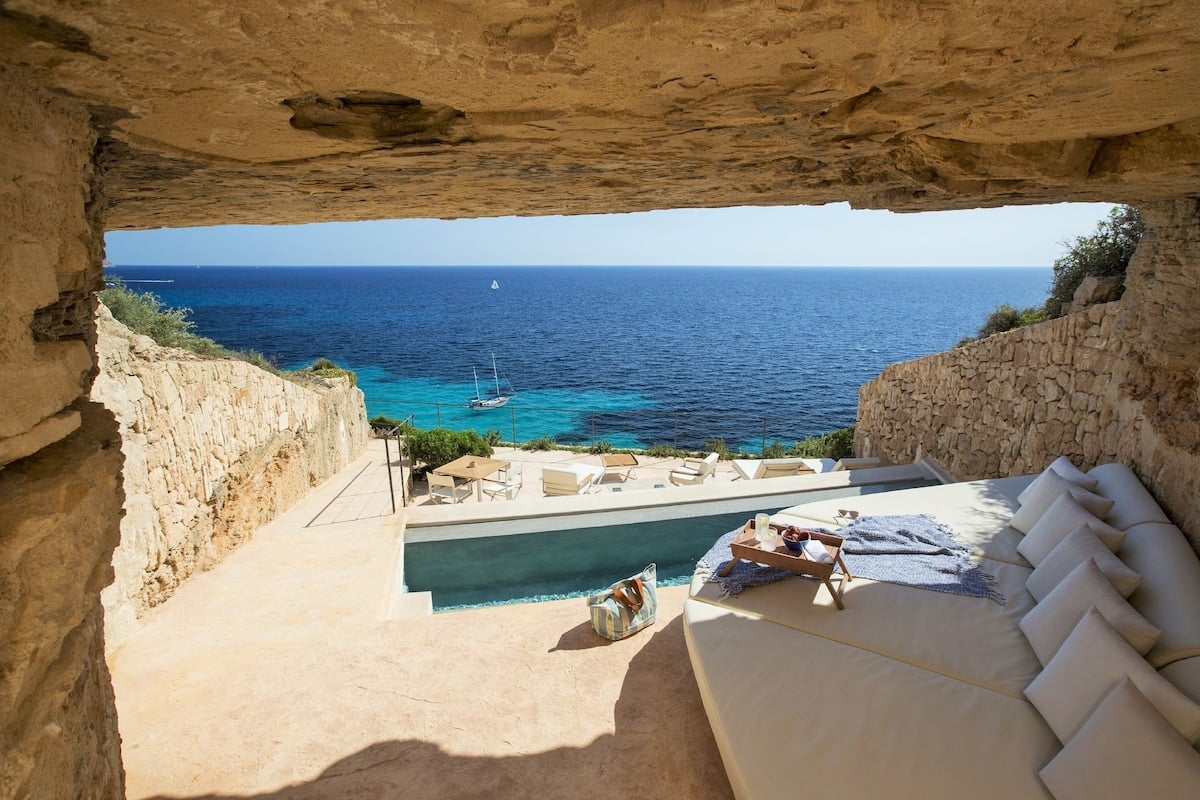
An 1898 coastal fort hewn from limestone — 30 rooms, a private peninsula, two restaurants and a spa twelve metres underground.
THE BACKSTORY
Fort de Cap Enderrocat was erected in 1898 as part of Palma's coastal defences after Spain lost Cuba and the Philippines — the island's largest fortress, hewn from the limestone cliff, never used in combat. From the 1980s it lay abandoned. Antonio Obrador, architect and owner, carried out a fifteen-year restoration that was awarded the Europa Nostra Prize, the Hispania Nostra Prize and the Fortress Study Group Prize. The hotel opened on 18 June 2010.
WHY NOW
La Fortaleza, the hotel's 30-seat dinner restaurant in the former troops' mess hall beneath the limestone vault, is led by chef Víctor García, holder of two Repsol Suns since 2019. The season closes in mid-November — the last open window before the winter rest is September and October, when the peninsula's light is at its sharpest and reservations are still available.
THE ROOM
The Sentinels category rooms are built directly into the fort's gun embrasures along the cliff edge — private terrace, no visible neighbours in any direction, unobstructed views across the Bay of Palma.
WELLNESS
The spa is excavated twelve metres underground in the fort's original water reservoir — an indoor pool in saltwater beneath a glass-ceiling landscape, hammam rituals and Shibori treatments with floating massage beds. Natural light through skylights; no visible walls on the upper level.
THE TABLE
The tasting menu with Mallorcan produce — local fish and shellfish, traditional recipes from the island's kitchen — La Fortaleza (the hotel's own restaurant). Chef Víctor García, two Repsol Suns since 2019, serves dinner for a maximum of 30 guests in a limestone hall with colonial porcelain and candlelight — summer evenings on the fortress rooftop overlooking the Bay of Palma. Hotel-operated, no external ownership.
THE SERVICE
Each morning the hotel offers a personal trainer included in the stay — one of the few luxury hotels on the island where fitness is part of the core package rather than an add-on.
THE NEIGHBORHOOD
Cala Blava, Carretera d'Enderrocat s/n — a protected peninsula 8.5 kilometres from Palma Airport (approximately 20 minutes by car). The hotel is surrounded by a 30-hectare nature reserve with 2 kilometres of private coastline. The nearest service town lies to the south; there is no walkable centre in the immediate vicinity.
HONEST CAVEAT
The hotel does not accept guests under 15 years of age, closes from mid-November to March and has no sand beach — sea access is via the rock platform at the Sea Club.
THE VERDICT
Fort de Cap Enderrocat was built in 1898 and never used in combat; Antonio Obrador's fifteen-year conversion project (Europa Nostra Prize laureate) has made the military architecture the hotel's central argument rather than its background scenery. For those who prioritise architectural radicality and complete seclusion over a beach holiday, there is nothing comparable on the island.
THE FULL PICTURE
You don’t check into Cap Rocat; you surrender to it. The approach is the first part of the negotiation, a private road that winds through the protected coastline of Cala Blava, shedding the last vestiges of Palma’s hum. Then, the fortress appears. Not as a hotel, but as a colossal military installation from the 19th century, carved into a limestone peninsula with severe, uncompromising lines. Crossing the drawbridge feels less like an arrival and more like a willing act of disappearance. The world, with its demands and its noise, is left on the other side. The contract is implicit: you have come here for silence, for a seclusion so profound it borders on the monastic, and the fortress will hold you to that promise. This is a redoubt for couples who have exhausted the performative romance of the Amalfi Coast and now seek something authentic, something that doesn't need an audience. It's for the London barrister celebrating a landmark victory not with champagne-soaked parties, but with three days of absolute quiet, punctuated only by the sound of the Mediterranean shaping the cliffs below.
Your quarters are not rooms; they are repurposed infrastructure of war. The Cap Rocat Sentinels, carved from former cannon emplacements, are studies in textural restraint—cool, rough-hewn stone walls, heavy white linens, and private patios that open directly onto the fortress’s edge. At 8 AM, there is no knock, only the quiet placement of a wicker basket on your terrace, bearing flaky ensaïmadas, local cheeses, and freshly squeezed orange juice. You take your coffee watching the sun climb over the Bay of Palma, a view once reserved for sentries scanning the horizon for enemy ships. The day’s central question is the descent to the water. The way down ends at the Sea Club at the water’s edge, above a sliver of impossible turquoise. The water is cool, saline, and startlingly clear. You swim out into the bay, turning back to see the fortress looming above, a golden bulwark against the world you’ve momentarily escaped. This is the rhythm of Cap Rocat: a slow, deliberate oscillation between the sun-baked stone of your private terrace and the cool embrace of the sea.
Let’s be brutally honest. This magnificent isolation is also the hotel’s defining limitation. Cap Rocat is not a base for exploring Mallorca; it is the destination in its entirety. The desire for a casual stroll to a tapas bar, for the spontaneous energy of a village market, will be met with the logistical reality of the fortress gates. Leaving feels like a campaign, a deliberate extraction from your self-imposed exile. The island’s celebrated culinary landscape—the ambitious tasting menus at Zaranda or Marc Fosh, the rustic genius of the Solivellas sisters at Ca Na Toneta—exists in another dimension, a choice forgone in favor of this hermetic existence. Furthermore, the property is a physical commitment. It’s a fortress, not a beach resort; expect uneven stone pathways, long walks to the sea, and countless stairs. The silence, too, can be unnerving. It is not the gentle peace of a country retreat but an absolute, profound quiet that can feel crushing if you are not prepared for its weight.
The emotional climax of your stay, the moment that justifies the pilgrimage, takes place at dusk. Dinner is at La Fortaleza, and your table—arguably the most dramatically situated on any Mediterranean island—is set within the walls of the fortress, high above the sea. The experience is engineered for two. As the sky bleeds from orange to indigo, the meal begins. Chef Víctor García’s cooking leans on the island’s fish and produce, and it tastes of its specific location, a distillation of the sea air, the mineral tang of the rock, and the island’s epicurean soul, served in a place of singular power. This is not merely a meal; it is the entire purpose of your stay rendered on a plate.
Departure is a reentry. As you cross back over the drawbridge, the sounds of the world rush back in—the engine of the car, the distant traffic, the chatter of a mobile phone. They feel alien, intrusive. The memory you take from Cap Rocat isn’t of a particular view or a specific taste, but of the quality of the silence you inhabited. You leave with the quiet still echoing inside you, a new baseline against which the noise of ordinary life will be measured. You didn’t just stay in a fortress; you were garrisoned by it, protected for a few precious days from everything beyond its formidable limestone walls.
FACTS
- Neighbourhood: Cala Blava
- Stars: 5
- From 800 EUR per night
- Tripadvisor: 4.6/5 (532)
- 39.3513, 2.7725
FAQ
When is the best time to visit?
La Fortaleza, the hotel's 30-seat dinner restaurant in the former troops' mess hall beneath the limestone vault, is led by chef Víctor García, holder of two Repsol Suns since 2019. The season closes in mid-November — the last open window before the winter rest is September and October, when the peninsula's light is at its sharpest and reservations are still available.
Anything I should know before booking?
The hotel does not accept guests under 15 years of age, closes from mid-November to March and has no sand beach — sea access is via the rock platform at the Sea Club.
What is the neighbourhood like around Cap Rocat?
Cala Blava, Carretera d'Enderrocat s/n — a protected peninsula 8.5 kilometres from Palma Airport (approximately 20 minutes by car). The hotel is surrounded by a 30-hectare nature reserve with 2 kilometres of private coastline. The nearest service town lies to the south; there is no walkable centre in the immediate vicinity.
MORE HOTELS IN Mallorca
- AluaSoul Mallorca Resort — Adults Only — Cala Egos / Cala d'Or
- Barefoot Hotel Mallorca — Portocolom
- Bikini Island & Mountain Hotel Es Trenc — Adults Only — Colonia Sant Jordi
- Bikini Island & Mountain Hotel Port de Sóller — Port de Sóller
- Blau Colònia Sant Jordi Resort & Spa — Colonia Sant Jordi / Ses Salines
- Bordoy Alcúdia Port Suites — Port d'Alcúdia