Convent de la Missió
Old Town Palma, Mallorca · flagship
THE VIBE
A 17th-century convent in the heart of Palma's old town — 27 rooms in Mallorcan baroque stone, Marc Fosh's Michelin star on the ground floor and a spa in the former crypt.
THE BACKSTORY
The building was erected in the 17th century by the Catholic Church as a missionary school — an educational centre for prospective missionaries bound for Spain's colonies in the Americas. For three centuries, Mallorcan baroque in marès stone and strict proportions defined life in the streets around Carrer de la Missió. In 2005 the Mallorcan family group Torre de Canyamel acquired the property and began its conversion into a boutique luxury hotel. Today the hotel has been a member of Historic Hotels Worldwide since 2025.
WHY NOW
Marc Fosh retains his star in the 2026 Michelin Guide España, with a new lunch menu ADN at €69. It is rare for a hotel of this size to sustain gastronomic standards year after year.
THE ROOM
Junior Suite or above — the interior atrium rooms have no natural daylight. Ask specifically for a street-view or top-floor terrace room at the time of booking.
WELLNESS
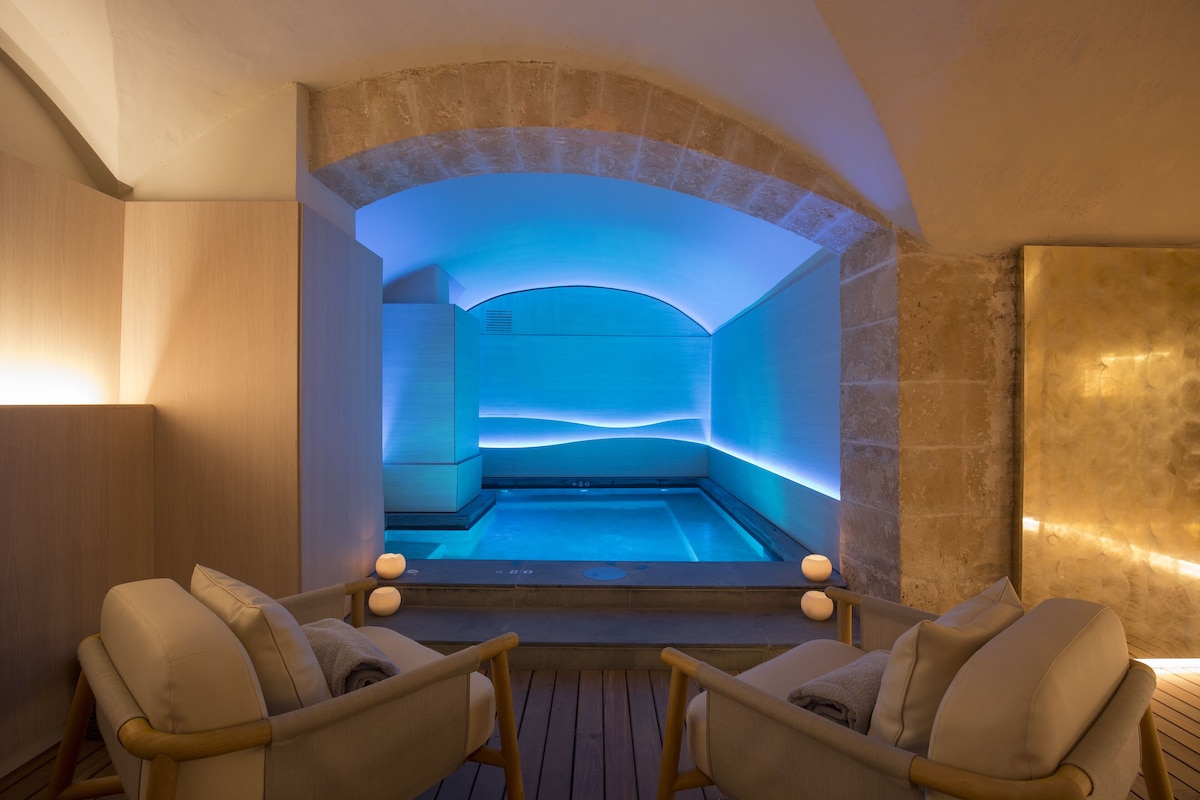
The spa occupies the building's former crypt: a heated indoor pool with water loungers, sauna, jacuzzi and treatment rooms offering massage, facials and exfoliation. The space can be booked for exclusive use. On the roof there is an outdoor pool — heated during cooler months — with sun loungers.
THE TABLE
Lunch menu ADN — five courses with a seasonal Mediterranean profile from Fosh's own farm — Marc Fosh. The hotel's own restaurant, run by Marc Fosh since 2009, holds 1 Michelin star in the 2026 guide. The lunch menu ADN at €69 is the entry point; the evening Marc Menu is €139. The restaurant occupies the hotel's ground floor.
THE SERVICE
The spa in the preserved crypt is available for exclusive use — a heated indoor pool, sauna and massage treatments in a room whose ceiling has stood since the 17th century.
THE NEIGHBORHOOD
Carrer de la Missió 7A, in Palma's old town (Casco Antiguo). The cathedral La Seu is within walking distance to the north; Passeig del Born with its cafés and shops lies to the south of the hotel. The old town is surrounded by narrow lanes in marès stone. The nearest commuter rail connections are at Plaça d'Espanya. Approximately 15 minutes by car from the airport.
HONEST CAVEAT
The adults-only hotel does not admit guests under 16. Breakfast is not included in the base rate at all booking levels — confirm at the time of booking.
THE VERDICT
Convent de la Missió is the only 5-star GL hotel in Palma's old town with a Michelin star under the same roof — a combination that rarely holds in this segment. The hotel's 27 rooms are few and the suite ratio high; book a Junior Suite or above to avoid interior atrium rooms without natural light. For culture-driven travellers who prioritise gastronomic integrity over pool palaces, this address is without equal in Palma.
THE FULL PICTURE
Finding the Convent de la Missió is the first part of the initiation. The taxi deposits you near the top of La Rambla, and from there, you are on foot, a pilgrim in the 21st century. You pull your wheeled case over the worn, golden flagstones of Palma’s Old Town, navigating a warren of alleys so narrow you can touch both walls at once. The air is thick with the scent of sun-baked stone and the distant sizzle of frying garlic from a hidden kitchen. Then, you see it: Carrer de la Missió. The hotel’s entrance is an exercise in monastic discretion—a heavy, studded wooden door set into an austere façade. To cross the threshold is to feel a palpable drop in temperature and a shift in time. The city’s clamor is instantly muffled, replaced by the hushed reverence of a space that has held secrets for four centuries. There is no grand, performative lobby; instead, you enter a soaring, white-walled atrium where light pools and contemporary art—a bold splash of color here, a challenging sculpture there—engages in a silent, centuries-long conversation with the original 17th-century architecture.
The atmosphere within these hallowed walls is one of composed quietude. The people who choose the Convent are not here for the scene; they are here to escape it. You won’t find influencers staging photoshoots by the courtyard fountain. Instead, you see a gallerist from Berlin, dressed in severe black linen, sketching in a Moleskine. A Parisian couple, both architects, quietly debate the genius of the load-bearing arches over breakfast. They carry well-read paperbacks, not beach bags. Their quiet confidence is the currency here, an unspoken understanding that true luxury isn’t about being seen, but about the quality of the space in which you are unseen. The design reinforces this. It is a masterclass in restraint, where ancient sandstone pillars and vaulted ceilings are the heroes, accented by judiciously placed pieces of modern furniture—a leather Wassily chair, a minimalist Italian floor lamp—that feel less like decoration and more like curated artifacts. Light is the primary medium, slanting through high, arched windows, tracing the passage of the day across the cool stone floors.
The defining sensory note of the Convent is not a scent you can bottle, but a complex chord. It’s the mineral coolness of ancient stone, the faint, waxy perfume of polished wood, and an undercurrent of something ecclesiastical and clean, like frankincense and dried lavender. It’s the smell of stillness. The dominant sound is its absence. You become acutely aware of the soft pad of your own footsteps on the terracotta tiles, the gentle gurgle of the fountain in the cloistered patio, the distant, muffled toll of a bell from the nearby Church of Sant Miquel. This acoustic serenity follows you as you ascend the narrow staircase to the rooftop terrace. The final steps deliver you into the open air, and the view is a sudden, commanding exhalation. Below, a jigsaw of terracotta roofs stretches across the Casco Antiguo. In the distance, the honey-gold buttresses of Palma’s cathedral, La Seu, catch the last rays of the sun, silhouetted against a sky blushing from apricot to violet. Up here, with a sharply made gin and tonic in hand—the ice clinking like a small bell—you are not just looking at Palma; you are suspended within its historic heart.
This devotion to craft extends to the hotel’s culinary soul, the Michelin-starred Adrián Quetglas. To dine here is not merely to have a meal; it is to surrender to a narrative. Quetglas, a Mallorcan who honed his skills in Moscow and London, constructs tasting menus that are both deeply personal and technically brilliant. A dish might evoke the island’s pastoral interior with smoked lamb and rosemary, while another references his time in Russia with a refined, deconstructed borscht. The experience is precise, intelligent, and utterly transportive. Yet, the Convent is not without its ascetic truths. A building designed for monastic contemplation in the 1600s was not conceived with the modern traveler’s demand for sprawling suites in mind. My own room, while impeccably appointed with fine linens and a bathroom carved from luminous marble, was a study in compact elegance. The thick, ancient walls, while a blessing for quiet, mean that you might occasionally hear the faint, ghostly echo of a closing door down the hall. This is not a flaw; it is a feature. It is a reminder that you are sleeping within history, not a purpose-built facsimile of it. The authenticity of the place demands this small concession.
Leaving the Convent de la Missió is like waking from a particularly vivid dream. Pushing open the heavy door and stepping back onto the street is a reentry into the vibrant, chaotic pulse of modern Palma. The sensory shield of the convent falls away, and the city rushes back in—the chatter from the tapas bar on the corner, the whir of a scooter, the bright Mediterranean sun. But you carry the quietude with you. The hotel re-calibrates your perspective. You find yourself noticing the details you might have missed before: the intricate ironwork on a balcony, the faded medieval frescoes on a wall near the Banys Àrabs. The hotel doesn't isolate you from Palma; it attunes you to its deeper frequencies. It’s a place that understands that the ultimate journey is an internal one. As I walk away, glancing back one last time at the unassuming façade, I realize the stay wasn’t just a booking. It was a brief, beautiful novitiate in the art of stillness.
FACTS
- Neighbourhood: Old Town Palma
- Stars: 5
- From 325 EUR per night
- Tripadvisor: 4.7/5 (646)
- 39.57, 2.651
FAQ
When is the best time to visit?
Marc Fosh retains his star in the 2026 Michelin Guide España, with a new lunch menu ADN at €69. It is rare for a hotel of this size to sustain gastronomic standards year after year.
Anything I should know before booking?
The adults-only hotel does not admit guests under 16. Breakfast is not included in the base rate at all booking levels — confirm at the time of booking.
What is the neighbourhood like around Convent de la Missió?
Carrer de la Missió 7A, in Palma's old town (Casco Antiguo). The cathedral La Seu is within walking distance to the north; Passeig del Born with its cafés and shops lies to the south of the hotel. The old town is surrounded by narrow lanes in marès stone. The nearest commuter rail connections are at Plaça d'Espanya. Approximately 15 minutes by car from the airport.
MORE HOTELS IN Mallorca
- AluaSoul Mallorca Resort — Adults Only — Cala Egos / Cala d'Or
- Barefoot Hotel Mallorca — Portocolom
- Bikini Island & Mountain Hotel Es Trenc — Adults Only — Colonia Sant Jordi
- Bikini Island & Mountain Hotel Port de Sóller — Port de Sóller
- Blau Colònia Sant Jordi Resort & Spa — Colonia Sant Jordi / Ses Salines
- Bordoy Alcúdia Port Suites — Port d'Alcúdia