Can Ferrereta
Santanyí, Mallorca · heritage
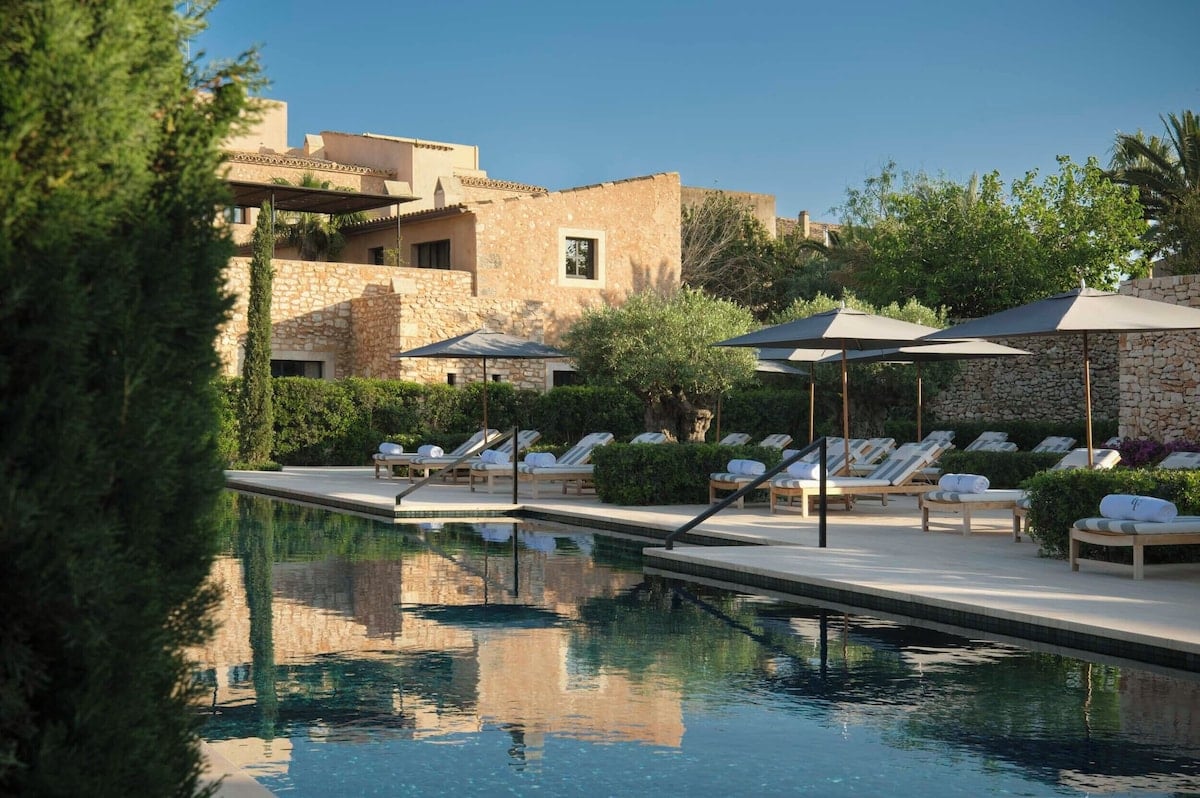
THE VIBE
A 17th-century Mallorcan stone manor opened in 2021 — 32 rooms, adults only, Michelin Guide-recognised in the inland where visitors otherwise drive straight through.
THE BACKSTORY
The property at Carrer de Can Ferrereta 12 is a 17th-century Mallorcan town palace that the Soldevila-Ferrer family — the same family behind Sant Francesc Hotel Singular in Palma — opened as a boutique hotel in April 2021. The restoration was carried out by Mallorca-based BASTIDAS Architecture in collaboration with Spanish design studio WIT, which preserved vaults, arches and original beams and integrated 32 rooms into the existing stone structure.
WHY NOW
Mallorca in October means near-empty beaches and temperatures around 22 degrees. Can Ferrereta stays open until mid-November — Santanyí's Saturday market is in full swing, and the Ocre kitchen runs its weekly market menu with the season's final harvest.
THE ROOM
The Pool Suite (70 m²) has a private heated pool and sun terrace — the only room category with direct pool access without sharing the 25-metre pool with other guests.
WELLNESS
Sa Calma Spa is the hotel's quietest room: a heated 10-metre pool surrounded by original stone, three treatment cabins with Anne Semonin protocols, hammam and sauna. The products draw their raw materials locally — flor de sal from Es Trenc, microalgae, lavender and citrus from Sóller.
THE TABLE
The market menu — Saturday, seasonal, composed from fresh produce from Santanyí's own market — Ocre. Ocre is the hotel's own restaurant, set in the house's former wine cellar with 17th-century vaults and original stone graffiti. The kitchen is led by head chefs Àlvar Albaladejo and Tamara Lumbreras and is listed in the Michelin Guide. Saturday's market menu is the only lunch service offered during the week.
THE SERVICE
Sa Calma Spa offers treatments using Anne Semonin products, salt from Es Trenc and citrus from Sóller — three cabins, hammam, sauna and a heated 10-metre indoor pool.
THE NEIGHBORHOOD
Santanyí is one of Mallorca's best-preserved inland towns with a market on Wednesdays and Saturdays. The hotel is located at Carrer de Can Ferrereta 12, in the historic quarter. The market and the town's church Sant Andreu Apòstol are within walking distance of the entrance. Palma airport is 40 km to the west.
HONEST CAVEAT
40 km to Palma airport and no beach option within walking distance — a car or taxi is a requirement for every swim.
THE VERDICT
Can Ferrereta earns its two Michelin Keys without reservation — but if you are buying it for its beach, this is the wrong hotel. The right choice is Santanyí for Santanyí's own sake.
THE FULL PICTURE
You don’t come to Santanyí by mistake. You don’t find Can Ferrereta while looking for a beach. You come here with intent, having decided that the thrum of Palma and the package-holiday static of the coast are precisely what you wish to escape. You’ve heard whispers of a different Mallorca, one built from the island’s very bones, and this 17th-century townhouse is its quiet, confident heart. The taxi drops you in the Placa Major, and for a moment, the afternoon sun is blinding against the town’s ubiquitous golden limestone. This is marès, the stone that built Palma Cathedral, and here it forms not just the buildings but the very air, which carries a dry, mineral scent. You push open a heavy, ancient door and the world outside vanishes. The immediate coolness is a physical relief, the silence a form of auditory reset.
The crowd here is self-selecting. At the table across the courtyard, a Dutch couple who restore mid-century furniture are quietly debating the merits of a local artist’s work they saw in a nearby gallery. By the pool, a novelist from London has fallen asleep over a book, her sunglasses askew. These are not first-timers to the island; they’ve done the Deià-to-Valldemossa drive, they’ve had the requisite dinner at Marc Fosh, and now they seek the island’s quieter, subtler truths. They talk in low voices about securing a table at Ca Na Toneta, or whether Andreu Genestra’s tasting menu is worth the pilgrimage. They understand that the hotel’s reputation isn’t about opulence, but about a specific, curated form of tranquility. This is a members’ club for people who have outgrown clubs.
A day here unspools with tidal grace. On Saturday, you wake at eight to the distant, rising hum of the market setting up in the square. You don’t rush. You take coffee in the courtyard, where the only sounds are the clink of ceramic on stone and the rustle of pages. By ten, you wade into the market’s gentle chaos. It’s a real town market, not a tourist performance. You buy a wedge of local cheese, a small jar of rosemary honey, and a rough-hewn ceramic bowl that will feel like a tangible piece of the island when you’re back home. The afternoon demands surrender. The pool, 25 metres of unheated, sun-warmed salt water between cypress and olive trees, is a punctuation mark in the day, a slash of green-tiled colour against the ancient stone, deep enough for a baptism from the heat. A Negroni appears on the white marble beside your lounger, sweating in the heat, its bitter orange notes a perfect counterpoint to the sun.
As the afternoon light softens, you make the pilgrimage. It is a real walk, the best part of an hour, to Es Pontàs. You cut through dusty lanes lined with fig and almond trees, the scent of wild fennel in the air. And then you see it: the improbable natural arch framing a triangle of cobalt sea, a geological sculpture that feels more profound than any man-made monument. You return as dusk bleeds purple into the sky. The hotel is glowing now, its inner life revealed. You dress for dinner at Ocre, the in-house restaurant, set in the former wine cellar and led by chef Àlvar Albaladejo, a space that feels less like a dining room and more like a hallowed cellar. The main event, when it is on, is island lamb with local herbs. It arrives not as a dish but as a statement of terroir, a plate that tastes exactly of the landscape you just walked through. The meat is tender, the jus a complex sweetness, the roasted vegetables tasting of earth and sun.
Let’s be clear: this is not a hotel for the restless. If your holiday rhythm requires a new beach club every day and a DJ by the pool, Can Ferrereta’s monastic calm will feel like a beautiful prison. On a Sunday, after the market has vanished, Santanyí can feel profoundly, almost unnervingly, quiet. The true pulse of the island’s celebrated food scene—the tasting menus at Zaranda or Marc Fosh—requires a car, a designated driver, and a reservation made months, not minutes, ago. The hotel is a sanctuary, but it is also an anchor. It assumes you are here to be still. Your reward is a deep, cellular unwinding that a week of frantic beach-hopping could never deliver. As you leave, stepping back out from the cool stone into the bright, indifferent sun, you feel it: you haven’t just visited a hotel. You’ve inhabited a place, and a piece of its quiet, stony soul has lodged itself within you.
FACTS
- Neighbourhood: Santanyí
- Stars: 5
- From 380 EUR per night
- Tripadvisor: 4.9/5 (285)
- 39.3583, 3.1249
FAQ
When is the best time to visit?
Mallorca in October means near-empty beaches and temperatures around 22 degrees. Can Ferrereta stays open until mid-November — Santanyí's Saturday market is in full swing, and the Ocre kitchen runs its weekly market menu with the season's final harvest.
Anything I should know before booking?
40 km to Palma airport and no beach option within walking distance — a car or taxi is a requirement for every swim.
What is the neighbourhood like around Can Ferrereta?
Santanyí is one of Mallorca's best-preserved inland towns with a market on Wednesdays and Saturdays. The hotel is located at Carrer de Can Ferrereta 12, in the historic quarter. The market and the town's church Sant Andreu Apòstol are within walking distance of the entrance. Palma airport is 40 km to the west.
MORE HOTELS IN Mallorca
- AluaSoul Mallorca Resort — Adults Only — Cala Egos / Cala d'Or
- Barefoot Hotel Mallorca — Portocolom
- Bikini Island & Mountain Hotel Es Trenc — Adults Only — Colonia Sant Jordi
- Bikini Island & Mountain Hotel Port de Sóller — Port de Sóller
- Blau Colònia Sant Jordi Resort & Spa — Colonia Sant Jordi / Ses Salines
- Bordoy Alcúdia Port Suites — Port d'Alcúdia