Jumeirah Mallorca
Port de Sóller, Mallorca · flagship
THE VIBE
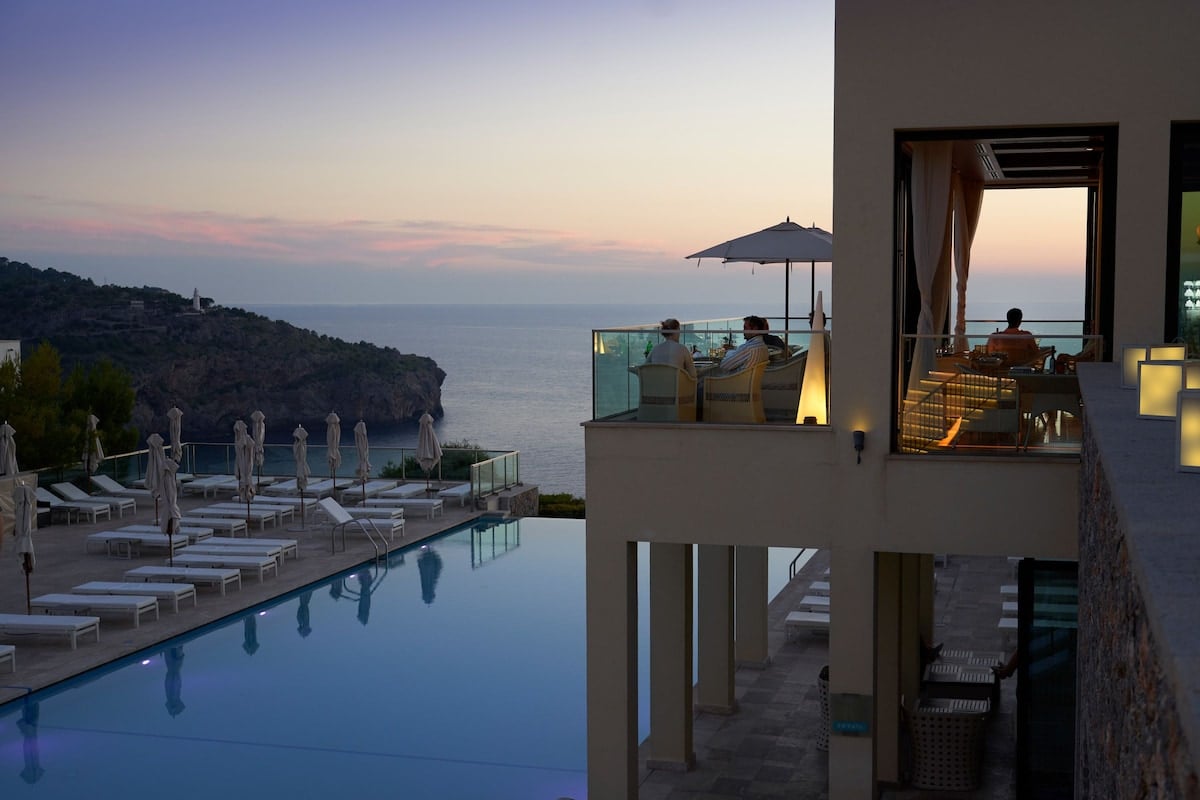
Seven buildings spread across 17 terraced levels cling to the cliff face above Port de Sóller — a property whose architecture is an engineering decision as much as an aesthetic one.
THE BACKSTORY
The foundation stone was laid in 1996, but the project stalled in 1999 and lay dormant for a decade. Jumeirah Group stepped in as operator in 2009, and architecture firm Arditecnica designed the terraced property in seven buildings along the cliff face. The hotel opened in March 2012.
WHY NOW
Es Fanals, the hotel's summit signature restaurant under chef Javier Lopez, is listed in the Michelin Guide 2025 — and represents the clearest reason to book right now: a Michelin-listed cliff restaurant with views over Serra de Tramuntana, without leaving the hotel.
THE ROOM
The Observatory Suite with private terrace offers the property's highest vantage point — seven buildings and 17 levels mean that the terrace category on the top floor differs fundamentally from the mountain views of the deluxe rooms.
WELLNESS
Talise Spa's hammam suite is positioned to offer direct views of the UNESCO-listed Serra de Tramuntana — treatments use local ingredients including olive oil, lemon, orange and almond. The thermal circuit with bio-sauna, steam room and ice fountain is available from 10:00.
THE TABLE
Balearic tasting menu (Sabores de Mallorca) — Es Fanals. The hotel's clifftop restaurant under chef Javier Lopez is listed in the Michelin Guide 2025 and serves three tasting menus focused on sustainable local produce from land and sea. Dinner service only.
THE SERVICE
Talise Spa covers 2,200 square metres and houses ten treatment rooms, a hammam suite with views towards the Tramuntana mountain range, an outdoor hydrotherapy pool, and a thermal circuit with bio-sauna, steam room, ice fountain and salt room.
THE NEIGHBORHOOD
Port de Sóller is reached from Sóller town via the tram line inaugurated on 4 October 1913 — still in operation in 2026 and one of Spain's two remaining first-generation tram lines. Palma airport is reached via the mountain pass through Serra de Tramuntana; the drive takes approximately 45 minutes.
HONEST CAVEAT
There is no coastal road from Palma — all driving goes via the mountain pass, which makes spontaneous city excursions time-consuming. Heavy summer traffic on the mountain roads should be considered when catching early flights.
THE VERDICT
Jumeirah Mallorca is the right choice for the traveller seeking dramatic cliff terrain, a serious wellness concept and a Michelin-listed table without changing address. The mountain pass to Palma is a built-in brake — choose the hotel for what it is, not for the convenience of its location.
THE FULL PICTURE
The road from Port de Sóller doesn't so much lead to the Jumeirah as it gives up, surrendering to a cliffside that seems too steep for anything but gulls and olive trees. You arrive with a sense of verticality, a feeling of having ascended to a different plane. And then you see it. The infinity pool, a blade of impossible turquoise cantilevered over the bay, doesn't just offer a view; it redefines it, imposing a severe, architectural horizon over the raw geography of the Tramuntana coast. This is not a hotel that gently integrates. It is a declaration, and it attracts a tribe that understands the language of bold statements: Munich industrial designers debating the ethics of concrete, London solicitors who’ve just closed a deal and need three days where their toughest decision is choosing between a dry Riesling and a Mallorcan white. They are not here for the boisterous energy of Palma; they have come for the engineered silence.
Your first morning begins not with an alarm, but with the clatter of the vintage 1913 tram making its first run along the waterfront far below, the sound carrying up the rock face like a faint, mechanical heartbeat. You slide open the glass doors and the air hits you—a layered scent of sea salt, dry pine, and the faintest trace of diesel from a fishing boat chugging out of the horseshoe harbor. The sun is just clearing the eastern peaks, throwing the water into sharp relief. The day presents a choice, a dilemma of competing calms. Do you descend to the pool, to claim one of the linen-draped daybeds and watch the light shift on the water for eight uninterrupted hours? Or do you pull on trail shoes and make the long, calf-burning hike up to the Mirador de ses Barques, a lookout point that offers a perspective so vast it makes the hotel’s grand gesture feel intimate by comparison?
This is the central tension, and the hotel's only real, honest flaw. Its magnificent isolation is both its greatest asset and its most significant compromise. Perched in its eagle’s nest, it is above Port de Sóller in every sense. The walk down to the promenade is a pleasant, winding affair. The walk back up, however, is a formidable pilgrimage, a test of will after a long lunch and a shared bottle of rosé. You are not part of the village; you are a spectator to it. This is not a base for spontaneous wanderings, but a self-contained world, a fortress of tranquility that requires a conscious, and often vertical, effort to leave or re-enter. Those seeking to stumble out of their lobby and into the thrum of local life will find themselves frustrated. This is a destination, not a doorway.
By late afternoon, the sun-worshippers have retreated, and the space around the pool takes on a hushed, golden-hour reverence. The day’s heat radiates from the stone underfoot as the sky softens from cobalt to apricot. This is the moment for a Negroni, the condensation tracing lines on its heavy glass, the ice cracking softly as the sky bleeds its last color. Dinner at Cap Roig is the evening’s ritual. While the island’s gastronomic pilgrims make bookings months in advance for the tasting menus at Zaranda, here the focus is a distilled, perfected version of the immediate surroundings. The order to make is whatever fish came in that day, simply prepared: a dish that tastes of the very water you’ve been gazing at all day.
Departure feels like a slow descent back to sea level, in both altitude and spirit. As you drive away, the hotel disappears back into the cliff, its sharp lines dissolving into the rugged landscape. The memory you take is not just of a view, but of a feeling: the sun on your skin, the cool shock of the pool, the clean taste of the sea. You leave with the quiet understanding that the property’s triumph is not its perch above the bay, but its ability to hold the world at bay, offering a curated silence that is, in itself, the ultimate extravagance.
FACTS
- Neighbourhood: Port de Sóller
- Stars: 5
- From 550 EUR per night
- Tripadvisor: 4.6/5 (1688)
- 39.7948, 2.6883
FAQ
When is the best time to visit?
Es Fanals, the hotel's summit signature restaurant under chef Javier Lopez, is listed in the Michelin Guide 2025 — and represents the clearest reason to book right now: a Michelin-listed cliff restaurant with views over Serra de Tramuntana, without leaving the hotel.
Anything I should know before booking?
There is no coastal road from Palma — all driving goes via the mountain pass, which makes spontaneous city excursions time-consuming. Heavy summer traffic on the mountain roads should be considered when catching early flights.
What is the neighbourhood like around Jumeirah Mallorca?
Port de Sóller is reached from Sóller town via the tram line inaugurated on 4 October 1913 — still in operation in 2026 and one of Spain's two remaining first-generation tram lines. Palma airport is reached via the mountain pass through Serra de Tramuntana; the drive takes approximately 45 minutes.
MORE HOTELS IN Mallorca
- AluaSoul Mallorca Resort — Adults Only — Cala Egos / Cala d'Or
- Barefoot Hotel Mallorca — Portocolom
- Bikini Island & Mountain Hotel Es Trenc — Adults Only — Colonia Sant Jordi
- Bikini Island & Mountain Hotel Port de Sóller — Port de Sóller
- Blau Colònia Sant Jordi Resort & Spa — Colonia Sant Jordi / Ses Salines
- Bordoy Alcúdia Port Suites — Port d'Alcúdia