HM Palma Blanc
Santa Catalina / Marina, Mallorca · discovery
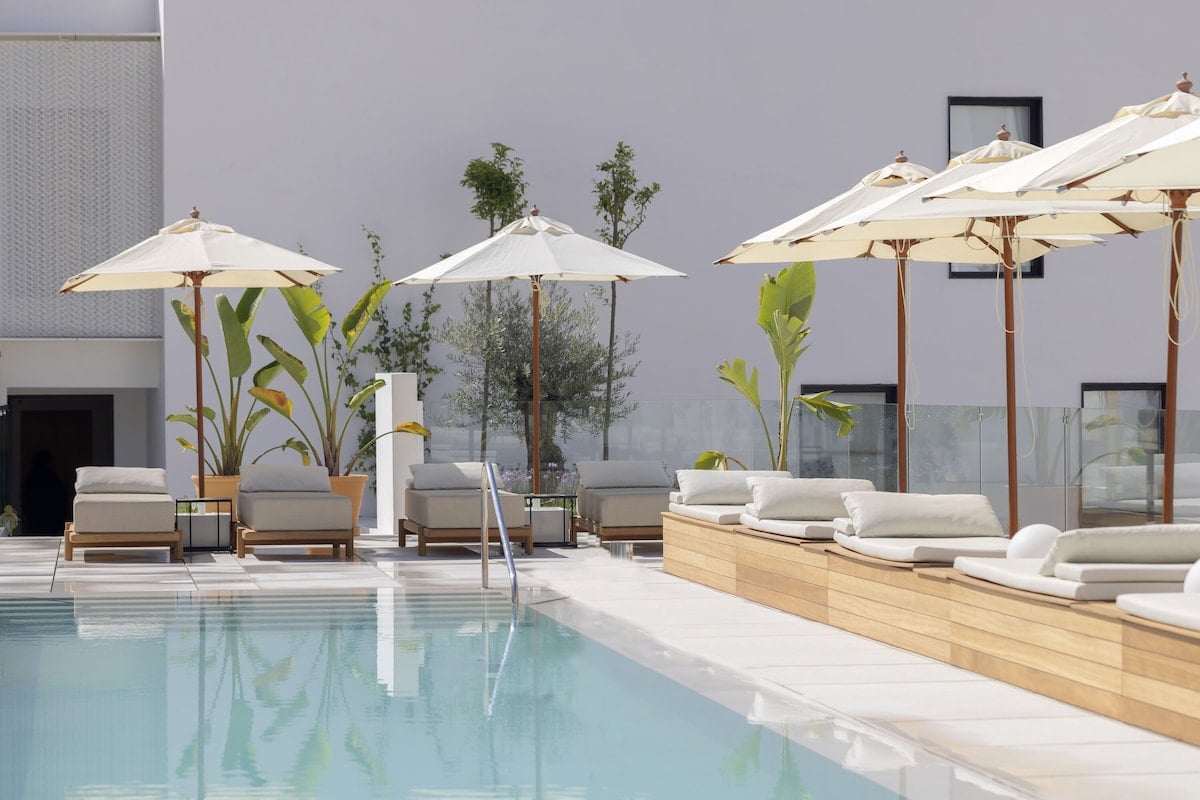
THE VIBE
Newly built city hotel of 118 rooms in a purpose-built structure on the site of the demolished Firestone building — restrained Mallorcan minimalist interiors, solar-powered, and with Repsol-recognised chef cuisine on the ground floor.
THE BACKSTORY
HM Hotels was founded in 2002 by the Horrach Moyá family, with Antoni Horrach as director and Antònia Maria Horrach as head of interiors. Palma Blanc is the chain's latest urban opening: the former Firestone industrial building on Carrer de Ramón y Cajal was demolished and replaced with a purpose-built 118-room hotel that opened in spring 2022 — financed with support from the EU recovery plan, with a 27.3 kWp solar installation integrated into the structure.
WHY NOW
Aromata, chef Andreu Genestra's restaurant acknowledged by the Repsol guide, has been in residence on the ground floor since November 2024 — and Genestra now oversees the hotel's entire food and beverage operation, including breakfast. It is the most significant culinary upgrade a four-star city hotel in Palma has seen in some time.
THE ROOM
Choose Superior (25 m²) or Junior Suite (35 m²) over the standard room at 15 m² — the price difference is marginal in shoulder season and the room size makes itself felt. Avoid the lowest floors facing the street if you are a light sleeper; early morning traffic towards the Santa Catalina market carries in.
WELLNESS
Spa with sauna, steam room, jacuzzi and two treatment rooms, open 09:00–20:00. The indoor pool is maintained at 28 degrees year-round. Gym available around the clock. No named signature treatments are published on the official website.
THE TABLE
Seasonal Mallorcan menu — jonquillo, esclatasangs and locally caught fish according to season — Aromata (in-house, ground floor). Aromata is run by chef Andreu Genestra, who holds a Michelin star at his namesake restaurant on Mallorca and a Repsol Sol for Aromata. The lunch menu (13:00–14:30, Tuesday–Saturday) is the cost-effective entry point to the kitchen.
THE SERVICE
Andreu Genestra is responsible not only for Aromata but for the entire F&B chain, meaning the hotel's breakfast buffet and snack menu underwent a complete overhaul when he took over — an unusual level of ambition for a four-star chain city hotel.
THE NEIGHBORHOOD
Carrer de Ramón y Cajal 12 sits in the zone where Palma's historic city centre transitions into Santa Catalina — a quarter of independent restaurants and a daily market (open 08:00–14:00). The Passeig des Born and the cathedral La Seu are reachable on foot in under 15 minutes. The airport is seven kilometres away.
HONEST CAVEAT
Standard rooms are 15 m² — dimensioned for function, not luxury. The outdoor rooftop pool is small and the shortage of sun loungers during high season is a recurring complaint in guest reviews.
THE VERDICT
HM Palma Blanc is a well-executed four-star city hotel with a credible sustainability programme and an unusually strong kitchen for its category. Aromata with Andreu Genestra's cooking is the real trump card. The weakness is room size in the base category — book up a level.
THE FULL PICTURE
The taxi pulls away, leaving you on a sun-bleached corner of Carrer de Ramón y Cajal where the polished stone of Palma’s Old Town begins to fray, giving way to the more bohemian weave of Santa Catalina. Your first breath inside HM Palma Blanc is a deliberate palate cleanser. The air isn’t perfumed; it’s scrubbed, carrying only the faintest mineral scent of plaster and the clean, sawn-wood aroma from the minimalist furniture. This is the hotel’s opening statement: a full-stop to the city’s baroque clamour, an immediate recalibration of the senses. It’s a space that appeals to a certain tribe: travellers who find serenity in unadorned surfaces and nod approvingly at the eco-programme, solar panels included. They aren’t here for ostentation; they’re here for a rigorously designed basecamp.
The rooms adhere to this same severe logic. They are compact, an exercise in intelligent restraint. You will not find sprawling suites or superfluous seating. The space is a monastic cell of white walls and pale wood, where the primary textures are the crisp percale of the sheets and the heavy weave of the blackout curtains. At 8 AM, pulling those curtains back reveals not a grand, postcard panorama, but a precise, architectural slice of the city: a neighbouring rooftop, a tangle of television aerials, the sharp angle of a sunlit wall. This is a room designed for deep sleep and clear thought, a place to decompress after a day spent wrestling with the magnificent, overwhelming scale of La Seu Cathedral, a walk of a quarter of an hour or so that feels like a pilgrimage under the midday sun. It is not a room for languishing.
You ascend to the roof not for sprawling leisure, but for a tactical strike. Let’s be clear: this is not a sprawling terrace for all-day lounging. The rooftop pool is a sliver of brilliant turquoise, more of a plunge bath than a basin for athletic laps, and the sun loungers that line its edge are a finite and fiercely sought-after commodity by 11 AM. You will find yourself in close proximity to your neighbours. The value here is not in space, but in perspective: the vantage point over Palma’s tiled rooftops, with a cocktail from the pool bar sweating in your hand. When the weather turns, there is a heated indoor pool in the spa, for guests over 16.
The hotel’s urban vegetable garden is not a gimmick; it’s the thesis statement for its restaurant, Kilómetro 0. The name is a promise of proximity, and the execution is sincere. Dinner is a quiet, considered affair, built on vegetables and local produce, with direct, earthy flavours that taste of sun and soil. It’s a meal that provides a sense of place without shouting about it. This isn't the high-wire gastronomy of Marc Fosh, nor the soulful, market-driven cooking you might find after a morning spent haggling for olives in the Santa Catalina market. It is its own quiet thing: honest, grounded, and grown on the premises. For the serious gourmand, it serves as an elegant overture before a drive inland to Ca Na Toneta in Caimari, for the rustic heart of the island’s cuisine.
The hotel’s location is its defining characteristic—a point of negotiation. You are neither in the labyrinthine heart of the Casco Antiguo nor amidst the culinary buzz of Santa Catalina. You are on the seam. This positioning requires a decision each time you step out the door. Head one way, and you are soon at Es Baluard, the contemporary art museum set into the old city ramparts, and beyond it the passageways that lead to the Almudaina Palace. Head the other, and within ten minutes you’re in the vibrant grid of Santa Catalina, searching for the city’s best ensaimada or a table at a perpetually booked tapas bar. This in-betweenness is the hotel’s central trade-off. You sacrifice immediate immersion for a kind of strategic neutrality. It’s a choice that pays dividends when, at midnight, you return from the thrum of the Passeig del Born to the profound, monastic quiet of your room. Leaving HM Palma Blanc feels less like checking out and more like a gentle re-entry. You depart not with memories of opulent lobbies or fawning service, but with the lingering feeling of clean lines, clear thoughts, and a quiet, intelligent perspective on one of the Mediterranean’s most seductive cities. You’ve been given a refuge, not a fantasy. For the right kind of traveller, that is more than enough.
FACTS
- Neighbourhood: Santa Catalina / Marina
- Stars: 4
- From 230 EUR per night
- Tripadvisor: 4.4/5 (443)
- 39.571, 2.633
FAQ
When is the best time to visit?
Aromata, chef Andreu Genestra's restaurant acknowledged by the Repsol guide, has been in residence on the ground floor since November 2024 — and Genestra now oversees the hotel's entire food and beverage operation, including breakfast. It is the most significant culinary upgrade a four-star city hotel in Palma has seen in some time.
Anything I should know before booking?
Standard rooms are 15 m² — dimensioned for function, not luxury. The outdoor rooftop pool is small and the shortage of sun loungers during high season is a recurring complaint in guest reviews.
What is the neighbourhood like around HM Palma Blanc?
Carrer de Ramón y Cajal 12 sits in the zone where Palma's historic city centre transitions into Santa Catalina — a quarter of independent restaurants and a daily market (open 08:00–14:00). The Passeig des Born and the cathedral La Seu are reachable on foot in under 15 minutes. The airport is seven kilometres away.
MORE HOTELS IN Mallorca
- AluaSoul Mallorca Resort — Adults Only — Cala Egos / Cala d'Or
- Barefoot Hotel Mallorca — Portocolom
- Bikini Island & Mountain Hotel Es Trenc — Adults Only — Colonia Sant Jordi
- Bikini Island & Mountain Hotel Port de Sóller — Port de Sóller
- Blau Colònia Sant Jordi Resort & Spa — Colonia Sant Jordi / Ses Salines
- Bordoy Alcúdia Port Suites — Port d'Alcúdia