Claris Hotel & Spa GL
Eixample, Barcelona · imperial
THE VIBE
An 1883 neoclassical palace converted into an archaeological museum you actually sleep in — some 70 Egyptian artefacts and pre-Columbian art distributed across corridors and rooms.
THE BACKSTORY
Palau Vedruna was built in 1883 as one of the first grand townhouses in Barcelona's Eixample, its neoclassical facade preserved and listed on Catalonia's architectural heritage inventory. In 1992 the building underwent a thorough renovation by architects Martorell, Bohigas and Mackay (MBM Arquitectes) ahead of the Barcelona Olympics — the brief was to preserve all three facades and insert a modern hotel. Behind it all stands owner Jordi Clos: Egyptologist, archaeological excavator for more than two decades, and founder of the Fundació Arqueològica Clos. The private collection encompasses over 400 objects — some 70 Egyptian pieces of exceptional quality, pre-Columbian ceramics and jade objects, Roman mosaics and Turkish kilim rugs. In 1994 Clos opened the adjacent Museu Egipci de Barcelona; hotel guests have free admission.
WHY NOW
The Mayan Secret Spa has been named the world's best spa in a historic luxury hotel by the World Luxury Spa Awards for eight consecutive years, 2018–2025. Meanwhile, new head chef Pedro Salillas is reworking the rooftop restaurant's seasonal menu.
THE ROOM
The King Suite (62 m², duplex) has its own sauna and whirlpool and features original artworks in the room — choose it over a standard Junior Suite if the budget allows.
WELLNESS
The Mayan Secret Spa is designed around pre-Columbian ritual tradition and houses authentic archaeological objects from the Mayan culture — the world's only spa-museum of its kind. The signature offering is the Temazcal, a pre-Hispanic steam bath handcrafted from volcanic stone with aromatic medicinal herbs. No shared wet areas; every treatment is private. The World Luxury Spa Awards named it the world's best spa in a historic luxury hotel 2018–2025.
THE TABLE
Seasonally driven Mediterranean menu — 'a la llauna' rice paper with red prawn and shore cuttlefish is the signature dish of the current kitchen — La Terraza del Claris. The hotel's own rooftop restaurant with views over Eixample's roofscape. Run by head chef Pedro Salillas with a Catalan-Mediterranean focus on local and seasonal produce. Open for lunch every day and dinner from 19:30.
THE SERVICE
The concierge arranges complimentary entry to the Museu Egipci de Barcelona — Europe's largest private collection of Egyptian art open to the public — owned by the same person as the hotel, Jordi Clos. Breakfast and check-in take place in the lobby against the backdrop of a fifth-century Roman mosaic.
THE NEIGHBORHOOD
The hotel is located at Pau Claris 150 in La Dreta de l'Eixample. Metro Passeig de Gràcia (L2/L3/L4) is a short walk south. Casa Batlló and Casa Milà (La Pedrera) are reachable along Passeig de Gràcia — the Manzana de la Discòrdia block is in the immediate vicinity. The Fundació Antoni Tàpies is on Carrer d'Aragó, the adjacent street. The Museu Egipci de Barcelona on Carrer de Valencia is within walking distance.
HONEST CAVEAT
The Mayan Secret Spa has no conventional wet area — no pool, jacuzzi or hammam within the spa environment. The value lies in the individual treatments (from 160 EUR / 50 min), not in a shared relaxation zone.
THE VERDICT
Claris solves an unusual equation: a 5*GL hotel whose real differentiator is archaeological. The owner's collection is not a decoration strategy — it is the reason the Jordi Clos Fundació Arqueològica exists. A guest seeking a design hotel with minimalist aesthetics is at the wrong address; one who wants Eixample's finest location combined with a genuinely museum-grade context is at exactly the right one.
THE FULL PICTURE
You don't check into the Claris so much as you cross a temporal threshold. One moment you are on the grand, humming artery of Passeig de Gràcia, navigating the tide of shoppers and disciples of Modernisme making their way to Gaudí's reptilian Casa Batlló just down the block. The next, you are silenced by the cool, tomb-like air of the lobby, face-to-face with pharaonic artefacts behind museum-grade glass. The abrupt shift from the sun-bleached Eixample grid to the dimly lit reverence of an archaeological collection is the hotel’s central, uncompromising statement: you are not here simply to sleep. You are here for a lesson in curated dissonance.
This is a hotel for people who have already seen Barcelona, perhaps several times. The crowd is self-selecting: a pair of London-based antiquarians arguing quietly about the Punic Wars over afternoon coffee; a celebrated architect from Chicago, here for a reckoning with the Sagrada Família’s impossible ambition, using the hotel as a contemplative base. They understand that the true value here isn’t the thread count, but the audacity of placing one ancient civilization inside the shell of another. The journey from the elevator to your room becomes a silent procession past antiquities whose stillness rebukes the city's frantic energy.
To book a standard room here is to miss the point entirely; it’s like visiting a library and staying in the cloakroom. The investment in a Museum Suite is non-negotiable. It’s where the collection bleeds from the hallways into your private space, with original pieces standing sentinel in the corner of your room. You wake at 8 a.m., not to an alarm, but to the particular quality of Barcelona light filtering through heavy drapes, catching the dust motes dancing over a piece of history that has witnessed millennia. The trade-off for this prime address, of course, is the city itself. Book a room below the fourth floor and the grand chorus of Passeig de Gràcia—the delivery trucks, the distant sirens, the murmur of a thousand conversations—becomes a persistent hum that the double-glazing can only muffle, not mute.
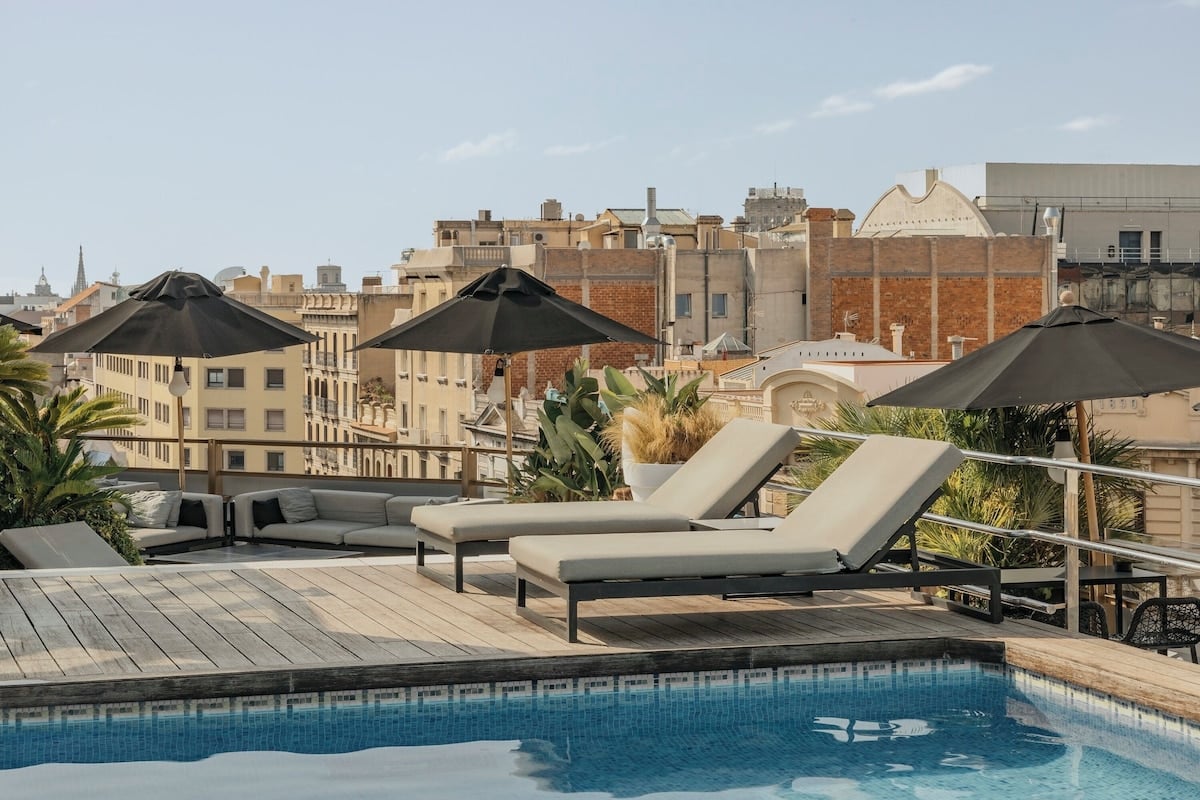
By 5 p.m., the day’s obligations are done. This is the hour to ascend to La Terraza del Claris, the rooftop bar and restaurant that serves as the hotel’s social apex. The pool is famously small, more of a reflecting basin for the Catalan sky than a space for athletic laps, but that’s irrelevant. Ordering a glass of bone-dry cava and claiming a corner table is the real purpose. Up here, the city lays itself out for inspection. You can trace the 17-minute walk to the Sagrada Família, its cranes and spires jabbing at the heavens, a monument to glorious, unfinished obsession. The crowd thins and thickens with the setting sun, a mix of hotel guests and in-the-know locals who treat this terrace as their private Eixample refuge. The DJ sessions are discreet, a pulsing backbeat rather than a party starter. This is where the hotel’s strange alchemy comes into focus. You order the Tuna tartare with Egyptian spices, and the fusion of Mediterranean freshness with North African aromatics feels like the thesis of the entire building served on a plate. It connects the view of a Gothic cathedral with the artefact you passed in the lobby, bridging continents and centuries in a single dish.
Later, you might feel the pull of Plaça de Catalunya, a ten-minute stroll away, but the hotel holds its own gravity. You find yourself wandering the first-floor museum space instead, a privilege reserved for guests after hours. Alone with the collection, the pieces cease to be decoration. They are characters, their silence heavy with stories the city outside cannot tell. There is no other place in Barcelona where the walk back from dinner at a nearby tapas bar concludes with a private viewing of Egyptian sarcophagi. This is the Claris’s core magic: it forces a re-evaluation of place. It suggests that Barcelona's history isn't just in its Roman walls or its Gothic alleyways, but in its capacity to absorb and reinterpret the world. Leaving the next morning, the sensory ghost of the place lingers. The weight of antiquity in your memory makes the city outside feel younger, louder, and somehow less mysterious. You've slept in a museum, and now the whole of Barcelona feels like an exhibition waiting for your gaze.
FACTS
- Neighbourhood: Eixample
- Stars: 5
- From 400 EUR per night
- Tripadvisor: 4.4/5 (3140)
- 41.3935, 2.166
FAQ
When is the best time to visit?
The Mayan Secret Spa has been named the world's best spa in a historic luxury hotel by the World Luxury Spa Awards for eight consecutive years, 2018–2025. Meanwhile, new head chef Pedro Salillas is reworking the rooftop restaurant's seasonal menu.
Anything I should know before booking?
The Mayan Secret Spa has no conventional wet area — no pool, jacuzzi or hammam within the spa environment. The value lies in the individual treatments (from 160 EUR / 50 min), not in a shared relaxation zone.
What is the neighbourhood like around Claris Hotel & Spa GL?
The hotel is located at Pau Claris 150 in La Dreta de l'Eixample. Metro Passeig de Gràcia (L2/L3/L4) is a short walk south. Casa Batlló and Casa Milà (La Pedrera) are reachable along Passeig de Gràcia — the Manzana de la Discòrdia block is in the immediate vicinity. The Fundació Antoni Tàpies is on Carrer d'Aragó, the adjacent street. The Museu Egipci de Barcelona on Carrer de Valencia is within walking distance.
MORE HOTELS IN Barcelona
- Hotel 1898 — La Rambla
- ABaC Hotel & Restaurant Barcelona Monument — Sarrià
- Alenti Sitges Hotel & Restaurant — Sitges
- Alexandra Barcelona Hotel Curio Collection — Eixample
- Alma Barcelona GL — Eixample
- Almanac Barcelona — Eixample