Grand Hotel Central
El Born, Barcelona · flagship
THE VIBE
Noucentist landmark on Via Laietana — a century-old office building turned Barcelona's most fully realised five-star city retreat.
THE BACKSTORY
Francesc Cambó — politician, cultural patron and one of the most powerful Catalans of the early twentieth century — commissioned Adolf Florensa to design the building in 1926. At its inauguration it was Barcelona's tallest property and the city's first with a lift. The top floor served as Cambó's private residence; his personal book collection is still kept in the hotel's library. The family owned the property until it was sold ahead of the renovation. New ownership opened the hotel in 2005; the complete renovation by Sagrada Studio was finished in March 2024.
WHY NOW
The building was designed in 1926 by Adolf Florensa and stood empty for generations. Since March 2024 it has been completely rebuilt by London-based Sagrada Studio in the Noucentisme spirit — a project that coincides with Barcelona's designation as UNESCO World Capital of Architecture in 2026.
THE ROOM
Deluxe rooms on the fifth floor and above, facing the cathedral skyline, offer views without Via Laietana's street noise dominating.
WELLNESS
The eighth-floor spa spans just over 200 m² with a hammam (95 per cent humidity), dry sauna and treatment rooms offering Natura Bissé and Alqvimia treatments. An additional panoramic sauna on La Terraza del Central rooftop with thermal contrast and cold shower was added in 2024.
THE TABLE
Tapas and wine tasting (Wine & Bite format) — Can Bo vins & tapes. The hotel's own street-kitchen at Via Laietana 30, led by head chef Lorenzo Cavazzoni and sommelier Amador Marín. Seasonal Spanish produce, over 100 wine labels, open 12:30–24:00.
THE SERVICE
Sommelier Amador Marín has built the Can Bo wine list from scratch — over 100 labels with Spanish regions at the centre and French and Italian additions. The Wine & Bite tasting can be booked daily from 12:30.
THE NEIGHBORHOOD
Via Laietana 30 sits on the boundary between the Barri Gòtic and El Born, with Jaume I metro (L4) directly across the street. Barcelona Cathedral is approximately 250 metres to the north. From here you walk to the Picasso Museum and Santa Maria del Mar without a map.
HONEST CAVEAT
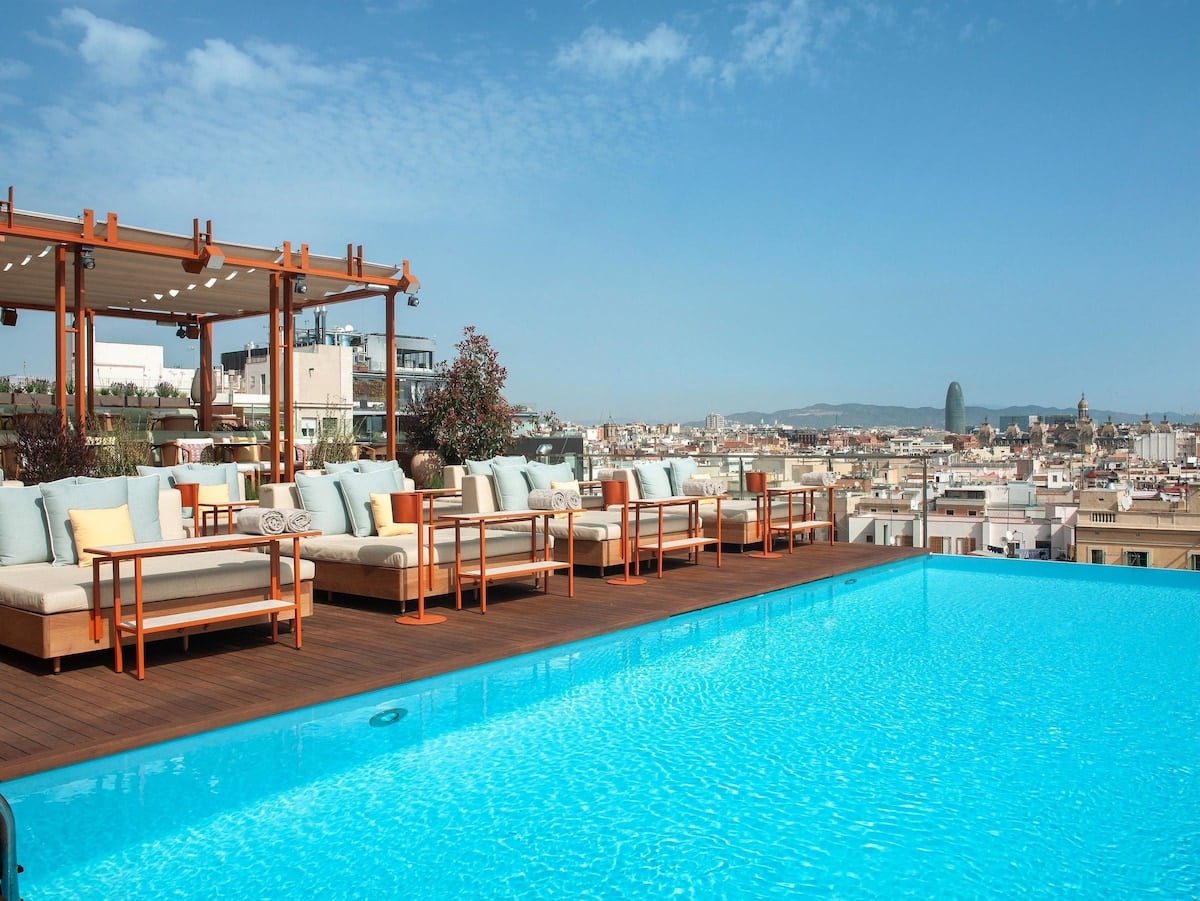
Via Laietana is a wide, heavily trafficked city thoroughfare — lower rooms facing the street are exposed to noise around the clock. The rooftop pool is exclusive to hotel guests, open 07:00–18:00, with sun-lounger bookings in two-hour segments.
THE VERDICT
147 rooms in a 1926 Noucentisme building, completely renovated in March 2024 by Sagrada Studio — with what may be Barcelona's most photographed rooftop pool, a spa floor with Natura Bissé on the eighth floor, and a street-kitchen restaurant that genuinely delivers. The price is right for what you get.
THE FULL PICTURE
The first thing you do at the Grand Hotel Central is exhale. You step from the six-lane thrum of Via Laietana—a river of taxis, scooters, and civic impatience—and cross a threshold into a deliberate, enveloping quiet. The air inside is different; it carries the scent of cedarwood and old leather, a tonic against the street’s exhaust fumes. The city’s glaring sunlight is filtered into a dim, golden glow by Art Deco sconces, pooling on polished brass and dark wenge wood panels. The lobby is a sanctuary of low murmurs, where Catalan business executives conduct discreet negotiations on deep velvet sofas, their conversation punctuated only by the soft clink of espresso cups on saucers. You find your own voice lowering, your shoulders dropping. The urban chaos doesn’t just stop at the door; it feels like it never existed. This is not a hotel you check into; it’s a place you retreat to, a sophisticated pause button pressed in the creative heart of El Born.
Your most critical decision happens at check-in, and it defines your entire stay. It is the choice between the view and silence. To secure that postcard panorama of the Barcelona Cathedral’s spires and the hypnotic, undulating ceramic roof of the Santa Caterina Market, you must request a Deluxe City View room, specifically 608 or 708. At 8 a.m., as you slide open the heavy curtains, the morning light floods in, illuminating the Gothic Quarter in a way that feels utterly private. But this vista comes with a non-negotiable price: the ceaseless, audible hum of Via Laietana. Even the double glazing cannot entirely defeat the city’s soundtrack of sirens and relentless traffic. If a night of profound, uninterrupted quiet is paramount, you must sacrifice the view. Opt for an interior-facing room—315 or 420, for instance—which looks onto a narrow, unremarkable lightwell. It offers no inspiration, but it guarantees a tomb-like silence that is its own form of solace.
The hotel’s social nexus, its irrefutable claim to fame, is the rooftop. The elevator doors open to the sky, and the view expands into a commanding 360-degree sweep of the city. But let us be brutally honest: the famed infinity pool, so compelling in photographs, is in reality a shallow, elongated plunge pool. It is a place to cool your ankles while holding a Negroni that sweats onto the white marble ledge, not a place for swimming laps. By 9:30 a.m. in July, every one of the two dozen sun loungers has been claimed by early-rising German architects and design editors from London, their tote bags neatly placed beside them. Arriving later means perching on a ledge, which is fine, because the point of this rooftop isn’t athletic exertion. It’s a strategic observation deck, a place to orient yourself, tracing the path from the base of the Cathedral, a three-minute walk away, to the distant spires of the Sagrada Família, which from here reads not as a tourist site but as a madman’s reckoning with ambition.
As afternoon bleeds into evening, the rooftop transforms. The sunbathers depart, replaced by a crowd here for the culinary prowess of Chef Rafa Zafra. His work at the Terraza restaurant has single-handedly dismantled the pejorative of the ‘hotel restaurant’. This is a serious gastronomic destination, a testament to Barcelona’s current obsession with hyper-local, radically fresh seafood. You must order the ‘Arroz de espardenyes con alioli de azafrán y toque ahumado’. Forget every paella you have ever been served. This is something else entirely: a masterclass in the sea. The tender, silken sea cucumbers (espardenyes) are woven into perfectly al dente bomba rice, the entire dish humming with oceanic intensity. A saffron aioli, kissed with a subtle, ingenious smokiness, cuts through the richness. Each spoonful, taken as the city lights begin to glitter below, is a direct connection to the morning’s catch from the Barceloneta fish auction, a profound taste of contemporary Catalan identity.
The hotel’s true power, however, is as a perfectly calibrated basecamp. It places you at the precise intersection of order and chaos. From its hushed lobby, you are a two-minute walk from the staggering, stained-glass explosion of the Palau de la Música Catalana. In the other direction, you are plunged into the medieval labyrinth of El Born, its narrow alleys hiding vermouth bars, independent bookshops, and ateliers turning out handcrafted leather goods. You can spend an afternoon lost in its passages, then retreat to the civilized calm of the hotel, re-emerging for the evening. When you finally depart, stepping back out onto Via Laietana for the last time, the noise of the city no longer feels like an assault. It is simply the rhythm of the place you have just come to understand, on your own terms, from a place of restorative calm.
FACTS
- Neighbourhood: El Born
- Stars: 5
- From 290 EUR per night
- Tripadvisor: 4.7/5 (3683)
- 41.3862, 2.1761
FAQ
When is the best time to visit?
The building was designed in 1926 by Adolf Florensa and stood empty for generations. Since March 2024 it has been completely rebuilt by London-based Sagrada Studio in the Noucentisme spirit — a project that coincides with Barcelona's designation as UNESCO World Capital of Architecture in 2026.
Anything I should know before booking?
Via Laietana is a wide, heavily trafficked city thoroughfare — lower rooms facing the street are exposed to noise around the clock. The rooftop pool is exclusive to hotel guests, open 07:00–18:00, with sun-lounger bookings in two-hour segments.
What is the neighbourhood like around Grand Hotel Central?
Via Laietana 30 sits on the boundary between the Barri Gòtic and El Born, with Jaume I metro (L4) directly across the street. Barcelona Cathedral is approximately 250 metres to the north. From here you walk to the Picasso Museum and Santa Maria del Mar without a map.
MORE HOTELS IN Barcelona
- Hotel 1898 — La Rambla
- ABaC Hotel & Restaurant Barcelona Monument — Sarrià
- Alenti Sitges Hotel & Restaurant — Sitges
- Alexandra Barcelona Hotel Curio Collection — Eixample
- Alma Barcelona GL — Eixample
- Almanac Barcelona — Eixample