H10 Casa Mimosa
Eixample, Barcelona · discovery
THE VIBE
The 1892 Godó palace on Pau Claris — interior-designed by Tarruella Trenchs, with the trees that name the house.
THE BACKSTORY
In 1892, textile magnate Carlos Godó Pié — co-founder of La Vanguardia in 1881 — commissioned a city palace at Pau Claris 179. The commission went to Joan Martorell i Montells, the architect who nine years earlier had recommended Antoni Gaudí to take over the construction of Sagrada Família. Martorell designed a restrained modernist façade but concealed a secret in the interior courtyard: a lush garden with mimosa trees, a century-old linden and a Washington palm. Over time the mimosas gave the building its name. H10 Hotels acquired the property and commissioned Tarruella Trenchs Studio to carry out the renovation. The hotel opened in 2016 with 48 rooms.
WHY NOW
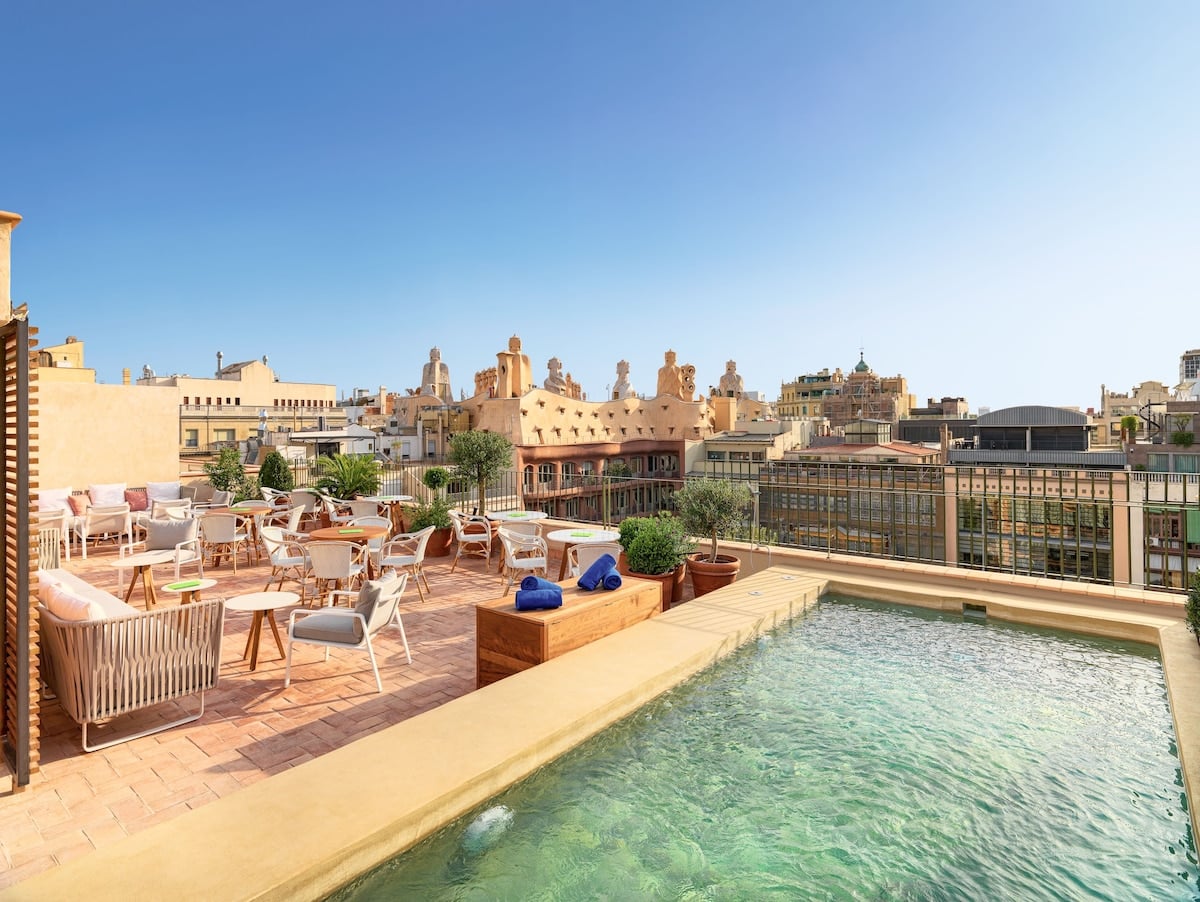
El Cel de Gaudí terrace with plunge pool and direct views of La Pedrera is open April–October — the best rooftop in Eixample Dreta at a four-star budget during peak season.
THE ROOM
The 60 m² Suite Condal has the original coffered ceiling intact — the only room in the house where 1892 is still visible overhead.
WELLNESS
No spa at Casa Mimosa. The hotel offers a small gym and two pool options: an elevated outdoor pool in the courtyard garden and a plunge pool on the El Cel de Gaudí terrace (April–October).
THE TABLE
Mediterranean-inspired à la carte lunch — El Til·ler Restaurant. The hotel's own restaurant serves lunch daily in the garden pavilion — the only opportunity to dine within the 1892 interior without booking a separate table.
THE SERVICE
El Til·ler Restaurant is the hotel's own-operated restaurant, serving a breakfast buffet and Mediterranean-inspired à la carte lunch daily — framed by the garden pavilion with coffered ceiling and brass details by Tarruella Trenchs.
THE NEIGHBORHOOD
Pau Claris 179 is in Eixample Dreta, on the same block as Casa Milà (La Pedrera). Passeig de Gràcia metro (L2, L3, L4) is under a minute's walk. Passeig de Gràcia with Gaudí's trifecta — Casa Milà, Casa Batlló and Casa Lleó i Morera — is reachable on foot in under five minutes.
HONEST CAVEAT
No spa. The gym is small. H10's standardised service model is reliable but not personal.
THE VERDICT
H10 Casa Mimosa is a listed 1892 palace at Pau Claris 179 — architect Joan Martorell i Montells, interior design by Tarruella Trenchs Studio, 48 rooms, TripAdvisor 4.8 from 934 reviews. The hotel has no spa and H10's service model is reliable rather than personal. But for those who want to sleep in a listed heritage building on the same block as Casa Milà, with Passeig de Gràcia metro a minute's walk away, there is no direct alternative in Eixample at these prices.
THE FULL PICTURE
You feel it the moment you pivot off Carrer de Pau Claris, trading the Eixample’s elegant clamor for something more composed. The air inside changes; it’s thick with the scent of mimosa blossoms and a particular kind of expensive, unidentifiable perfume that clings to cashmere scarves. Your heels click against the intricate geometry of original Nolla mosaic tiles, their polished surfaces reflecting a vast, contemporary chandelier that seems to float in the hushed air. This is not a lobby for the hurried. To your left, a couple with silver hair and impeccable Italian are debating the merits of a reservation at Gresca versus Estimar, their voices a low murmur. A porter, moving with the silent efficiency of a chess piece, stacks monogrammed luggage by the lift. The building’s Modernista soul has been preserved, but it’s a soul that now wears custom-tailored clothes.
Your room, if you’ve been properly advised, is not one of the grand suites overlooking the ceaseless river of traffic on Passeig de Gràcia. You’ve instead requested a ‘Privilege’ room—specifically 304 or 404—facing the inner courtyard. Here, the prize is not the view but the profound, almost monastic quiet and the survival of the original ceiling mouldings, elaborate flourishes of plaster that draw your eye upward. This is the essential transaction of staying here: you trade the postcard shot of Gaudí’s architectural fever dreams for the possibility of an undisturbed night’s sleep. Those who opt for the street-facing rooms learn a hard lesson about Barcelona’s rhythms around 5 a.m., when the city’s refuse collection trucks perform their roaring, percussive ballet. It’s a detail the reservation agent will not mention, just as they won’t elaborate on the service, which carries the distinct DNA of its H10 corporate parentage. It is efficient, correct, and entirely impersonal. You will be checked in swiftly and your bags will arrive promptly, but you will not be mistaken for a cherished friend returning home.
Forget unpacking. The reason you are here is upstairs. Ascend to the rooftop terrace, El Cel de Gaudí, as the afternoon begins to bleed into evening. The city’s notorious humidity has started to break, and a breeze drifts over the tightly packed tables. This is where the hotel’s true purpose is revealed. It’s a space populated by architects from Zurich who have come to argue about urban planning over a third glass of cava, and by couples from Paris who understand that the best views are often the most specific. The plunge pool is precisely that—a postage-stamp basin of chilled water, large enough for two people to cool their ankles in, and it is perpetually occupied after 3 p.m. It is an urban concession, not an amenity, and you will rightly ignore it.
Your objective is a small table at the edge of the terrace. From here, you are not looking down upon or up at La Pedrera; you are having a direct, eye-level conversation with the surrealist chimneys, those warrior-sentinels that punctuate the skyline. At this hour, the golden light catches their undulating forms, transforming them from stone into something alive. This is a vantage point no museum ticket can grant you. Order the house vermouth, the Vermut de la casa. It arrives dark and herbaceous, a local recipe from a small producer, poured over a single, large ice cube with a sliver of orange peel. It is accompanied by a trio of gildas, the classic Basque skewer of a fat Cantabrian anchovy, a tart piparra pepper, and a firm Manzanilla olive. The sharp, saline bite of the gilda against the bittersweet botanicals of the vermouth is a sensation that is pure Barcelona. It is a moment of such potent satisfaction that it forgives the transactional service and the early morning noise. It’s the reason the reservation book for this terrace fills up by noon.
Later, you might consider the nine-minute walk down to the city’s chaotic heart at Plaça de Catalunya, or a longer, more determined stride to the Gothic Quarter’s Cathedral, seventeen minutes away. You could contemplate the stained-glass fantasia of the Palau de la Música Catalana. But you won’t. You are already at the city’s most coveted intersection of comfort and culture. This hotel is not a retreat from Barcelona but a calibrated instrument for experiencing it. You leave the next morning with the taste of salt and botanicals still on your tongue, understanding that you didn’t just find a place to sleep. You found the perfect perch.
FACTS
- Neighbourhood: Eixample
- Stars: 4
- From 170 EUR per night
- Tripadvisor: 4.8/5 (934)
- 41.3926, 2.165
FAQ
When is the best time to visit?
El Cel de Gaudí terrace with plunge pool and direct views of La Pedrera is open April–October — the best rooftop in Eixample Dreta at a four-star budget during peak season.
Anything I should know before booking?
No spa. The gym is small. H10's standardised service model is reliable but not personal.
What is the neighbourhood like around H10 Casa Mimosa?
Pau Claris 179 is in Eixample Dreta, on the same block as Casa Milà (La Pedrera). Passeig de Gràcia metro (L2, L3, L4) is under a minute's walk. Passeig de Gràcia with Gaudí's trifecta — Casa Milà, Casa Batlló and Casa Lleó i Morera — is reachable on foot in under five minutes.
MORE HOTELS IN Barcelona
- Hotel 1898 — La Rambla
- ABaC Hotel & Restaurant Barcelona Monument — Sarrià
- Alenti Sitges Hotel & Restaurant — Sitges
- Alexandra Barcelona Hotel Curio Collection — Eixample
- Alma Barcelona GL — Eixample
- Almanac Barcelona — Eixample