Hotel Arts Barcelona
Port Olímpic, Barcelona · imperial
THE VIBE
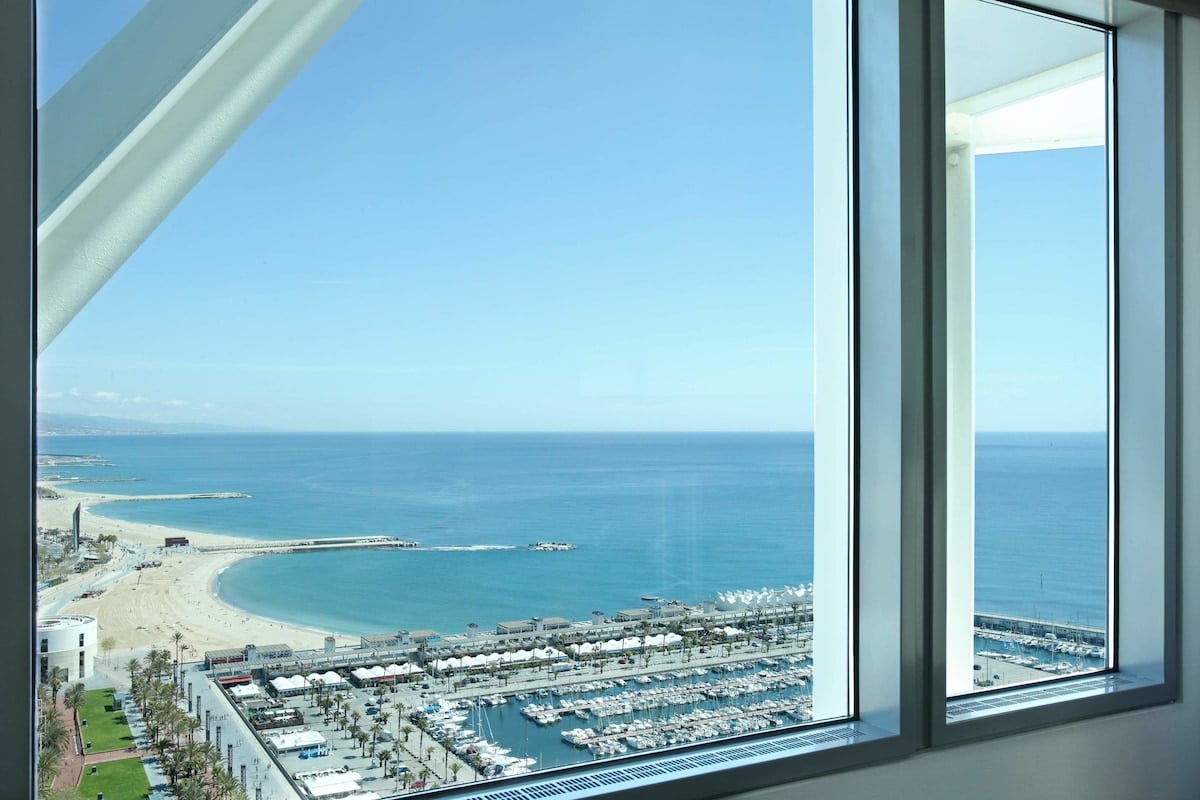
Hotel Arts Barcelona's 44-storey glass exoskeleton rises 154 metres above Port Olímpic's coastline — the Ritz-Carlton's most consequential European address.
THE BACKSTORY
Bruce Graham of Skidmore, Owings & Merrill (SOM) designed the tower for the 1992 Olympics — a steel exoskeleton set 1.5 metres clear of the glass facade, an approach that pioneered computer-assisted construction. The hotel opened at full scale in 1994 as the Ritz-Carlton's first European property. By the entrance: Frank Gehry's 'El Peix', a 52-metre sculpture in gilded stainless steel, built for the same Olympiad and now one of Barcelona's most recognised waterfront works.
WHY NOW
Since June 2025, all 483 rooms and suites have been reimagined by Meyer Davis — soft coastal palettes, open-plan layouts, natural light throughout. The public spaces follow in a second phase through December 2026; book now while the hotel delivers the renovated room without the full-scale construction noise.
THE ROOM
South-facing rooms overlooking the sea receive Meyer Davis's soft blues and sandy tones; request specifically a mid-floor room (20–35) for an unbroken horizon without paying the penthouse premium.
WELLNESS
43 The Spa — originally on floor 43, temporarily relocated to floors 3–4 since March 2025 during the renovation — offers eight treatment rooms and Natura Bissé's product line. Hydrotherapy pool, steam room and sauna are included. The panoramic position on the 43rd floor returns when the renovation is complete.
THE TABLE
Seasonally driven Mediterranean tasting menu — Enoteca Paco Pérez. Two Michelin stars in the 2026 guide. Paco Pérez runs a seasonally led Catalan seafood kitchen with international references — the hotel's most consistent constant across three decades of operating history.
THE SERVICE
Club Level on floor 33 provides a dedicated concierge and lounge access with panoramic Mediterranean views. Penthouse guests on the upper floors receive butler service and a Mini Cabrio at their disposal — a step beyond standard luxury in a city that otherwise demands hiring a car outside the centre.
THE NEIGHBORHOOD
Carrer de la Marina 19-21 sits within Vila Olímpica del Poblenou, a residential quarter built for Olympic athletes in 1992 and now quiet and well-ordered. Barceloneta beach begins directly at the hotel's gardens. Mercat de la Barceloneta, where locals buy their fish, is a five-minute walk north. The Gothic quarters are accessible via L4, two stops to Barceloneta or three to Jaume I.
HONEST CAVEAT
Pool 2 and restaurant Lokal are closed until October 2026 due to renovation works. Buy into the renovated room — but expect construction activity in the lobby and pool areas.
THE VERDICT
Barcelona's strongest combination of beach, city skyline and gastronomic weight under one roof. The distance to Barri Gòtic is real — twenty minutes by metro, L4 from Ciutadella/Vila Olímpica — but for guests who prioritise the sea over history, this is the correct address.
THE FULL PICTURE
The taxi swings past the flotilla of masts at Port Olímpic, and there it is. Frank Gehry's golden fish, a monumental scales-and-sun sculpture, glints at the base of a 44-story tower of blue glass and steel. This isn't a hotel you stumble upon while looking for tapas; arriving here is a deliberate act, a conscious decision to trade the Gothic Quarter's medieval tangle for the clarifying expanse of the Mediterranean. You are choosing horizon over history, perspective over proximity. The valets who take your bags move with a silent, practiced efficiency, and as the glass doors slide open, the city’s clamor—the scooters, the gulls, the distant hum of Barceloneta’s beachfront life—is instantly replaced by a cool, conditioned hush. The air inside is scrubbed clean, carrying a faint, expensive scent of white tea and fig, a world away from the brine and diesel of the marina you just left.
The lobby is a theater of quiet power. You'll see the men in Loro Piana loafers who look like they own the marina below, and the families from Dubai whose children are better dressed than most of the adults in town. Listen closely, and you’ll catch the polyglot murmur of deals being made in hushed tones—the clientele is less about conspicuous consumption and more about the consolidation of capital. These are not the bohemian backpackers sketching in Plaça de Catalunya; these are the people who own the companies the backpackers work for. The elevator ascent is a silent, rapid decompression. As you rise past the 30th floor, the city reconfigures itself into a cartographer’s model, a grid of streets and landmarks laid out for your private consideration.
Push open the heavy door to a panoramic suite. Before you register the crisp Frette linens on the king bed or the polished marble of the bathroom, your eye is pulled, magnetically, past the floor-to-ceiling glass to the balcony. Step out. The teak is warm underfoot. There is no noise, only the whisper of high-altitude wind and the vast, unbroken plane of the sea. This is the hotel's central promise, delivered without compromise. From here, Barcelona is an abstraction. You can see the twin towers of the Sagrada Família, not as a tourist destination, but as a distant, sand-colored reckoning with human ambition. The entire city is an exhibition, and you have the best seat in the house.
But this sublime isolation comes with a non-negotiable price. Let’s be brutally honest: you are remote. The hotel isn't part of the city's living tissue; it’s an elegant appendage. A twenty-minute walk will get you to the formidable doors of the Barcelona Cathedral, a half-hour to the glorious, gory sensory assault of La Boqueria market. But these are expeditions, not rambles. Every foray into the old town requires a taxi and a plan, a logistical commitment that feels jarring after the effortless serenity of your suite. You will find yourself weighing the desire to lose yourself in the labyrinth of El Born against the magnetic pull of the hotel's rooftop pool, and more often than not, the pool will win. It is, frankly, a better Barcelona decision than most day trips.
The reward for this trade-off is realized at dinner. Enoteca Paco Pérez, the hotel's two-Michelin-star temple to gastronomy, is not merely a restaurant; it’s the culmination of your stay. The room is formal, the service telepathically attentive. You order the "Sea bass in a sea of algae." It arrives not as food but as a composition, an edible diorama of the very seabed you've been gazing upon. The flavor is a profound distillation of the ocean—a pure, clean salinity balanced by the vegetal notes of the algae, a testament to chef Paco Pérez’s almost fanatical command of his ingredients. Paired with one of the 700 wines from the cellar, it’s a moment of such intense focus and pleasure that you forget all about the city beyond the glass.
On your final morning, you open the shutters at 7 a.m. The sun is a pale disc over the water, the horizon a clean, hard line between grey and blue. You make a coffee and take it to the balcony one last time. You came here not to be *in* Barcelona, but to look *at* it. You traded the grit for the view, the noise for the quiet, the chaotic intimacy of the streets for the controlled perfection of a tower by the sea. Leaving feels like a descent, a re-entry into the beautiful mess you paid to observe from above. It’s a choice that isn’t for everyone, but for those who value perspective above all else, it’s the only choice that matters.
FACTS
- Neighbourhood: Port Olímpic
- Stars: 5
- From 550 EUR per night
- Tripadvisor: 4.4/5 (5968)
- 41.3871, 2.1964
FAQ
When is the best time to visit?
Since June 2025, all 483 rooms and suites have been reimagined by Meyer Davis — soft coastal palettes, open-plan layouts, natural light throughout. The public spaces follow in a second phase through December 2026; book now while the hotel delivers the renovated room without the full-scale construction noise.
Anything I should know before booking?
Pool 2 and restaurant Lokal are closed until October 2026 due to renovation works. Buy into the renovated room — but expect construction activity in the lobby and pool areas.
What is the neighbourhood like around Hotel Arts Barcelona?
Carrer de la Marina 19-21 sits within Vila Olímpica del Poblenou, a residential quarter built for Olympic athletes in 1992 and now quiet and well-ordered. Barceloneta beach begins directly at the hotel's gardens. Mercat de la Barceloneta, where locals buy their fish, is a five-minute walk north. The Gothic quarters are accessible via L4, two stops to Barceloneta or three to Jaume I.
MORE HOTELS IN Barcelona
- Hotel 1898 — La Rambla
- ABaC Hotel & Restaurant Barcelona Monument — Sarrià
- Alenti Sitges Hotel & Restaurant — Sitges
- Alexandra Barcelona Hotel Curio Collection — Eixample
- Alma Barcelona GL — Eixample
- Almanac Barcelona — Eixample