Mandarin Oriental Barcelona
Eixample, Barcelona · imperial
THE VIBE
Banco Hispano-Americano's neoclassical 1955 façade now houses Patricia Urquiola's interior — discipline and precision of detail on Barcelona's most scrutinised boulevard.
THE BACKSTORY
The building at Passeig de Gràcia 38–40 was constructed in 1955 as the headquarters of Banco Hispano-Americano, designed by the bank's house architect Galíndez in a restrained neoclassicism with a granite portico. Mandarin Oriental Group transformed the property with Carlos Ferrater and Joan Trias de Bes as lead architects and Patricia Urquiola as interior designer; the hotel opened in November 2009. Urquiola's signature is the floating entrance ramp that crosses the inner courtyard — visible from inside the lobby, screened by metal grilles.
WHY NOW
2026 is the hotel's self-declared Gaudí year: themed experiences tied to Casa Batlló, located 200 metres south along the same boulevard. The rooftop restaurant Terrat by Hublot is open April through October.
THE ROOM
Suites facing Passeig de Gràcia on the upper floors offer direct views of Casa Batlló's polychrome façade — 28 suites in total throughout the property, with the greatest concentration of boulevard views on the fifth and sixth floors.
WELLNESS
The Spa at Mandarin Oriental covers 1,000 square metres below street level, designed by Patricia Urquiola. Eight treatment rooms including a couples suite with jacuzzi. A twelve-metre heated indoor pool, a hammam with mist function and rain shower. Access to the 24-hour Technogym fitness suite is included in the spa fee.
THE TABLE
Seasonal tasting menu featuring Catalan produce — Moments. The hotel's fine-dining restaurant under Raül Balam's direction holds one Michelin star (2025 Guide) — the kitchen moves along the Catalan tradition with contemporary technique.
THE SERVICE
The concierge team specialises in Barcelona's gastronomic scene and holds direct relationships with Michelin-starred restaurants across the Eixample. The hotel's own Moments, led by Raül Balam, holds one Michelin star (2025 Guide).
THE NEIGHBORHOOD
Passeig de Gràcia 38–40, La Dreta de l'Eixample. Casa Batlló (Gaudí, 1904–1906) stands at number 43 — approximately 200 metres south along the same boulevard. Metro Passeig de Gràcia (lines 2, 3 and 4) is within the block. Fundació Antoni Tàpies is at Carrer d'Aragó 255, a couple of blocks to the west.
HONEST CAVEAT
The hotel has 120 rooms and suites — among the smaller inventories in the five-star segment. Standard rooms feel compact relative to the price point; choose a suite for the proportions.
THE VERDICT
120 rooms in a 1955 bank palace on Passeig de Gràcia — Patricia Urquiola's interior, a Michelin-starred restaurant on site and a 1,000-square-metre spa below street level. The address's prestige is fact-based, not invented.
THE FULL PICTURE
You don't arrive at the Mandarin Oriental, Barcelona, through a grand, trumpet-blaring portal. Instead, a discreet ramp descends from the bustling energy of Passeig de Gràcia, immediately silencing the thrum of the city. The air inside the glass-and-steel cocoon holds the specific, expensive scent of white tea and supple leather, a hushed introduction to a world apart. In the central atrium, beneath a mesmerizing web of suspended ivory latticework, financiers in soft-shouldered Zegna suits converse in low tones while a woman, her vintage Hermès Kelly bag resting on a polished travertine bench, inspects a limited-edition gallery book. This isn't a hotel for the package tourist; it's a sanctuary for Barcelona's discerning elite, for the architects who’ve come to argue about Gaudí’s radical ambition over a third glass of cava, and for those who understand that true cultural immersion often begins with quiet observation.
Your arrival suite, if you’ve secured Boulevard Terrace Suite 505, immediately clarifies the hotel’s spatial genius. Open the shutters at 7 am, and the morning light floods the room, illuminating polished oak and crisp white linens. Directly opposite, the undulating, skeletal facade of Casa Batlló presents itself not as a mere tourist attraction, but as a direct challenge to architectural convention, its scale and fantastical detail now within intimate reach. This is the money shot, a private box seat to Gaudí’s unsettling genius, and it anchors your stay with a visual anchor few other addresses can claim. For a similar, though perhaps slightly less immersive, spectacle, Deluxe Boulevard rooms on the fifth or sixth floor offer the same architectural dialogue without the premium. However, be warned: the boulevard-facing rooms, despite exceptional soundproofing, occasionally transmit the faint rumble of early-morning street cleaners and the city's waking traffic on Passeig de Gràcia. For absolute quiet, a Deluxe Garden room, overlooking the serene interior Mimosa garden, is the essential counterpoint, a sudden oasis where the city's pulse completely vanishes.
Midday might find you stepping out, the Eixample grid unfolding around you. Casa Batlló is a two-minute stroll away, an essential pilgrimage. From there, a seven-minute walk leads to the grand sweep of Plaça Catalunya, a nexus of city life. For an afternoon of cultural provocation, the Palau de la Música, a riot of Catalan Modernisme, is a ten-minute walk east, its intricate details an absorbing counterpoint to Gaudí’s organic forms. Or perhaps you wander a little further, eleven minutes, to MACBA in El Raval, where contemporary art demands a different kind of engagement.
As afternoon stretches towards evening, the hotel shifts its cadence. The ground-floor Banker's Bar, while technically adept at its craft – a perfectly composed Negroni, sweating coolly on white marble – lacks the pulsating energy of Barcelona’s true cocktail temples like Paradiso or Two Schmucks. It’s a quiet place for a strategic pre-dinner drink, a place for hushed conversations, not for the vibrant hum of the city's more daring establishments.
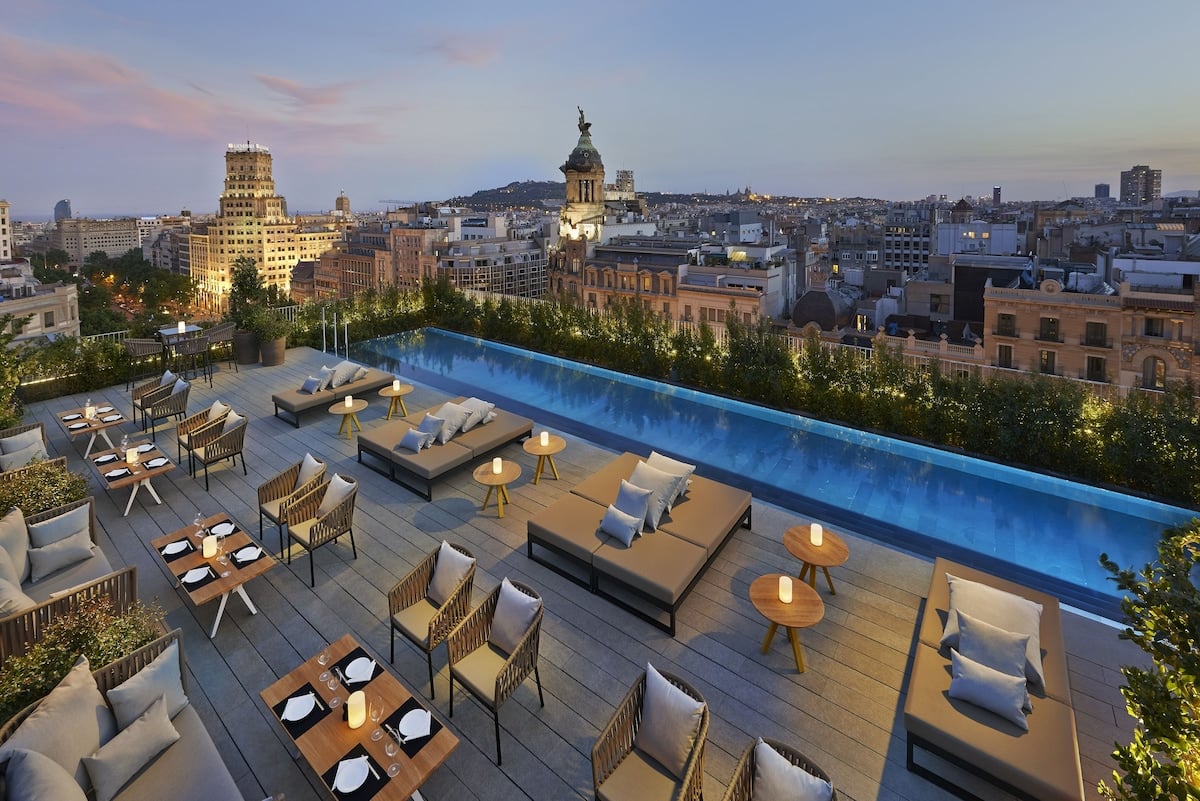
The true evening spectacle awaits on the roof. The city’s rooftop bar scene is fiercely competitive, but the Mandarin’s Terrat, re-emerging with Gastón Acurio’s refined Peruvian influence, offers a decisive edge. Here, as the sun dips, casting long shadows across the Eixample, the air cools, and the scent of citrus and fresh herbs from the kitchen mingles with the distant city breeze. Order the sharp, citrus-heavy tiraditos and causas – their bright acidity cuts through the summer heat with remarkable precision. As dusk deepens, the Sagrada Família, visible in the distance, begins to glow, a monumental silhouette against the deepening indigo sky. This is where the Cava starts flowing, where the city’s pulse feels both near and beautifully remote. Book your table when you book your room; walk-ins are a fantasy, and the view, a reckoning with Gaudí’s ultimate unfinished ambition, is non-negotiable. Be aware, though, that the rooftop pool is not for swimming laps. It’s a plunge pool, barely larger than a family-sized jacuzzi, designed for cooling off between cocktails, not for serious aquatic exercise.
For dinner, Moments, Carme Ruscalleda and Raül Balam’s two-Michelin-star temple to Catalan produce, is essential. The dining room, awash in amber and gold, feels both formal and deeply comforting. The menu shifts with the seasons, but if the 'llàgrima' (tear) pea from Maresme is on offer, it is a non-negotiable experience. Each tiny pea bursts with a concentrated, almost crystalline sweetness, served in a deeply savory Iberian ham broth with a hint of mint. It is a dish of profound simplicity and technical brilliance, an unpretentious masterpiece that speaks volumes about regional terroir. Another morning might bring the Dim sum-brunchen at Blanc Brasserie & Gastrobar, a more casual but equally refined culinary detour.
Departing, you carry not just memories of polished surfaces and hushed service, but a deeper understanding of Barcelona’s layered identity. The interplay between Gaudí’s monumental fantasies and the elegant grid of the Eixample, the contrast between the city’s vibrant street life and the hotel’s controlled calm, imprints itself. The Mandarin Oriental, Barcelona, doesn’t merely offer a place to stay; it offers a vantage point, a curated immersion into the city’s complex, alluring soul.
FACTS
- Neighbourhood: Eixample
- Stars: 5
- From 680 EUR per night
- Tripadvisor: 4.6/5 (1956)
- 41.3912, 2.1666
FAQ
When is the best time to visit?
2026 is the hotel's self-declared Gaudí year: themed experiences tied to Casa Batlló, located 200 metres south along the same boulevard. The rooftop restaurant Terrat by Hublot is open April through October.
Anything I should know before booking?
The hotel has 120 rooms and suites — among the smaller inventories in the five-star segment. Standard rooms feel compact relative to the price point; choose a suite for the proportions.
What is the neighbourhood like around Mandarin Oriental Barcelona?
Passeig de Gràcia 38–40, La Dreta de l'Eixample. Casa Batlló (Gaudí, 1904–1906) stands at number 43 — approximately 200 metres south along the same boulevard. Metro Passeig de Gràcia (lines 2, 3 and 4) is within the block. Fundació Antoni Tàpies is at Carrer d'Aragó 255, a couple of blocks to the west.
MORE HOTELS IN Barcelona
- Hotel 1898 — La Rambla
- ABaC Hotel & Restaurant Barcelona Monument — Sarrià
- Alenti Sitges Hotel & Restaurant — Sitges
- Alexandra Barcelona Hotel Curio Collection — Eixample
- Alma Barcelona GL — Eixample
- Almanac Barcelona — Eixample