Monument Hotel
Eixample, Barcelona · flagship
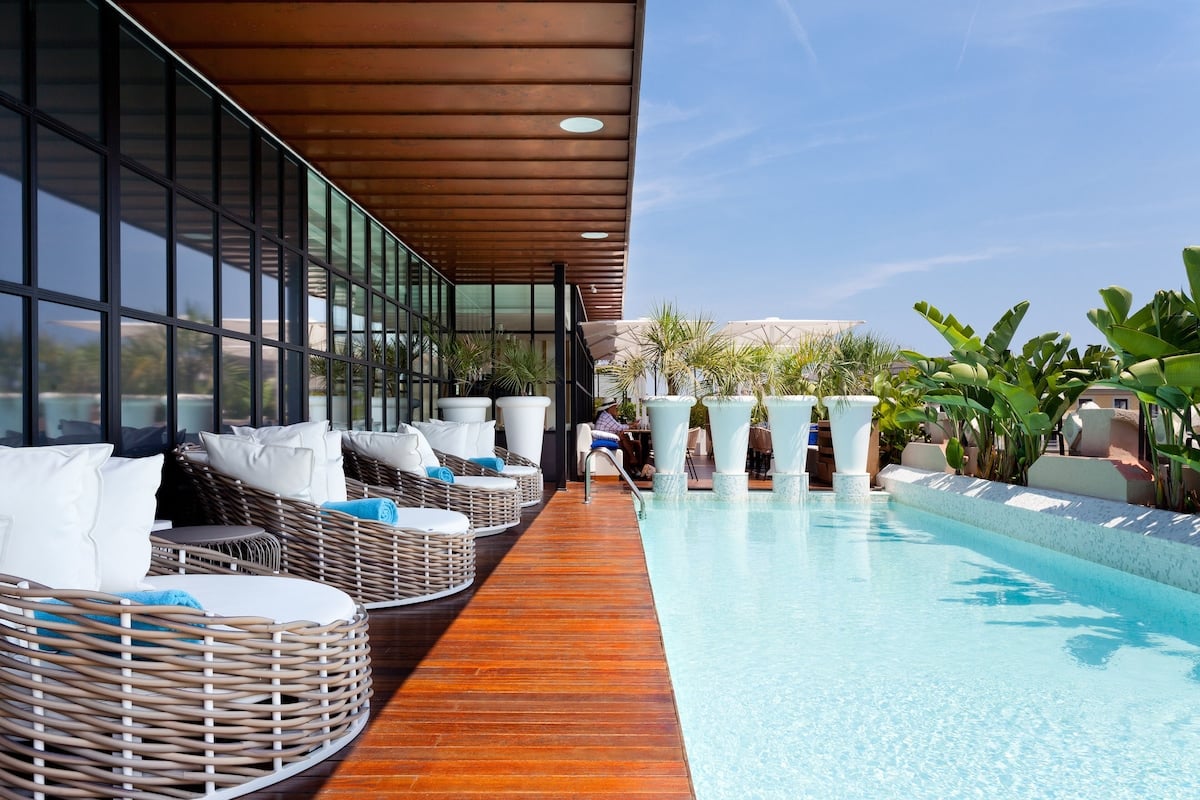
THE VIBE
Monument Hotel — Casa Enric Batlló from 1895, 84 rooms, Lasarte's three Michelin stars and Vilaseca's polychrome façade on Passeig de Gràcia.
THE BACKSTORY
The industrialist Enric Batlló commissioned architect Josep Vilaseca i Casanovas in 1895 to design a private palace at Passeig de Gràcia 75. Vilaseca — a central figure in the pre-Modernista movement — conceived a façade combining brick, stone, ceramics and wrought iron in polychromy. The building was awarded Heritage Protection status. Hotel Condes de Barcelona opened in the building in 1986; in 2016 Oscar Tusquets, Carles Basso, Tote Moreno and interior designer Mercè Borrell undertook a thorough renovation, and Monument Hotel was inaugurated.
WHY NOW
BERA por Martín Berasategui opened in spring 2026 on the redesigned ground floor — a more accessible expression of Berasategui's kitchen, open daily, no waiting list. Lasarte's three stars remain intact under Paolo Casagrande.
THE ROOM
The Suite Enric Batlló (85 m²) bears the name of the original owner and offers a balcony facing Passeig de Gràcia with a direct view of La Pedrera. The courtyard rooms deliver absolute quiet at a comparable rate.
WELLNESS
Valmont for Monument Hotel houses massage rooms, sauna and hammam with Valmont's full treatment menu — Kobido facial massage, body rituals and aromatherapy. The fitness room is open around the clock with Technogym equipment.
THE TABLE
The sharing dishes from BERA's daily menu — BERA por Martín Berasategui. Berasategui's new opening of spring 2026 on the hotel's redesigned ground floor — flexible menu, open daily until 22:30, without Lasarte's restricted waiting list.
THE SERVICE
The concierge at Monument Hotel has a direct relationship with Lasarte's reservations desk — a connection that no app can replicate when the restaurant accepts guests Wednesday through Saturday with limited availability.
THE NEIGHBORHOOD
Passeig de Gràcia 75 in the Eixample's Quadrat d'Or. La Pedrera (Casa Milà) stands directly opposite on the other side of the street. Metro Diagonal (lines 3 and 5) is 200 metres to the north. Carrer de Provença, with restaurants and boutiques, begins 100 metres to the east.
HONEST CAVEAT
Lasarte's three-star menu is a separate reservation at its own price, open Wednesday to Saturday. Staying at the hotel confers no guaranteed access to a table.
THE VERDICT
One of Barcelona's few 5*GL addresses where the architectural history is substance rather than decoration: Vilaseca's brick arches and wrought iron from 1895–96 carry the hotel, not the other way around. Having Lasarte's three Michelin stars in-house is a privilege — but Paolo Casagrande's kitchen is a separate reservation, not a hotel amenity.
THE FULL PICTURE
The heavy, neo-Gothic doors of the Monument concede slowly, exchanging the diesel fumes and sun-baked pavement of Passeig de Gràcia for a hushed, cool atrium of carved stone. The air here carries the scent of old wood, a faint, clean verbena from a single vase resting on a polished travertine slab at the reception desk. A German art dealer, his voice a low thrum, debates client calls on a raw silk jacket, while an older couple, perhaps in their sixties, quietly studies the intricate wrought-iron balustrade winding upwards. This is not a lobby for overt display; it’s a monastic, scholarly refuge, a quiet port for those who navigate Barcelona's relentless pulse with deliberation. This is the tribe: architects who've come to argue about Gaudí over a third glass of cava, collectors seeking respite from the din of auction houses, or writers contemplating the precise arc of a Spanish sentence. They are here for quietude, for the serious business of living well, unobserved.
At 7 am, in a Junior Suite on the fifth floor, room 502, you slide the heavy wooden shutters open. The early morning light floods the room, illuminating the polished herringbone parquet and catching the glint of brushed brass fixtures. Directly across, through the plane trees beginning to rustle, is the surrealist roofline of Gaudí's Casa Batlló, its ceramic scales still cool in the morning light, awaiting the full heat of the Eixample sun. This is the prize: a direct architectural communion with one of the city's great reckonings with ambition. The trade-off, undeniably, is sound. The kinetic energy of Passeig de Gràcia, with its constant hum of traffic and the distant murmur of late-night revelers, is a presence. For those who require absolute silence, the identical interior-facing rooms offer quietude, though their views are limited to the hotel's opposite wall, and on lower floors, they can feel undeniably dark, sacrificing kinetic energy for calm. It is a decision that defines your stay.
Barcelona’s culinary scene often flirts with fleeting global trends, chasing the next sensation. The Monument, refreshingly, has doubled down on its Basque-Catalan gastronomic heritage, a steadfast commitment to provenance and technique. Martín Berasategui, the chef-patron whose twelve Michelin stars speak to a sustained mastery, continues to personally oversee the menus at both Oria and the three-starred Lasarte. A visit now feels like a pilgrimage to the source, a timely reminder that classic, ingredient-driven technique possesses an inherent fortitude that outlasts any ephemeral fad. In the relative calm of Oria Restaurant’s glass-ceilinged atrium, the kitchen’s mastery is clearest in its handling of the sea. Forget the risotto; order the Truffled kokotxas and crab ravioli. This dish presents the delicate, gelatinous Basque specialty of hake throats, poached to a perfect quiver and served alongside a single, taut raviolo filled with sweet crab meat. It is finished with a heady truffle vinaigrette that binds the subtle flavors of the ocean to the earth. This is a technical, precise, and deeply satisfying plate, a testament to a kitchen operating at the apex of its craft. You might also encounter the Iberico-tartare, a testament to the kitchen's precision with terrestrial delights.
Stepping out from the hushed enclave of the Monument, you are immediately immersed in the structured elegance of Barcelona's Eixample district. Passeig de Gràcia stretches out, a grand promenade of modernist masterpieces. Casa Batlló is literally steps away, a mere 61 meters, inviting a closer, more detailed inspection of its unsettling facade. From here, a nine-minute walk takes you to the bustling Placa Catalunya, the city's central artery, or in thirteen minutes, to the architectural lyricism of the Palau Musica. The neighborhood, with its grid of wide avenues and elegant buildings, feels both monumental and eminently walkable. The city’s pulse, once left behind the heavy doors, is now at your fingertips, a vibrant counterpoint to the hotel’s measured calm.
A candid assessment: the intimate, boutique scale of the Monument, while lending a sense of refined seclusion, can also feel constrained. There is no pool, a significant omission when Barcelona’s August humidity clamps down, making a cool dip a true necessity rather than a luxury. And as noted, the rooms facing Passeig de Gràcia, while offering those spectacular, eye-level views of Casa Batlló, are subject to the constant hum of traffic and the occasional late-night reveler. Light sleepers would do well to pack earplugs or, better yet, insist on an interior courtyard room, even if it means sacrificing that architectural vista for undisturbed slumber. The base-category rooms facing this courtyard can indeed feel dark, with views limited to the opposite wall of the hotel, a detail worth considering for those who require expansive natural light.
The true gift of the Monument is not just its architectural grace or its Michelin-starred kitchens, but its quiet insistence on depth. It is a place where you sit in the cloistered calm of the atrium, a Negroni sweating gently on a white marble coaster, and the city’s cacophony feels a world away. This quiet intellectualism permeates every interaction, every precisely chosen material. You leave not just having stayed in Barcelona, but having engaged with a specific, discerning version of it—one that prioritizes heritage, craft, and a cultivated sense of calm over fleeting trends. It is a hotel that equips you to understand Barcelona more profoundly, a city of contradictions that, like the Monument itself, reveals its true character to those who take the time to look, listen, and taste with intent.
FACTS
- Neighbourhood: Eixample
- Stars: 5
- From 480 EUR per night
- Tripadvisor: 4.7/5 (1020)
- 41.3921, 2.1647
FAQ
When is the best time to visit?
BERA por Martín Berasategui opened in spring 2026 on the redesigned ground floor — a more accessible expression of Berasategui's kitchen, open daily, no waiting list. Lasarte's three stars remain intact under Paolo Casagrande.
Anything I should know before booking?
Lasarte's three-star menu is a separate reservation at its own price, open Wednesday to Saturday. Staying at the hotel confers no guaranteed access to a table.
What is the neighbourhood like around Monument Hotel?
Passeig de Gràcia 75 in the Eixample's Quadrat d'Or. La Pedrera (Casa Milà) stands directly opposite on the other side of the street. Metro Diagonal (lines 3 and 5) is 200 metres to the north. Carrer de Provença, with restaurants and boutiques, begins 100 metres to the east.
MORE HOTELS IN Barcelona
- Hotel 1898 — La Rambla
- ABaC Hotel & Restaurant Barcelona Monument — Sarrià
- Alenti Sitges Hotel & Restaurant — Sitges
- Alexandra Barcelona Hotel Curio Collection — Eixample
- Alma Barcelona GL — Eixample
- Almanac Barcelona — Eixample