Olivia Balmes Hotel
Eixample, Barcelona · discovery
THE VIBE
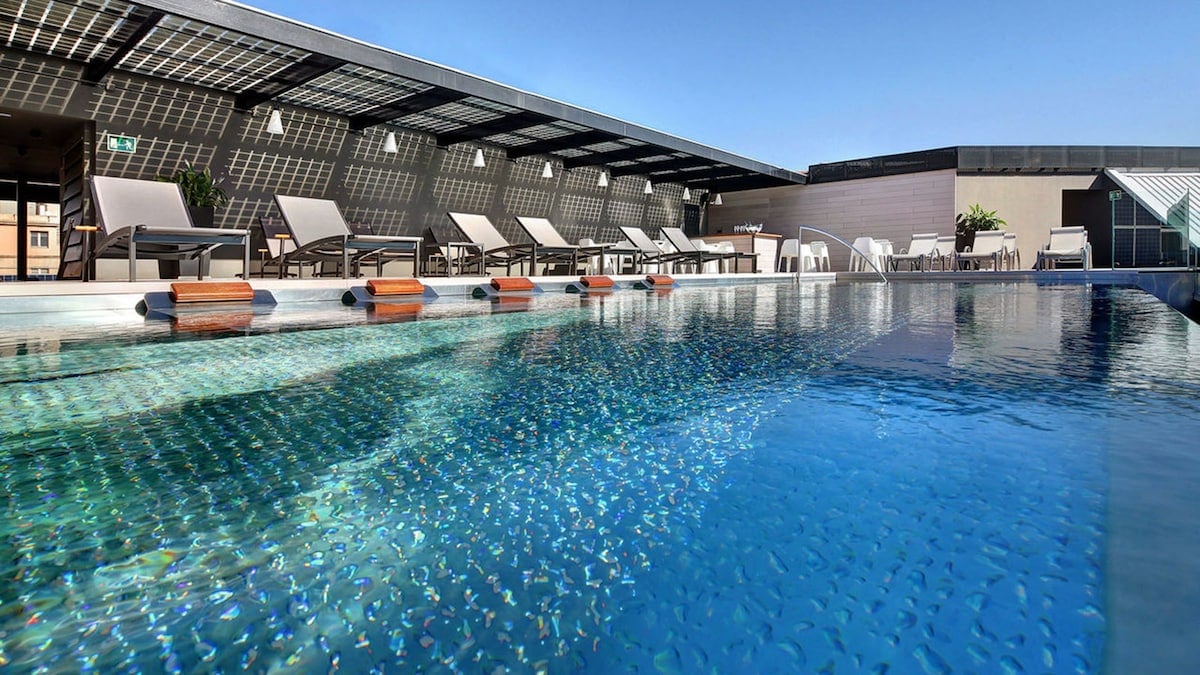
Olivia Balmes opened in 2013 as a purpose-built property on Eixample's central axis — 128 rooms, rooftop pool with views across the neighbourhood's canopy of plane trees.
THE BACKSTORY
Olivia Hotels Collection was founded in 1992 by the Valderrama family and today operates six properties in Barcelona, Palma de Mallorca, Vilafranca del Penedès and Lisbon. Olivia Balmes, the group's Eixample address, was inaugurated in the summer of 2013 as a new-build on the northern corner of Carrer de Balmes — designed by architects Álex Ibáñez Walter and Sara Galmán Gracia, with interiors by GCA arquitectos asociados. The 9,437 m² building was, at opening, the first hotel in its category to be awarded energy class A — with 220 m² of solar panels and LED lighting across 6,000 linear metres, energy consumption was reduced by 54 percent compared to conventional hotel standards.
WHY NOW
Olivia Balmes was, at its 2013 opening, the first hotel in its category to achieve energy class A — solar panels, LED lighting and recycled greywater are built into the fabric of the building from the ground up, not retrofitted. It shows in the operational quality.
THE ROOM
Premium Double with balcony facing Carrer de Balmes — additional natural light without appreciable street noise, thanks to the 7.5 cm argon-filled windows.
THE TABLE
Weekly market dish (rotating Mediterranean plates based on seasonal produce) — Seventeen Restaurant. The hotel's own restaurant on the ground floor, open for breakfast, lunch and dinner — Catalan-Mediterranean cuisine with a weekly-changing menu based on local ingredients.
THE SERVICE
Reception covers nine languages and the Seventeen Restaurant reservations line ([email protected]) responds on the same day — a concrete service indicator in a segment where email response is often irregular.
THE NEIGHBORHOOD
Carrer de Balmes 117 sits on the boundary between Dreta and Esquerra de l'Eixample — Cerdà's grid plan in immediate reality. Casa Milà (La Pedrera) is approximately 400 metres away. The nearest public transport is FGC station Provença (lines L6/L7) with underground connections to Diagonal (metro L3 and L5).
HONEST CAVEAT
The breakfast buffet is not included in the room rate and costs extra. Morning coffee is served from a machine, not by a barista.
THE VERDICT
Olivia Balmes is a well-built city hotel with an unusual quality at its core: a new building, certified energy performance and a rooftop pool terrace that genuinely delivers on its views. Service is consistent but not ambitious. Those seeking Barcelona in flagship format should look further; those wanting a reliable, well-positioned base with functioning gastronomy in-house will find it at Balmes 117.
THE FULL PICTURE
You arrive at Olivia Balmes by taxi, and your first thought is that there has been a mistake. You’ve given the driver the address of a mid-tier corporate headquarters, a generic glass-and-steel facade so anonymous it’s almost hostile, an architectural shrug amidst the grand, wrought-iron balconies and Modernist flourishes of the Eixample. The automatic doors slide open not with a welcoming sigh but a sterile hiss, revealing a lobby of polished concrete and a silence so profound it feels deliberate. The air carries the faint, clean scent of industrial cleaning fluid and recently brewed Nespresso pods. There is no bellhop, no concierge desk bustling with activity, only a single, almost invisible counter where a staff member checks you in with the transactional efficiency of a security guard issuing a visitor’s pass. You are not greeted; you are processed. This is not a hotel. It is a high-end residential block that happens to rent out its units, and in that distinction lies its entire purpose.
You’ve been warned, of course. You know to avoid the lower-floor ‘Deluxe’ rooms at all costs, those dim cells facing an interior courtyard that serves as a concrete echo chamber for your own disappointment. You have insisted on a Terrace Apartment, 6th floor or higher, facing the street. When the elevator doors open onto your corridor, the silence continues. But then you unlock the door to apartment 704, and everything changes. The entire space is flooded with a brilliant, unfiltered afternoon light that bounces off the minimalist furniture and warms the polished floors. You walk past the compact, immaculate kitchenette and slide open the heavy glass doors to the terrace. Here, high above the dense canopy of the plane trees lining Carrer de Balmes, the city reveals itself. The hum of traffic below is not an annoyance but a rhythmic pulse, the lifeblood of the grid. This is your perch, large enough for a small table, two chairs, and a bottle of cava sweating in the sun. From here, you are not a tourist looking at Barcelona; you are a temporary resident, presiding over your domain.
This is the hotel’s brutal, brilliant contract: it trades all warmth and personality for light, space, and a profound sense of autonomy. Your fellow guests are not wide-eyed tourists clutching maps. They are German film producers on a three-month shoot, architects from Stockholm who have come to argue about Gaudí’s reckoning with divine ambition at the Sagrada Familia, a twenty-minute walk away. They are a tribe of temporary locals who understand that as Barcelona moves to ban all tourist apartments by 2028, this legally sanctioned, professionally managed model is the only intelligent way to truly embed yourself in the city for more than a weekend. You will never see a housekeeper unless you explicitly hang the sign on your door. The staff will not remember your name. You are on your own, and the freedom is absolute.
This autonomy has its sharp edges. The rooftop pool, photographed from clever angles to suggest an urban oasis, is a cruel joke. It is a plunge pool, a concrete trough barely large enough for two adults to sit in without their knees awkwardly touching. By 11 AM on any day with sun, the dozen sun loungers surrounding it are fiercely contested territory, staked out with novels and forgotten towels. You are not here for the amenities. You are here for the location, the kitchen, and the terrace. You are here because from your room, you can set out on foot and in eleven minutes be standing before the reptilian shimmer of Casa Batlló’s facade, feeling the unsettling genius of its design. You are here because you can live within the city’s perfect grid, not just visit it.
In the evening, when the relentless cycle of patatas bravas and jamón becomes a tyranny, you will need an escape. You’ll leave the sterile confines of the building and walk five minutes north up Carrer de Balmes to the leafy, locals-only terrace at Hotellet. You will order the Medelhavsallad. It arrives not as a delicate composition but as a defiant, rustic bowl: a pile of bitter greens, aggressively salty Kalamata olives, sun-scorched tomatoes that taste of pure heat, and enormous, chalky chunks of feta. The dressing is a sharp mix of good olive oil and oregano that cuts through everything. Surrounded by the low murmur of Catalan chatter, this honest, cleansing meal is the perfect antidote to touristic indulgence, a reminder that you are in a real city. You return to your apartment, open another bottle of cava on the terrace, and watch the lights of the Eixample flicker on, feeling less like a guest and more like you hold a temporary deed to a small piece of the Barcelona sky. This isn’t a place you check into; it’s a base you inhabit.
FACTS
- Neighbourhood: Eixample
- Stars: 4
- From 175 EUR per night
- Tripadvisor: 4.8/5 (3623)
- 41.3952, 2.1555
FAQ
When is the best time to visit?
Olivia Balmes was, at its 2013 opening, the first hotel in its category to achieve energy class A — solar panels, LED lighting and recycled greywater are built into the fabric of the building from the ground up, not retrofitted. It shows in the operational quality.
Anything I should know before booking?
The breakfast buffet is not included in the room rate and costs extra. Morning coffee is served from a machine, not by a barista.
What is the neighbourhood like around Olivia Balmes Hotel?
Carrer de Balmes 117 sits on the boundary between Dreta and Esquerra de l'Eixample — Cerdà's grid plan in immediate reality. Casa Milà (La Pedrera) is approximately 400 metres away. The nearest public transport is FGC station Provença (lines L6/L7) with underground connections to Diagonal (metro L3 and L5).
MORE HOTELS IN Barcelona
- Hotel 1898 — La Rambla
- ABaC Hotel & Restaurant Barcelona Monument — Sarrià
- Alenti Sitges Hotel & Restaurant — Sitges
- Alexandra Barcelona Hotel Curio Collection — Eixample
- Alma Barcelona GL — Eixample
- Almanac Barcelona — Eixample