The Serras Barcelona
Barri Gòtic, Barcelona · flagship
THE VIBE
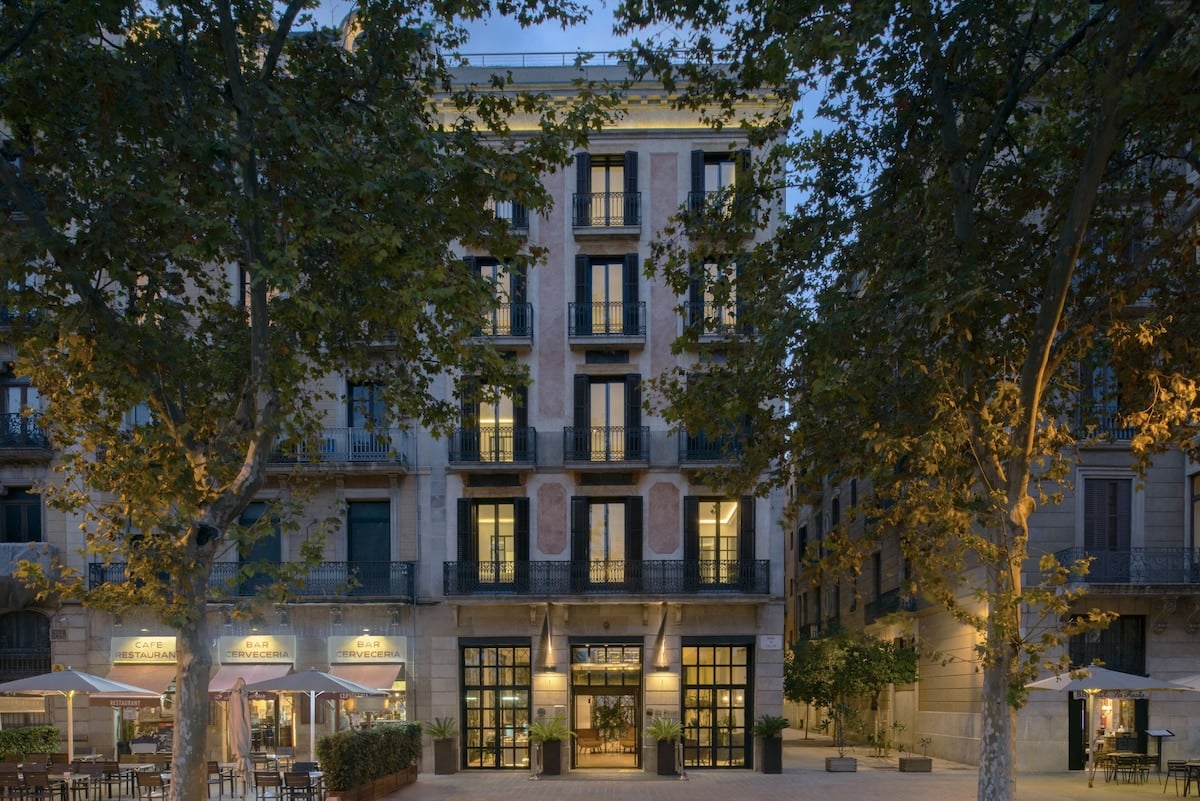
Neo-classical 1846 façade overlooking Port Vell — 28 rooms, a rooftop pool on the sixth floor, and Picasso's early shadow cast across the walls.
THE BACKSTORY
The building at Passeig de Colom 9 was designed in 1846 by Francesc Daniel Molina — the same architect who laid out Plaça Reial three blocks to the north. In 1897, the sixteen-year-old Pablo Picasso rented a studio room here and painted Ciencia y Caridad, a realist masterwork that today hangs at Museu Picasso 750 metres to the north. The hotel opened in January 2015 following a renovation that preserved the neo-classical façade; the interiors were designed by Eva Martínez, with hydraulic encaustic tiles as headboards and natural materials on a muted Mediterranean scale.
WHY NOW
Since Agreste Mar opened with Fabio Gambirasi's Italo-Catalan kitchen, the hotel has gained two distinct culinary identities under one roof. The rooftop pool remains open throughout summer with a direct view over Marina Port Vell.
THE ROOM
Junior Suite Marina on the upper floors faces the harbour basin — sailing boats in Port Vell are visible without getting out of bed.
WELLNESS
No spa on site. In-room treatments — massage, reflexology, facials — can be arranged through the concierge. The hotel's 24-hour gym is equipped with Life Fitness machines.
THE TABLE
Fresh pasta — tagliarini or ravioli with seasonal produce — Agreste Mar. Fabio Gambirasi's Italo-Catalan kitchen, awarded 1 Sol Repsol, is served in the hotel's own restaurant overlooking the marina quays — the pasta is rolled by hand every day.
THE SERVICE
The hotel's size — 28 rooms — means staff know every guest by name from check-in; the concierge books tables at Agreste Mar directly, without any external intermediary.
THE NEIGHBORHOOD
Passeig de Colom 9 sits on the border between Barri Gòtic and Port Vell. Plaça Reial is a five-minute walk through the narrow lanes of the Gothic Quarter. Museu Picasso lies 750 metres to the north via Carrer de la Princesa. Barceloneta and the beach are accessible to the south.
HONEST CAVEAT
No spa on site — in-room treatments must be arranged separately. Rooms are compact even by boutique standards; the Superior category is not suited to guests who need space to spread out.
THE VERDICT
The Serras is Barcelona's most compact five-star address: 28 rooms, no proper lobby, no spa. What justifies the price tag is its position at the waterline in a city where five stars otherwise means Eixample distance from the sea — and a rooftop pool whose view is difficult to put a price on.
THE FULL PICTURE
The heavy glass door swings shut, instantly muting the diesel hum of Port Vell’s marina traffic. The air inside is cool and smells of worn leather and strong coffee from the compact bar. A pair of maritime lawyers in unstructured blazers murmur over contracts at a low table, while the concierge, unflustered, directs a German couple towards the Picasso museum. This isn't a lobby for grand entrances; it's a discreet, functional threshold between Barcelona's Gothic labyrinth and its modern maritime wealth, an immediate recalibration of pace. You feel the city's pulse here, but from a carefully managed distance.
The true decision begins the moment you consider your room. The trade-off is stark: city or sea. Insist on a Sea View room on the fourth or fifth floor to secure the definitive panorama of the marina and its superyachts. Corner Suite 501 has the best vantage, with a balcony that wraps around the building's neoclassical facade, offering a sweeping arc of the port. Open the shutters at 7am and the day's first light catches the masts of the sailboats, glinting against the deep blue of the Mediterranean. The air, crisp with a faint saline tang, slides through the open balcony doors. Below, the polished travertine of the promenade catches the sun, and the early risers – joggers in neon, fishermen mending nets – begin their rhythm. This is the view that anchors your stay, a constant reminder of Barcelona's maritime heart. The lower-floor City rooms, while having high ceilings, absorb the near-constant traffic noise from Passeig de Colom; a compromise not worth the savings, particularly when the clatter of delivery trucks can penetrate even the thickest glass at dawn.
Stepping out, the city calls. From this perch on the edge of the Barcelona Barri Gòtic, the narrow, shadowed lanes of the ancient quarter are a mere seven-minute walk to the Cathedral, its spires piercing the morning sky. This is not just a landmark; it’s a reckoning with centuries of civic aspiration, its intricate facades telling stories of faith and power carved into grey stone. By late morning, after navigating the medieval arteries, the aroma of cured meats and ripe fruit pulls you towards La Boqueria, a ten-minute stroll from the hotel. Here, amid the clamor of vendors and the vibrant chaos of stacked produce, a cultural anthropologist might pause, dissecting the city’s layers of ambition and daily life through its culinary rituals.
Back at the hotel, the ground floor hums with a more refined energy. Chef Marc Gascons has recently refocused the menu at Informal, turning away from broader Mediterranean tropes to a fiercely local, seasonal playbook. This autumn, that means a deep dive into wild mushrooms from the forests of Montseny and game sourced directly from Pyrenean hunters. It's a significant culinary shift that makes the hotel’s ground-floor restaurant a destination in its own right, drawing a discerning local crowd that wasn't here a year ago – architects who've come to argue about Gaudí over the third glass of cava, and discreet art collectors discussing acquisitions. Forget every soggy, sauce-drenched plate of bravas you've ever had. His Patatas bravas 'millefeuille' deconstructs the city's signature tapa into an architectural marvel of crisped potato. Hundreds of paper-thin layers of confited potato are pressed, chilled, and fried into a perfect, shattering cube. It’s served with a sharp, garlicky aioli and a deeply smoky tomato sauce, a technical masterclass that elevates a humble classic into something you'll talk about for days, a testament to what local ingredients, rigorously applied, can achieve.
As dusk settles, the city lights begin to speckle the water, and the thought turns to a Negroni sweating on white marble. The hotel's rooftop is the natural magnet, offering that sweeping vista from the Barri Gòtic across the marina to the distant Montjuïc. But let's be candid: the rooftop pool is emphatically not for swimming. It’s a narrow plunge pool, a sliver of water designed more for Instagram backdrops and cooling your feet after a long day of walking than for any sort of aquatic exercise. The handful of sun loungers are fiercely contested and often claimed before 10 a.m. Furthermore, service on the roof can be glacial on busy afternoons, so order your second glass of cava when the first one arrives. It’s a trade-off: a sublime view and a cooling dip, but expect to be patient for your drink.
The evening might take you to the Palau Musica, a twelve-minute walk through the gas-lamp lit streets, to witness the commanding intricate details of its modernist concert hall. Or you might simply settle back at the hotel’s bar, the murmur of maritime lawyers still present, but now softened by the clink of ice and the low thrum of conversation. This hotel understands its particular place in Barcelona: a quiet anchor for those who appreciate the city's depth without needing to shout about it. It's a place that asks you to engage, to observe, and to immerse yourself, leaving you with a lingering taste of Barcelona's intricate layers, a sense of having genuinely connected with the city's sophisticated pulse.
FACTS
- Neighbourhood: Barri Gòtic
- Stars: 5
- From 420 EUR per night
- Tripadvisor: 4.9/5 (2211)
- 41.3802, 2.1808
FAQ
When is the best time to visit?
Since Agreste Mar opened with Fabio Gambirasi's Italo-Catalan kitchen, the hotel has gained two distinct culinary identities under one roof. The rooftop pool remains open throughout summer with a direct view over Marina Port Vell.
Anything I should know before booking?
No spa on site — in-room treatments must be arranged separately. Rooms are compact even by boutique standards; the Superior category is not suited to guests who need space to spread out.
What is the neighbourhood like around The Serras Barcelona?
Passeig de Colom 9 sits on the border between Barri Gòtic and Port Vell. Plaça Reial is a five-minute walk through the narrow lanes of the Gothic Quarter. Museu Picasso lies 750 metres to the north via Carrer de la Princesa. Barceloneta and the beach are accessible to the south.
MORE HOTELS IN Barcelona
- Hotel 1898 — La Rambla
- ABaC Hotel & Restaurant Barcelona Monument — Sarrià
- Alenti Sitges Hotel & Restaurant — Sitges
- Alexandra Barcelona Hotel Curio Collection — Eixample
- Alma Barcelona GL — Eixample
- Almanac Barcelona — Eixample