Can Mascort Eco Hotel
Palafrugell, Costa Brava · discovery
THE VIBE
Quiet, materially honest and lightly ascetic — like staying with an architect who owns a great many books.
THE BACKSTORY
The building at Carrer Raval Inferior 23–25 in Palafrugell carries a heritage classification of local interest. Before becoming a hotel, it housed a pharmacy — a tradition that lives on today as an ecological pharmacy-boutique on the ground floor. Lourdes Gaude studied hospitality management and drove the project with her partner Alfred; the 15 rooms are distributed across three categories: Standard, Superior and Junior Suite.
WHY NOW
Hotel owners Lourdes Gaude and Alfred renovated the building using bioconstruction methods — solar panels, motion-sensor lighting and natural materials. A TripAdvisor rating of 5.0 across 67 reviews suggests it delivers on its promise.
THE ROOM
Junior Suite Botines has two balconies — one facing Calle Botines and one facing Calle de la Font. Of the five suites, it is the only one with a dual street-level outlook.
WELLNESS
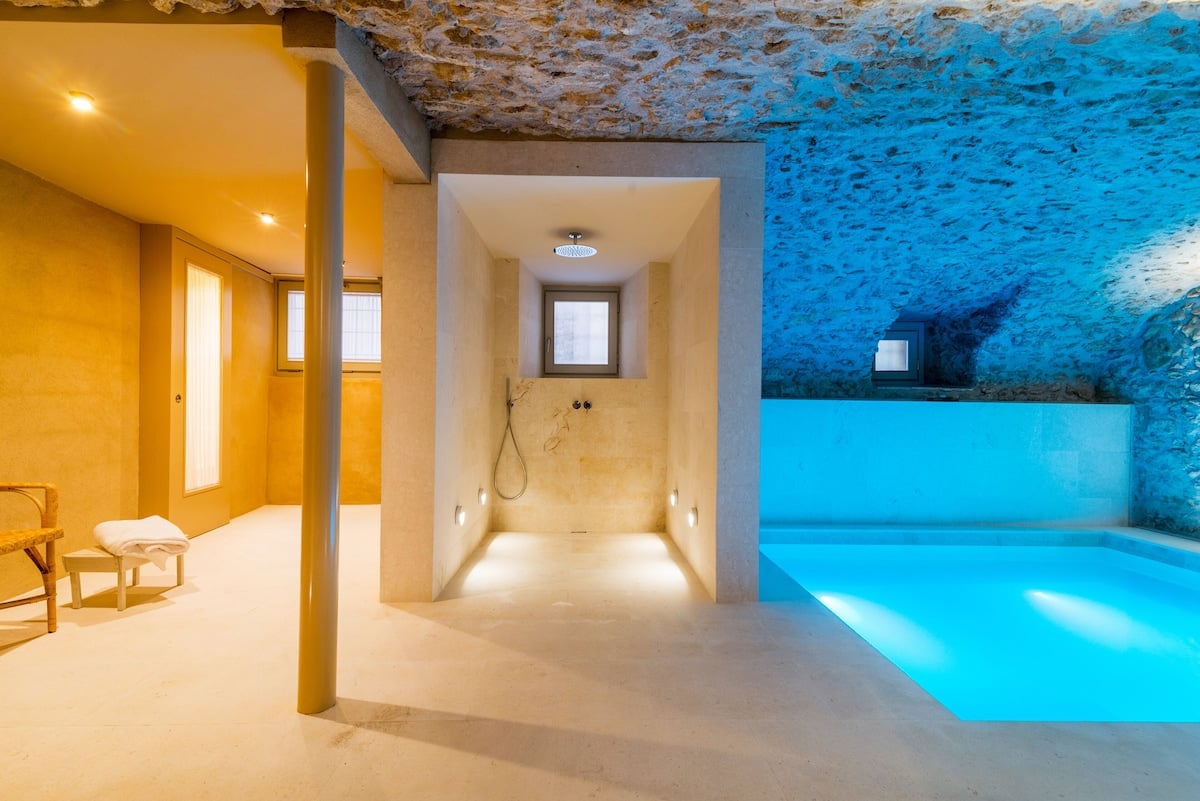
The caldarium — a vaulted stone chamber — offers chlorine-free water at 36 degrees. It is booked separately for private use; bathrobes, slippers, towels and Catalan cava are included in the session.
THE SERVICE
No restaurant kitchen; instead, an honour bar open around the clock and a library with a piano. Breakfast is served 08:30–10:30 and costs 20 euros per person, not included in the room rate — zero-kilometre produce, herbs from the rooftop garden. Bicycle rental and storage are included.
THE NEIGHBORHOOD
Carrer Raval Inferior 23–25 sits in Palafrugell's historic centre. The three beaches of Calella de Palafrugell, Llafranc and Tamariu lie within 4–4.5 km. Girona-Costa Brava Airport is a 50-minute drive.
HONEST CAVEAT
Three-star classification in an old town house — physical limitations of the rooms (low ceilings, narrow staircases) are probable but not source-verified. No restaurant kitchen on site; dinner requires a walk into town.
THE VERDICT
A credible small hotel with a clear philosophy of restraint and an unaffected material language — the right choice for those seeking Palafrugell's centre without resort dynamics.
THE FULL PICTURE
The turn off the coastal road arrives without ceremony — a gravel track, narrowing between low stone walls, the kind of route that discourages anyone not already committed to the destination. Dust lifts behind the tyres in pale clouds. Cicadas drill their single note into the afternoon heat. The scent of rosemary, sharp and medicinal, reaches the car before the building does. And then Can Mascort materialises: an eighteenth-century Catalan farmstead, its sandstone walls the colour of dry bread, standing in the kind of silence that cities have forgotten how to produce.
This is not the Costa Brava of waterfront loungers and sangria buckets. Palafrugell's hinterland operates on a different frequency — agricultural, unhurried, indifferent to the coastal calendar of peak and off-peak. Can Mascort sits at the centre of that indifference, a property that has traded the logic of tourism for the logic of soil. The organic gardens are not an amenity; they are the reason the hotel exists. Vegetables, herbs, olive oil — everything produced on site, everything travelling zero metres from earth to plate. The Slow Food philosophy here is not a marketing position. It is an operating model.
The guests who find their way down that gravel track tend to share a certain orientation. Documentary filmmakers seeking a week of silence to shape a rough cut. Agronomists on sabbatical, curious about the crop rotation. Architects who want to study how a working farm adapts to hospitality without betraying its structure. The occasional family — usually Nordic, usually with children old enough to tolerate the absence of a pool — drawn by the promise that their kids will learn where food actually comes from. What unites them is a tolerance for simplicity and a suspicion of performance. Nobody here is performing relaxation. They are simply present.
The garden suites determine the quality of the stay — this distinction matters more than it might at a conventional property. Waking in a garden suite at seven in the morning is a full sensory event: the soft percussion of the irrigation system clicking on, water hissing across cultivation rows visible through the open window. Basil — peppery, green, immediate — floods the room before coffee does. The terracotta floor tiles hold the coolness of the night. Beyond the linen curtain, artichoke plants stand in ordered ranks, their silvered leaves catching the early light like radar dishes. The standard rooms, honest as they are, face inward. They are clean, well-restored, perfectly quiet. But they miss the agricultural connection that gives Can Mascort its particular charge. Book the garden suite. The price difference is modest; the experiential difference is categorical.
Breakfast sets the terms for the day. A long olive-wood table, its surface carrying the patina of a thousand meals. Tomatoes sliced thick — still warm from the morning sun, impossibly sweet, dressed with nothing but the estate's own oil and a crumble of flaky salt. Fig jam made from the trees visible through the dining room window. Sourdough bread with a crust that resists the knife before yielding. This is not a buffet; it is a statement about what eating can be when the supply chain is measured in footsteps rather than kilometres. The coffee, admittedly, is not produced on site — but it arrives strong and dark in heavy ceramic cups, and nobody complains.
The middle hours belong to the landscape. There are no organised activities in the resort-hotel sense — no tennis courts, no spa menu, no excursion desk. What exists is the land itself. Walking paths thread through the olive groves and out toward the cork oak forests that define this part of the Emporda. The soil changes colour as the elevation shifts — red clay near the farm, pale limestone higher up, dark humus in the shaded valleys where streams run thin in summer. One can observe the farmers working the plots, ask questions about companion planting, or simply sit beneath a fig tree with a book and let the hours dissolve. The nearest beach requires a fifteen-minute drive. The nearest nightlife requires considerably more than that. This is the cost of the location, and Can Mascort does not apologise for it.
Dinner is the day's gravitational centre. There is no menu in the traditional sense — the kitchen works with whatever the gardens have produced that day, and the result arrives at a communal table under low, warm light. A salad of leaves picked an hour ago. Artichokes braised slowly in the estate oil. A herb whose name the server explains but which resists translation. Local red wine, served in short-stemmed glasses, from a family bodega whose output never reaches export markets. The conversation around the table tends toward food systems, land stewardship, the politics of organic certification — not because these are imposed topics, but because the setting makes them inevitable. One eats, and one understands something about the distance between industrial agriculture and what is happening on this plate. The sensation is not luxury. It is clarity.
The departure carries a specific weight. Not the melancholy of leaving a beautiful place, but the recalibration of leaving a coherent one. The smell of dried herbs clings to clothing. A bottle of estate olive oil, heavy and golden, sits in the bag. The taste of that morning's tomato — a taste that supermarket produce has never delivered and never will — persists as a sensory benchmark. Can Mascort does not compete with the coastal hotels of the Costa Brava, and it would be a misunderstanding to compare them. This is a farmstead that has found its twenty-first-century purpose: to demonstrate that ecological credibility is not a constraint on hospitality but its most compelling form. The gravel track that seemed like an inconvenience on arrival now reads as a threshold — the line between the noise of the coast and the deep, productive quiet of the interior.
FACTS
- Neighbourhood: Palafrugell
- Stars: 3
- From 195 EUR per night
- Tripadvisor: 5/5 (67)
- 41.9213, 3.1642
FAQ
When is the best time to visit?
Hotel owners Lourdes Gaude and Alfred renovated the building using bioconstruction methods — solar panels, motion-sensor lighting and natural materials. A TripAdvisor rating of 5.0 across 67 reviews suggests it delivers on its promise.
Anything I should know before booking?
Three-star classification in an old town house — physical limitations of the rooms (low ceilings, narrow staircases) are probable but not source-verified. No restaurant kitchen on site; dinner requires a walk into town.
What is the neighbourhood like around Can Mascort Eco Hotel?
Carrer Raval Inferior 23–25 sits in Palafrugell's historic centre. The three beaches of Calella de Palafrugell, Llafranc and Tamariu lie within 4–4.5 km. Girona-Costa Brava Airport is a 50-minute drive.
MORE HOTELS IN Costa Brava
- Almadraba Park Hotel — Roses
- Boutique Hotel Can Pico — Empordà Interior
- Casa Vincke — Baix Empordà
- Finca Victoria — Begur
- Gran Hotel Reymar & Spa — Tossa de Mar
- Hostal de La Gavina — S'Agaró