Costa Brava — Hotels
Hand-picked hotels in Costa Brava, Katalonien, Spain. Mondmodel's magazine-grade reporting: verified imagery, no paid placement, honest caveats.
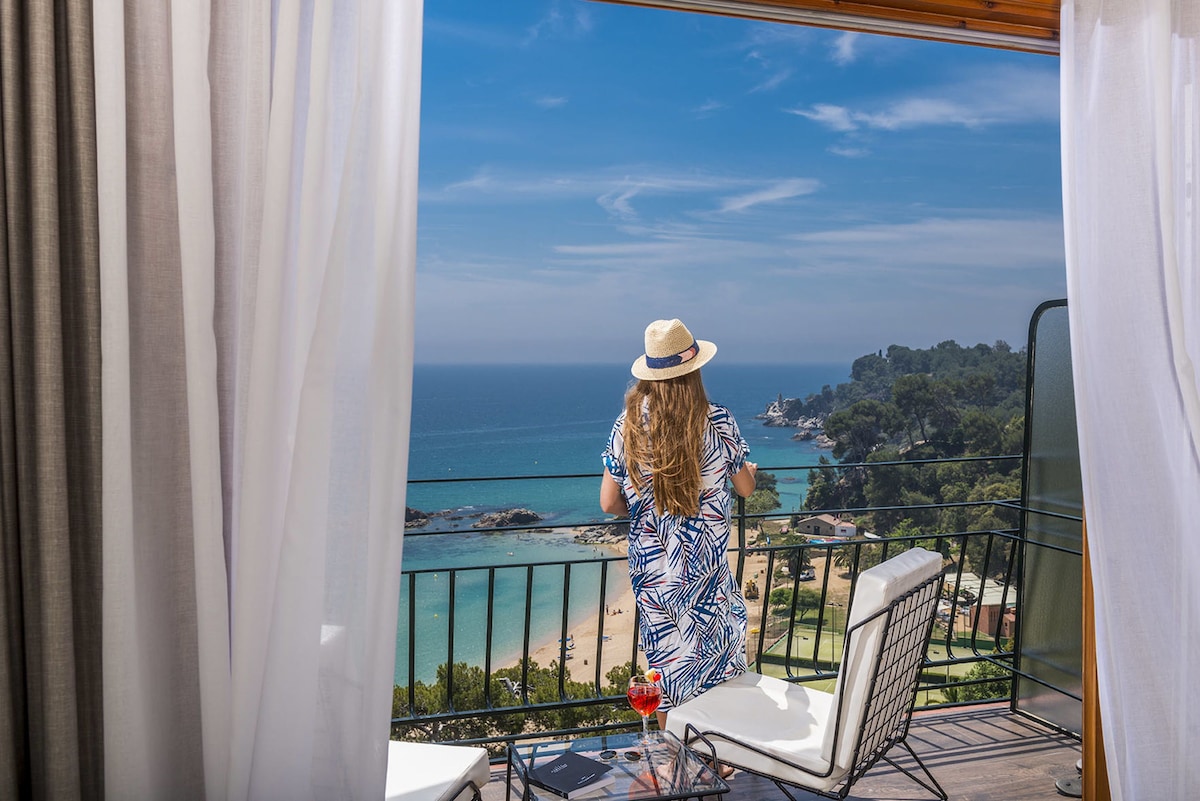
Den Vilda Kustens Ryggrad
Hostal de La Gavina vakar över S'Agarós välbevarade 1920-talsby från sin klippposition sedan 1932 — havsstigen mot Sant Pol löper 200 meter söderut. Vägen vänder inåt mot Empordàs kalkstensslätt: Mas de Torrent reser sig som en katalansk masia mellan olivlundar och vingårdar, åtta kilometer från kustklippan.
Från Mas de Torrents jordklädda stenmurar löper landet norrut — vingårdarna tätnar, Pyrenéernas förberg dyker upp i horisonten. Hotel Peralada placerar sig vid Castell de Peraladas medeltida vingård, där Alt Empordàs kalla tramuntana-vind ger viner med gränsskärpa. Ryggraden avslutar i jord, inte i hav.
The hotels
- Almadraba Park Hotel — Roses / Cala Almadrava · 4★
For the traveller who seeks authenticity without irony: four generations of expertise, Cap de Creus as a neighbourhood, and a kitchen whose defining ingredient gives the hotel its name. - Boutique Hotel Can Pico — Pals / Torrent · 4★
Fifteen rooms in a preserved 1665 masia, four kilometres from the beaches of the Bay of Roses, no spa and a restaurant limited to weekend evenings. Breakfast and a sun-heated pool are included. The right address for those who want the Empordà countryside as a base and the sea as a day trip — wrong for anyone seeking evening service every night. - Can Mascort Eco Hotel — Palafrugell · 3★
A credible small hotel with a clear philosophy of restraint and an unaffected material language — the right choice for those seeking Palafrugell's centre without resort dynamics. - Casa Vincke — Baix Empordà · 4★
Casa Vincke solves a specific equation: nine rooms in a listed eclectic 1900s palace, garden with pool, and Dvisi — Repsol Sol 2026, listed in the Michelin Guide — on the same address. The hotel is not a beach-and-pool resort but a well-reasoned choice for those seeking gastronomic substance and a Catalan house with documented history. The absence of direct beach access is a real compromise. - Finca Victoria — Begur / Aiguablava · 5★
GCA Architects' €12M restoration of a 1960s villa at Cala Sa Riera — 38 rooms and 10 suites in a Member of Design Hotels that opened in July 2025. The right choice for a coastal setting with considered architecture and a kitchen with broad Michelin continuity behind it. - Gran Hotel Reymar & Spa — Tossa de Mar · 4★
At the same address by Mar Menuda since 1961 — a deliberate choice of location, not of design. 166 rooms in 4-star superior class, Reymar Spa with indoor facilities and a PADI dive school at the door. Standard rooms carry the patina of time; balcony rooms overlooking the cove justify the category. Right for guests who are buying the position, not the interior details. - Hostal de La Gavina — S'Agaró / Platja d'Aro · 5★
La Gavina is Spain's oldest LHW hotel in continuous family ownership — a distinction that cannot be bought, only inherited. - Hotel Aigua Blava — Begur / Aiguablava · 4★
Hotel Aigua Blava is not a design hotel — it is one of Catalonia's few remaining family-run coastal hotels with sufficient history to justify every return. - Hotel Aiguaclara — Begur / Aiguablava · 3★
Ten rooms in a listed 1866 palacete in Begur's medieval centre — family-owned since 2000, renovated in 2020 with original details intact. No pool, no spa; the price is justified by location and patina. TripAdvisor's highest-ranked hotel in Begur (4.8 out of 5, 1,586 reviews) confirms the trade-off is worth it. - Hotel BlauMar Llafranc — Palafrugell · 4★
Hotel BlauMar is a considered 4-star option for those seeking direct sea views and the intimacy of a boutique hotel without paying five-star prices. Its position at the foot of Cap de Sant Sebastià with the GR 92 trail accessible from the door makes it a credible base for active coastal stays. - Hotel Camiral — Girona / Caldes de Malavella · 5★
Camiral is the Costa Brava's most complete inland resort: 149 Rosa-Violán-designed rooms, 36 holes with the 2031 Ryder Cup secured, and a 1,000-square-metre wellness centre. The weakness is position — the nearest beach is twenty minutes away and the campus scale demands planning. Best for golfers, wellness travellers, and Girona gastronomes who prioritise resort infrastructure over coastal proximity. - Hotel Casamar — Llafranc · 2★
Casamar is the rare Costa Brava address where the kitchen and the sea view genuinely justify each other. Book a quarter in advance. - Hotel Diana — Tossa de Mar · 4★
One of Costa Brava's few hotels where architectural history is a primary reason to book, not a side effect of location. - Hotel El Far — Calella de Palafrugell / Llafranc · 4★
El Far is a nine-room boutique hotel on Cap de Sant Sebastià, run by the Figueras family and housed in a historic three-building complex spanning three different centuries. The restaurant — monthly menus of rice, fish and shellfish — carries half the stay. The rooms are sober. It is a hotel for those seeking coastal-path stillness and a sea view that is genuinely earned. - Hotel Esperit Roca — Peralada / Inland Empordà · 4★
A 19th-century military fortress, renovated by Fuses-Viader Arquitectes and inaugurated as a hotel in the summer of 2024 by the Roca brothers: a one-Michelin-star restaurant, 80,000 bottles in the cellar and a Catalan kitchen named after their mother. Rewards the gastronomy-driven traveller who plans ahead. - Hotel Historic — Girona · 4★
Hotel Històric is the right choice for the traveller who prioritises historical grounding in place over hotel comfort in the broad sense — the building has the story built into its walls, the location is without competition in Barri Vell, and the family operation provides a connection to the place that chains cannot replicate. TripAdvisor 4.3 indicates that execution holds, not that it excels. Booking price from 165 USD per night. - Hotel Hostalillo — Tamariu / Begur · 3★
The right choice for those who want the Costa Brava's clear waters without the high-season crowds — and refuse to compromise on the view. - Hotel Museu Llegendes de Girona — Girona · 4★
Fifteen rooms, a 700-year-old stone house and the cathedral as your nearest neighbour — the correct address for history-minded travellers to Girona. - Hotel Nord 1901 — Girona · 4★
Hotel Nord 1901 delivers exactly what a food traveller heading to El Celler de Can Roca actually needs: location, credibility, and a kitchen of its own without arrogance. - Hotel Peralada Wine Spa & Golf — Peralada / Inland Empordà · 5★
One of Alt Empordà's most complete five-star offerings: vineyard, golf, wine spa and two restaurants — one of them Michelin-starred — all on a single estate. - Hotel Playa Sol — Cadaqués / Cap de Creus · 4★
For the Cadaqués visitor who wants a base right at the water's edge — with a nature park as a back garden and the village within walking distance — Playasol delivers four-star comfort without a large hotel's impersonality. - Hotel Rigat Park & Spa — Lloret de Mar · 5★
Hotel Rigat Park & Spa is the safest address in Lloret de Mar — a family-held five-star house from 1956 set in a coastal park directly above Platja de Fenals. The tension between a genuinely grand property and a multifaceted budget destination persists; secure a sea-facing room and the argument largely resolves itself. - Hotel Salles Cala del Pi — Platja d'Aro / Cala del Pi · 5★
The right choice for those who want adult tranquillity, a genuinely regional kitchen and a spa of real substance — not the anonymous resort experience. - Hotel Sant Roc — Calella de Palafrugell / Llafranc · 3★
Hotel Sant Roc is the Costa Brava's most consistent family hotel — three generations of the Boix family have run the same address since June 1955, and it shows in how every detail is prioritised without effort. Choose it for the combination of established craft, clifftop position, and chef-driven cuisine. - Hotel Santa Marta — Lloret de Mar · 5★
Hotel Santa Marta is Costa Brava's most carefully composed coastal option for the guest seeking historical substance, pine-scented repose and an adult pool with a sea horizon — without compromising on service standards. The heritage carries its weight and its elegance in the right proportions. - Hotel Spa Cap de Creus — Cap de Creus · 3★
Three stars in the right format: an honest beachfront position in Spain's easternmost coastal village, the Cap de Creus nature park right outside the door, and an aparthotel that makes no attempt to be anything other than what it is. - Hotel Terramar — Llafranc · 3★
For guests seeking authentic Costa Brava character — a family name, a bay and a table with sea views — Hotel Terramar delivers without detour. No more, no less. - Hotel Trias — Palamos · 4★
Hotel Trias sells a location and a literary-historical address — not a design hotel. Lázaro Rosa-Violán's 2005 interior ages with dignity but is ready for a second act. For those who want to stay beside a working fishing harbour on the Costa Brava, with an in-house kitchen that takes its ingredients seriously, it is hard to find better. - Hotel Vistabella — Roses · 5★
Family-owned since 1961, five-star since 2000 and Michelin-recognised since 2012: Vistabella is not a hotel striving upward but one that has long occupied the summit. A new NUXE Spa, Rafa Zafra's kitchen and the third generation of the Veitl family all give good reason to book now. - La Bionda Hotel — Begur · 4★
La Bionda is a 17th-century townhouse restored with a single voice: Carla Lloveras and Quintana Partners Studio. Seven rooms, owner-run, no restaurant and no pool — and that is precisely what the house is meant to be. Those who want beach at their door are in the wrong place; those who want to stay in Begur itself are in exactly the right one. - La Vella Farga — Solsonès Interior · 4★
For those seeking a genuinely remote setting with Relais & Châteaux standards, La Vella Farga delivers without compromise — provided one accepts the isolation as part of the proposition. - Mas de Torrent Hotel & Spa — Pals / Torrent · 5★
Mas de Torrent is Empordà's well-founded anchor point: a manor complex with verified Relais & Châteaux status, a 600-square-metre spa, and gastronomic guidance with elBulli roots. - Mas Ses Vinyes — Calonge / Sant Antoni de Calonge · 4★
For those seeking historic character, a working kitchen and directly bookable tranquillity near the coves of the Costa Brava — without families with children. - Sa Punta Restaurant & Hotel — Begur / Aiguablava · 4★
Sa Punta is a well-rooted four-star adults-only hotel in Begur with a concrete restaurant heritage dating to 1976 and a clearly recast offer since 2023. Choose it for calm, saltwater and a kitchen focused on local produce — not for luxurious new-build design. - Silken Park Hotel San Jorge — Platja d'Aro · 4★
Park Hotel San Jorge is a cliff hotel on a natural site that is in practical terms irreplicable — the pine forest, the two private coves and the Camí de Ronda forming one continuous unit. Right for travellers who choose natural setting and tranquillity over sandy beach and beach club.
Curated areas
Cadaqués & Cap de Creus
The Dalí house-museum at Port Lligat (149,000 visitors a year) defines Cadaqués along Spain's second most expensive coast (€6,760/m²). Compartir — three former elBulli chefs — serves in an 18th-century courtyard.
Roses & Empuriabrava
The Ciutadella de Roses holds thirteen centuries of history within 131,480 m². Empuriabrava — Europe's largest residential marina with 24 km of canals and 42 nationalities — connects watersport to archaeology.
L'Escala & Empúries
Empúries (founded 575 BC) is the only site on the Iberian Peninsula where Greek and Roman ruins stand side by side — 142,000 visitors a year. Salaons Solés has been salt-curing anchovies since 1888.
Begur & Sa Riera
The Costa Brava's luxury epicentre — fifteen-plus colonial villas from the 19th-century Cuban returnees, and Aiguablava property prices that have risen 25–35% since 2020. The strictest rental licences along the entire coast protect its character.
Calella de Palafrugell, Llafranc & Tamariu
The Cantada d'Havaneres (58th edition in 2025) fills Port Bo beach with sea-shanty Cuban songs and flaming cremat. The Camí de Ronda links three villages in two hours. Birthplace of Josep Pla (1897–1981).
Palamós
Gamba de Palamós (€150–225/kg) is auctioned at 4 PM in a Dutch descending format — nine certified trawlers fish at 400–800 metres' depth. Espai del Peix offers cooking classes (€25/person).
S'Agaró
Rafael Masó's noucentista garden city (1916, declared of cultural interest) celebrated its centenary in 2024. Hostal de La Gavina (since 1932) — Murano glass, Carrara marble, Valmont spa — guest book: Ava Gardner, Sean Connery.
Tossa de Mar
The walls of Vila Vella (national monument) are the only preserved medieval fortress on the Catalan coast. Chagall painted here in the summers of 1933–34. ZEL Costa Brava (2024, Meliá × Nadal, 214 rooms) marks a new era.
Lloret de Mar & Blanes
Jardí Botànic Marimurtra in Blanes (4,000+ species) and the Santa Clotilde gardens (HBO House of the Dragon location) refute the mass-tourism reputation. Costa Brava Hub (since 2022) draws digital nomad conferences.
Inland Empordà
Peratallada (declared of cultural interest, with stone-cut moats) and the Pals rice fields (harvest September–October) form the Costa Brava's hidden trump card. Bo.TiC in Corçà serves two-star creative Empordà cooking in a converted carpentry workshop.
The table
El Celler de Can Roca (Creative Catalan). Third best in the world according to The World’s 50 Best, but better than number two if you ask us. The Roca brothers built an institution — Joan cooks, Josep picks the wine, Jordi makes desserts that make grown-ups cry.
Bo.TiC (Creative Empordà). A converted carpentry workshop in a stone village nobody finds without GPS. Two Michelin stars that prove greatness doesn’t need a big city. Albert Sastregener turns Empordà into avant-garde.
Compartir (Creative sharing). The same trio as Disfrutar — just without three-star formalism. A courtyard in an 18th-century house in Cadaqués, sharing dishes, and the feeling you’re dining with friends who happen to be geniuses.
La Cuina de Can Simón (Catalan coastal). One Michelin star in the shadow of Tossa de Mar’s medieval wall. Fishermen land the catch in the morning, you eat it in the evening. Suquet de peix that makes you question every fish stew you’ve had before.
What to do
The Dalí Triangle — Figueres, Port Lligat, Púbol
1.5 million visitors a year. The Teatre-Museu Dalí in Figueres (Catalonia's most-visited museum outside Barcelona), the artist's labyrinthine home in Port Lligat (eight fishermen's cottages joined over 40 years), and the medieval castle in Púbol he gave his wife Gala — on the condition he needed written permission to visit.
Port Lligat allows a maximum of eight visitors per time slot — book online months ahead. Start there at 9 AM, then Púbol, and end with the Figueres museum in the late afternoon.
Kayaking through hidden coves
The Costa Brava's coastline holds hundreds of coves reachable only from the sea. By kayak you slip into caves, snorkel over Posidonia meadows, and stop for a picnic on cliffs no path can reach.
Start from Tamariu towards Cala Pedrosa — a cove with no road access. Early-morning tours give mirror-still water and a better chance of spotting dolphins.
DO Empordà — The wine revolution in the Tramuntana wind
DO Empordà: 2,000 hectares shaped by the Tramuntana wind (gusts up to 120 km/h) that stresses and aerates the grapes. 16 of 27 wineries are organically certified. Exactly the small, terroir-driven wines Nordic sommeliers are already drinking.
Espelt Viticultors (eighth generation, Anna Espelt) produces La Vella — made from nearly extinct white Carignan grapes from hundred-year-old vines. Barely available outside the region.
Camí de Ronda — The coastal trail GR 92
Historic smugglers' paths transformed into Europe's most beautiful coastal walk. The GR 92 winds past hidden coves, through pine-clad cliffs with the Mediterranean fifty metres below.
The Calella de Palafrugell–Llafranc–Tamariu stretch (two hours) is the perfect balance of effort and beauty. Finish with fish by the sea in Tamariu.
Snorkelling at the Medes Islands
Protected marine reserve since 1983. Grouper, moray eels, octopus, and barracuda in crystal-clear water. The underwater world here is what the rest of the Mediterranean once was.
The Medes Islands have the highest fish density in the Mediterranean thanks to forty years of protection. Glass-bottom boat tour plus snorkelling from L'Estartit harbour, book the morning tours for the clearest visibility.