Hotel Casamar
Llafranc, Costa Brava · curated
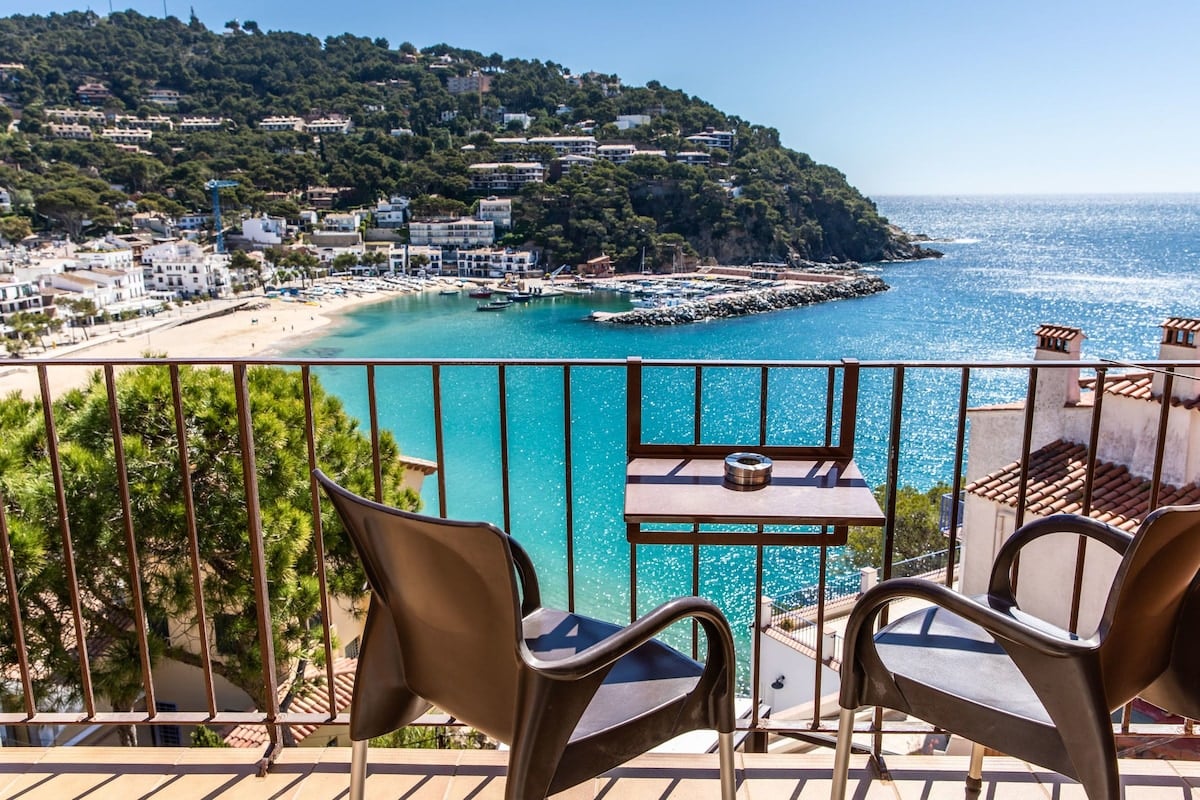
THE VIBE
Seventy years of family history framed by cliffs and Empordà cuisine — without luxury pretensions.
THE BACKSTORY
Joan Casellas and Maria Balaguer opened Casamar in 1955 in an early-twentieth-century summer house at C/ del Nero 3 in Llafranc. The family has deep Catalan roots — descendants of those who once emigrated to Bern and opened Café Madrid there. Quim and María Casellas took over in 2000. The restaurant earned its Michelin star in 2011 — the first in the region that year — and held it for ten years until 2021.
WHY NOW
In winter 2025, Grupo Escriva Interiors renovated all rooms — reducing them from 21 to 18 more generous units — and Biosphere certification followed immediately after. The restaurant reopened on 27 March 2026 with Quim Casellas and head chef Ferran Lladó at the stove.
THE ROOM
Request Double Sea View or Deluxe Sea View — both face the sea. If you want your own kitchen, The Stone Little House at 40 sq m is available.
THE TABLE
Vegetarian cannelloni with Mas Marcè cheese and Dublin Bay prawn — Restaurant Casamar. The hotel's own restaurant — Michelin star 2011–2021 — opens Wednesday to Sunday with tasting menus and à la carte. Slow Food collective and La Cuina de l'Empordanet member since 2007.
THE SERVICE
María Casellas leads the hotel side. Sommelier Àlex Peiró oversees a wine list of over 600 labels, with an emphasis on small producers and DO Empordà. The tone is familial rather than formal.
THE NEIGHBORHOOD
Llafranc lies in the municipality of Palafrugell, tucked between cliffs and one of Costa Brava's most prosperous small marinas. The walk along the cove to Calella de Palafrugell takes under ten minutes.
HONEST CAVEAT
No pool, no spa. The hotel's two stars accurately reflect the service level — this is a well-run family hotel, not a luxury resort.
THE VERDICT
Casamar is the rare Costa Brava address where the kitchen and the sea view genuinely justify each other. Book a quarter in advance.
THE FULL PICTURE
The final serpentine curve of the GI-654 road peels away the inland scrub of the Empordà, revealing Llafranc not with a shout, but a whisper. The village clings to its perfect crescent of a bay, a tumble of terracotta roofs and whitewashed walls punctuated by the dark green of umbrella pines. Hotel Casamar presents itself with similar understatement. From the Carrer de Xaloc, it’s a clean-lined, mid-century structure, its 1950s origins clear but its bearing confident. There is no grand porte-cochère, no uniformed doorman rushing to take your bags. The arrival is a quiet, personal affair: a press of a buzzer, a discreetly marked door, and then an immediate, commanding pivot. You step inside, and the world dissolves into a frame of pure, shimmering Mediterranean blue. The entire rear of the building is glass, and the Bay of Llafranc, with its fleet of small, bobbing *llaüts*, isn't just a view; it's the hotel's central organizing principle. The transition is disarming—from a sleepy Catalan street to a stage overlooking one of the Costa Brava’s most faultless scenes.
The 2019 renovation, which could have easily been a pastiche of coastal kitsch, instead took a sharp turn north. The aesthetic is a study in Nordic restraint: pale oak floors, seating by Carl Hansen & Søn, textiles in muted tones of sea-foam and sand. It’s a design language that refuses to compete with the view, acting instead as a serene, minimalist foreground. This choice has cultivated a specific clientele. You won't find the loud, brand-heavy vacationer here. The crowd at Casamar is one of quiet connoisseurs. There’s the Belgian couple, both architects, poring over a book on Bofill's nearby creations. There’s the woman from San Francisco, a tech executive who hasn’t looked at her phone in two days, simply watching the light change on the water. They speak in hushed tones, not out of formality, but out of a shared understanding that the primary experience here is sensory, not social. They’re here for chef Quim Casellas’s singular vision, for the architectural calm, and for the privilege of being in a place that has edited out everything extraneous.
Nightfall in Llafranc brings a particular soundscape, one that filters perfectly into the sea-view rooms. With the balcony doors slid open, the dominant sound is the gentle, rhythmic shush of waves washing over the coarse sand of the beach below. It's a sound softer than a crash, more of a persistent, calming sigh from the sea. Layered over this is the distant, intermittent clink of wine glasses and cutlery from the terrace of the restaurant—a sound that carries not as noise, but as a faint, promising melody of the evening to come. My room, number 12, is an extension of the public spaces' philosophy. The bed, low-slung and dressed in heavy, immaculate linen, faces the water directly. There are no superfluous cushions, no distracting art. The only decoration needed is the shifting tableau outside: the early morning sun catching the Cap de Sant Sebastià lighthouse to the south, the deep indigo of the sea at dusk. The air itself carries a specific scent, a blend of briny sea salt and the sharp, resinous perfume of the Aleppo pines that cling to the surrounding cliffs, a fragrance that is the very essence of the Costa Brava.
The true pilgrimage for many who come to Casamar, however, is not just for the sea, but for the table. Securing a reservation at Restaurant Casamar has become a competitive sport since Quim Casellas earned his Michelin star in 2020. But the hotel holds a trump card: a four-course lunch tasting menu, an evolving showcase of the day's market, available only to its 22 rooms of guests. To sit down for this meal is to understand the deep narrative of the Empordà. Casellas is not a chef of foams and gels; he is a storyteller, and his medium is the raw, potent produce of his home. A dish of near-translucent, ruby-red Palamós prawns, barely touched by heat, tastes not just of the sea, but of this *specific* sea, a concentration of its minerality and sweetness. Another course, a modern interpretation of *mar i muntanya*, might pair a delicate sliver of local pork belly with sea cucumber, a bold, textural dialogue that speaks to the region's geography. This isn't just eating; it's a lesson in terroir. The exclusivity of the guest-only lunch transforms it from a simple meal into the heart of the Casamar experience—a quiet, intimate conversation with one of Catalonia's most vital culinary voices, far from the clamor of the chasing crowds.
Let's be clear: Casamar’s monastic calm and its unwavering focus on a singular aesthetic are its greatest strengths, but they can also be its sole, minor limitation. If your vision of a Mediterranean holiday involves vibrant, social evenings by a bustling pool bar or rooms filled with the warm, rustic clutter of traditional design, this is not your place. The Nordic purity, while striking, can at times feel cool, almost academic. It’s a space designed for contemplation, not boisterous celebration. But this quietude is precisely the point. It encourages you to step outside. A ten-minute walk south along the Camí de Ronda—the coastal path that snakes its way along this entire stretch of coast—brings you to the impossibly characterful fishing village of Calella de Palafrugell, with its waterfront arches and excellent, no-frills seafood at Tragamar. Head north, and the path climbs steeply towards the Sant Sebastià lighthouse, offering staggering views back over the coastline. Casamar doesn't try to contain you; it acts as a perfectly calibrated basecamp from which to engage with the wild, elemental beauty of the Costa Brava on your own terms.
Leaving is a process of quiet reversal. You walk back through the pale wood lobby, away from the wall of glass that has framed your last few days. The door closes behind you, and the sound of the sea is replaced by the gentle hum of the Llafranc morning. The sensory imprint, however, is indelible. It’s the memory of that specific quality of light—a soft, golden glow that seems unique to this corner of Catalonia. It's the lingering taste of salt and the memory of a prawn so fresh it was practically electric. Hotel Casamar doesn't leave you with a memory of overt luxury or fawning service. It leaves you with something far more potent: a sharpened sense of place. It’s a reminder that true refinement isn't about adding more, but about stripping everything away to reveal the essential, perfect thing—in this case, a view, a flavor, and a profound, restorative quiet. You don’t just check out of Casamar; you carry its meticulously crafted sensory world with you.
FACTS
- Neighbourhood: Llafranc
- Stars: 2
- From 195 EUR per night
- Tripadvisor: 4.4/5 (223)
- 41.8905, 3.1968
FAQ
When is the best time to visit?
In winter 2025, Grupo Escriva Interiors renovated all rooms — reducing them from 21 to 18 more generous units — and Biosphere certification followed immediately after. The restaurant reopened on 27 March 2026 with Quim Casellas and head chef Ferran Lladó at the stove.
Anything I should know before booking?
No pool, no spa. The hotel's two stars accurately reflect the service level — this is a well-run family hotel, not a luxury resort.
What is the neighbourhood like around Hotel Casamar?
Llafranc lies in the municipality of Palafrugell, tucked between cliffs and one of Costa Brava's most prosperous small marinas. The walk along the cove to Calella de Palafrugell takes under ten minutes.
MORE HOTELS IN Costa Brava
- Almadraba Park Hotel — Roses
- Boutique Hotel Can Pico — Empordà Interior
- Can Mascort Eco Hotel — Palafrugell
- Casa Vincke — Baix Empordà
- Finca Victoria — Begur
- Gran Hotel Reymar & Spa — Tossa de Mar