Hotel Santa Marta
Lloret de Mar, Costa Brava · imperial
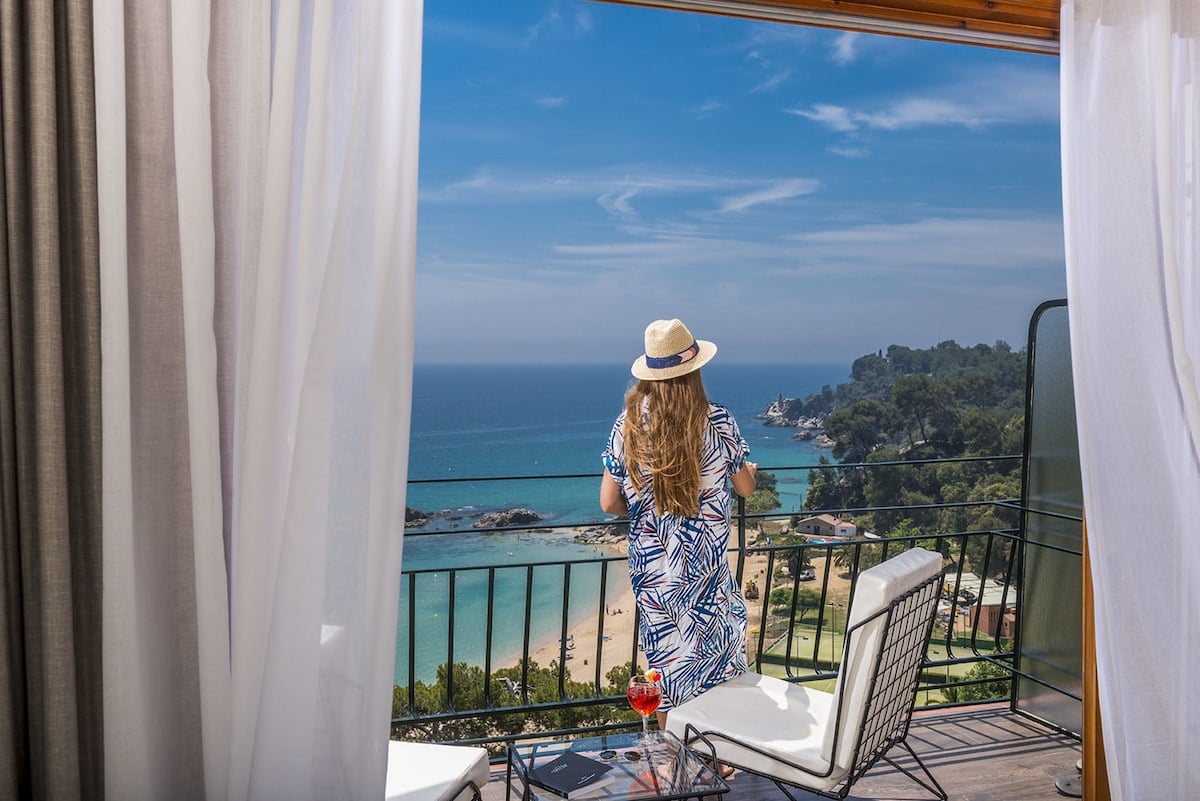
THE VIBE
Five-star family heritage in a pine forest at Santa Cristina Bay — opened 14 June 1958 by Josep Noguera Espasa and Marta Batlló Canadell, built from the Batlló family's late-19th-century summer villa. Architect Joan Barangué Tusquets designed an elongated building adapted to the rugged coastal landscape. The hotel bears the owner's name and that of the Catalan patron saint of hospitality: Santa Marta.
THE BACKSTORY
The property has its roots in the Batlló family's late-19th-century summer villa. Josep Noguera Espasa and Marta Batlló Canadell commissioned architect Joan Barangué Tusquets to convert and expand the villa into a hotel, inaugurated on 14 June 1958. The hotel was named after Marta — the owner — and Santa Marta, the patron saint of Catalan hospitality. In 1962 a further 20 rooms were added, and in 1972 a further 14, bringing the total to the current 76 rooms. The building is elongated and respects the rugged coastal landscape in the spirit of Barangué.
WHY NOW
During the summer of 2025, guests confirmed in reviews that the exterior outdoor areas had undergone updates. SantaMar beach club's infinity pool — reserved for adults — places Costa Brava's quietest bathing cove in direct line with the Mediterranean. Early booking is recommended: 76 rooms and a property that has never expanded beyond its natural boundary.
THE ROOM
Sea Rooms offer direct views of Santa Cristina Bay. Nature Rooms and Forest Deluxe face the hotel's pine forest — suited to those who prioritise shade and quiet over sea views. Choose based on the direction of morning light rather than room category size.
WELLNESS
The hotel's spa covers 400+ m² with a complete hydro-circuit programme: heated pool, cold-water pool, steam bath, sauna, chromotherapy showers and a jacuzzi with underwater reclining surface. The treatment menu includes Ayurvedic massage, reflexology and massage offerings in the protected outdoor Serenity zone — individually or for couples.
THE TABLE
Rice dishes and fresh fish from the maritime Costa Brava kitchen — Restaurant 58. The hotel's own restaurant concept, named after its opening year 1958, serves coastal Catalonia's traditional maritime cuisine revisited with seasonal local ingredients and panoramic views.
THE SERVICE
Five-star service with a spa and wellness team, adults-only pool attended at SantaMar beach club, and three dining surfaces: Restaurant 58 for dinner, the SantaMar restaurant at the beach club for lunch, and the Serenity zone for outdoor massage. TripAdvisor's 520+ reviews confirm personalised service as the hotel's consistent strength.
THE NEIGHBORHOOD
The hotel is situated at Platja de Santa Cristina, one of Costa Brava's more sheltered coves north of Lloret de Mar's centre. Santa Cristina beach is accessible on foot from the hotel's SantaMar beach club. Lloret de Mar itself is one of Catalonia's most visited resort towns — sharply contrasted by the hotel's forest setting.
HONEST CAVEAT
Restaurant 58 holds a 4.0 TripAdvisor rating on a limited review base — it is a good table but not uncontested. Lloret de Mar as a destination is dense in summer and entertainment-oriented; the hotel's position at Santa Cristina beach provides a marked sense of calm, but the town beyond is of a different character.
THE VERDICT
Hotel Santa Marta is Costa Brava's most carefully composed coastal option for the guest seeking historical substance, pine-scented repose and an adult pool with a sea horizon — without compromising on service standards. The heritage carries its weight and its elegance in the right proportions.
THE FULL PICTURE
You don't drive to the Hotel Santa Marta; you arrive upon it. The road out of the thrumming, almost febrile heart of Lloret de Mar coils upwards and inwards, the public asphalt giving way to a private lane that cuts through seven hectares of protected Aleppo pine forest. The air changes instantly. The humid, sweet-shop scent of resort towns is replaced by the dry, resinous perfume of sun-baked needles and salt. There is no grand, declarative entrance, just a discreet sign and then the long, low-slung 1969 profile of the hotel, its modernist bones given a comprehensive 2022 polish. As I stepped from the taxi, the only sound was the manic, rhythmic thrum of cicadas, a sound so dense it felt like a physical barrier. The porter, a man of impeccable posture and a face that had seen decades of summers come and go, took my bag without a superfluous word. Check-in was not at a desk, but in a hushed salon overlooking the searing blue of the Mediterranean, with a glass of ice-cold, bone-dry rosé placed in my hand. This is not an arrival; it is a decompression.
The crowd here is a specific tribe of Quiet European. They are not here to be seen, but to disappear. You spot them by the pool—not the main family pool, but the more secluded infinity pool higher on the cliff—deep into paperbacks, not phones. They are architects from Hamburg, gallerists from Milan, dynastic Catalan families whose grandfathers might have summered here when Franco was still in power. Their children are well-behaved, their swimwear is understated, and their conversations are pitched low. This is a place for people who understand that the greatest luxury is not addition, but subtraction. There is no thumping music, no intrusive animation team. The quiet is the primary amenity, a resource to be fiercely guarded. The renovation has been intelligent and respectful; it has not erased the hotel’s history but burnished it. The original terrazzo floors are polished to a cool gleam, the furniture is a mix of Spanish design classics and custom pieces in pale wood and linen, and the art on the walls is abstract and suggestive. Every detail, from the weight of the door handles to the weave of the bathrobes, communicates a quiet, confident quality.
My most indelible memory will not be of a grand view or an exquisite meal, but of a sound. Every morning, just before dawn, I’d wake to the faint, rhythmic lapping of waves on the fine-grained sand of Santa Cristina beach below. With the balcony doors cracked open, it was a soft, persistent *shush-shush* that filtered up through the pines, a natural metronome setting the pace for the day. It was a sound of profound stillness, punctuated only by the cry of a distant gull. It is this sensory detail that defines the Santa Marta. The light here, too, is different; filtered through the canopy of pines, it dapples the terraces and walkways in a constantly shifting pattern of chiaroscuro, a living, breathing architecture. In the evening, this experience is translated onto the plate at Sa Caleta restaurant. To sit on the terrace, watch the last embers of the sun die behind the headland, and be presented with the tasting menu is a form of theatre. The chef reinterprets Catalan classics with a surgeon’s precision; a deconstructed *suquet de peix* (fish stew) where each component is perfectly cooked and allowed to shine, or local *gambas de Palamós* served almost raw with just a whisper of olive oil and sea salt. It is cooking that whispers, not shouts.
But no place is without its quirks. The honest caveat of the Santa Marta is a product of its greatest strength: its history. Even with the exhaustive renovation, there is a lingering formality to the service that might feel a touch remote to those accustomed to the effusive, first-name-basis style of modern boutique hotels. The staff are impeccably professional, efficient, and anticipatory, but there is a certain ceremonial distance. It is not cold, but neither is it warm. It is a holdover from a grander, more formal era of hotellerie, a style that prizes discretion and protocol over chummy familiarity. For someone looking for a concierge to become their best friend, this could feel stiff. For me, it was part of the charm, the mark of an institution that feels no need to chase every trend. To truly appreciate the hotel's seclusion, one must also leave it. A walk along the coastal path to the neighbouring Santa Clotilde Gardens, a masterclass in clifftop Neoclassical design, is essential. So too is a short taxi ride to Tossa de Mar to explore its walled medieval old town, the Vila Vella, a sharp, historic counterpoint to the modern clamour of Lloret.
Leaving the Santa Marta is like a slow ascent from a deep dive. As the taxi wound back through the pines and onto the main road, the outside world felt intrusively loud, garish. The scent of pine and salt lingered on my clothes, a phantom of the quiet I was leaving behind. The hotel is not an escape from reality. It is a temporary immersion into a more considered, deliberate version of it. The memory I carry is not of a single event, but of a state of being: the feeling of cool stone floors under bare feet, the dappled sunlight on a whitewashed wall, and the eternal, calming sound of the sea whispering through the trees. It’s a place that doesn’t demand your attention, but simply rewards it.
FACTS
- Neighbourhood: Lloret de Mar
- Stars: 5
- From 380 EUR per night
- Tripadvisor: 4.3/5 (516)
- 41.711, 2.8445
FAQ
When is the best time to visit?
During the summer of 2025, guests confirmed in reviews that the exterior outdoor areas had undergone updates. SantaMar beach club's infinity pool — reserved for adults — places Costa Brava's quietest bathing cove in direct line with the Mediterranean. Early booking is recommended: 76 rooms and a property that has never expanded beyond its natural boundary.
Anything I should know before booking?
Restaurant 58 holds a 4.0 TripAdvisor rating on a limited review base — it is a good table but not uncontested. Lloret de Mar as a destination is dense in summer and entertainment-oriented; the hotel's position at Santa Cristina beach provides a marked sense of calm, but the town beyond is of a different character.
What is the neighbourhood like around Hotel Santa Marta?
The hotel is situated at Platja de Santa Cristina, one of Costa Brava's more sheltered coves north of Lloret de Mar's centre. Santa Cristina beach is accessible on foot from the hotel's SantaMar beach club. Lloret de Mar itself is one of Catalonia's most visited resort towns — sharply contrasted by the hotel's forest setting.
MORE HOTELS IN Costa Brava
- Almadraba Park Hotel — Roses
- Boutique Hotel Can Pico — Empordà Interior
- Can Mascort Eco Hotel — Palafrugell
- Casa Vincke — Baix Empordà
- Finca Victoria — Begur
- Gran Hotel Reymar & Spa — Tossa de Mar