Hotel Esperit Roca
Peralada / Inland Empordà, Costa Brava · curated
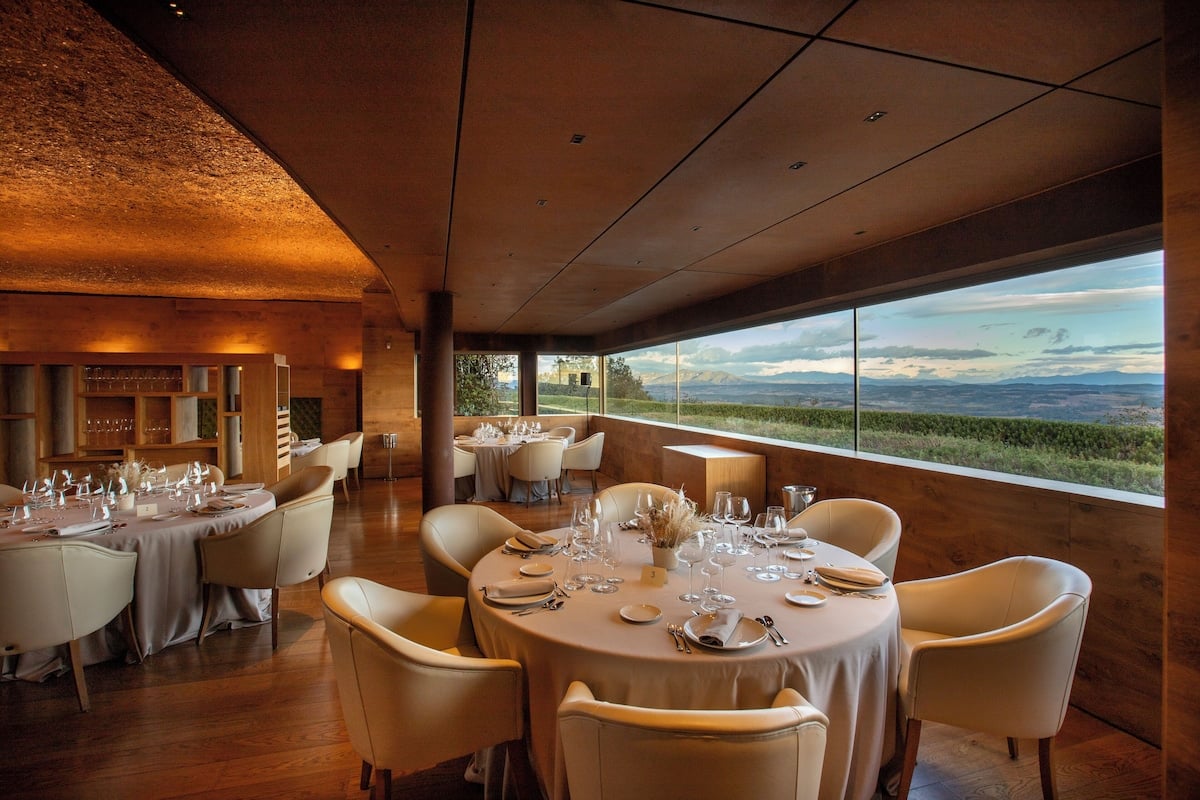
THE VIBE
A 19th-century hilltop fortress 12 km north of Girona — silent, stripped back and deeply gastronomic.
THE BACKSTORY
The fort on the Sants Metges hill was begun in 1893 under the direction of engineering lieutenant Rafael Peralta Maroto and completed in 1912 — the only example in Catalonia of the defensive system designed by General Séré de Rivières. The architecture practice Fuses-Viader Arquitectes (Josep Fuses and Joan M. Viader) completed a ten-year transformation in 2018 for the jeweller Ramón López, who created an art centre and hotel within the masonry. After López's death, the complex closed during the pandemic. Brothers Joan, Josep and Jordi Roca — owners of El Celler de Can Roca, the three-Michelin-star restaurant in Girona — opened Esperit Roca in May 2024.
WHY NOW
Restaurant Fontané opened on 27 April 2025, bringing Montserrat Fontané's Catalan home cooking up to the fortress's top floor — open to all, not just hotel guests. The complex is now fully operational with two restaurants for the first time since the Roca brothers took over.
THE ROOM
Request a room with views toward the Empordà side: the panorama over the southern foothills of the Pyrenees carries more weight than the city perspective. The most sought-after positions book out months in advance.
WELLNESS
The spa accommodates an outdoor jacuzzi, sauna, hammam, heated stone benches and a sensation shower; the treatment cabin, stocked with Natura Bissé products, is booked separately. The offering is subordinate to the fortress's gastronomic centre of gravity — a complement to dinner, not an independent reason to book.
THE TABLE
Tasting menu of six savoury courses and two desserts — a reinterpretation of El Celler de Can Roca's signature dishes — Esperit Roca (in-house). The house restaurant holds one Michelin star in Guide España 2026. Restaurant Fontané on the upper floor serves Catalan home cooking at €70 (set menu including water, bread and coffee) and is open to the public Thursdays–Sundays.
THE SERVICE
Reception coordinates reservations between the house's two restaurants — the Michelin-starred Esperit Roca and the Catalan kitchen Fontané on the upper floor — ensuring dinner and the following day's lunch do not clash. A helipad and parking are available on site.
THE NEIGHBORHOOD
The fortress crowns the Sants Metges hill in Sant Julià de Ramis, 12 km north of Girona. Girona's cathedral and railway station are a little over fifteen minutes' drive away. El Celler de Can Roca — the brothers' three-star original restaurant — is in Girona's city districts and is not reachable on foot from here. Girona Airport is 30 minutes away.
HONEST CAVEAT
Without a car, you are stranded. The hotel sits 12 km from Girona and no services exist nearby beyond the fortress's own restaurants — every movement outside the complex requires a taxi or hire car.
THE VERDICT
A 19th-century military fortress, renovated by Fuses-Viader Arquitectes and inaugurated as a hotel in the summer of 2024 by the Roca brothers: a one-Michelin-star restaurant, 80,000 bottles in the cellar and a Catalan kitchen named after their mother. Rewards the gastronomy-driven traveller who plans ahead.
THE FULL PICTURE
The drive north from Girona traces the serene course of the Ter river, the soft contours of the Gavarres hills rolling against a crisp Catalan sky. Then, with little fanfare, it appears. The fortress of Sant Julià de Ramis is not a storybook silhouette of turrets and flags but a stark, geological fact embedded in the landscape—a bastion of sandstone that has weathered centuries of wind and history. The arrival at Hotel Esperit Roca is a deliberately understated affair. There is no grand, sweeping driveway, no over-eager valet. A discreet gravel track leads to a single, immense, iron-studded door. The crunch of tires on stone is the only sound. This is a threshold, not just to a building but to a different cadence of time. The moment that heavy door swings open and you step inside, a palpable shift occurs. The temperature drops by several degrees; the ambient sound of the outside world is completely extinguished, replaced by a dense, almost devotional quiet. You have not just arrived; you have retreated. The check-in is a quiet ceremony at a desk of reclaimed oak, the only offering a glass of chilled local spring water infused with a sprig of rosemary. It's the first clue to the Roca philosophy that permeates every detail: the essential, the local, the thing that speaks for itself without shouting.
It’s the scent that first defines the experience within the walls. A complex, layered perfume that could never be bottled. First, the chalky, cool scent of medieval stone that has been breathing for a millennium. Then, a subtle, dry note of wild lavender and thyme, as if the Empordà wind has slipped through the arrow-slit windows and left its ghost behind. And beneath it all, an almost imperceptible, saline undertone of Jamón Ibérico being carved in some distant part of the stronghold. This is the olfactory manifesto of the Roca brothers' vision. My suite is a masterclass in textural restraint. The room is almost monastic in its simplicity, yet every surface invites touch: the rough-hewn beams of dark pine, the hand-loomed linen sheets from a local weaver that feel cool against the skin, a single, heroic slab of regional marble forming the vanity. Light is the primary decorative element here. It falls in dramatic shafts through the meter-deep window embrasures, once designed for crossbowmen, tracing the slow passage of the day across the polished limestone floor. This is a room that doesn't just shelter you; it demands your presence. It compels you to slow down, to notice the grain in the wood, to feel the heft of a handmade water glass, to simply be.
The evening meal is the central ritual of the place, the axis around which the day revolves. The dining room, perhaps a former munitions hall, is a cavernous space made intimate by intelligent lighting, with warm pools of light creating isolated islands of conversation at each table. The crowd is as curated as the menu. They are not the conspicuous consumers of luxury, but a self-selecting tribe of connoisseurs. At one table, a Pritzker Prize-winning architect sketches quietly in a Moleskine between courses. At another, a couple from Tokyo who have flown here for this express purpose, their conversation a low murmur. There is a shared understanding in the room; no one is here by accident. The menu is a dialogue with the surrounding landscape, a gastronomic translation of the Empordà terroir. A dish of local *recuit de drap* cheese with anchovies from L’Escala and a syrup of dried figs is not just food; it is a topographical map on a plate. It is the El Celler de Can Roca ethos—memory, landscape, technique—distilled into a more elemental, direct form that is in perfect dialogue with the soul of the fortress.
And here, an honest caveat is necessary. Hotel Esperit Roca is not a resort; it is a thesis. It is an argument for a certain way of living, and its convictions are uncompromising. The silence, so profound within these two-meter-thick walls, can feel absolute, almost unnerving to a nervous system accustomed to the constant hum of distraction. The location, while strategically poised, requires commitment. A spontaneous desire to pop into Girona's Old Quarter for a *vermut* is not a whim but a planned, 20-minute excursion. This is a destination in the truest sense; you do not stay here to see the Empordà, you stay here to inhabit a very specific, masterfully articulated vision *of* the Empordà. For some, this intense focus could feel less like a sanctuary and more like a beautiful, exquisitely catered, and slightly demanding monastery.
Leaving is a process of sensory re-acclimatization. The moment the heavy gates close behind the car and you are back on the public road, the sounds and smells of the world rush back in: the drone of a distant tractor, the scent of dry dust and hot asphalt, the unfiltered glare of the sun. The experience does not end abruptly; it leaves an aftertaste, an intellectual residue. You find yourself considering the provenance of the olive oil at your next meal, noticing the texture of a stone wall in a village you pass through. The Roca brothers have not just created a hotel; they have created a lens through which to see the world. It is a formidable, demanding, and profoundly intelligent piece of work that recalibrates your senses long after you have departed. You leave not merely rested, but with a heightened sense of place, carrying a piece of the fortress's soul with you down the winding Catalan road.
FACTS
- Neighbourhood: Peralada / Inland Empordà
- Stars: 4
- From 350 EUR per night
- Tripadvisor: 4/5 (2)
- 41.992, 2.825
FAQ
When is the best time to visit?
Restaurant Fontané opened on 27 April 2025, bringing Montserrat Fontané's Catalan home cooking up to the fortress's top floor — open to all, not just hotel guests. The complex is now fully operational with two restaurants for the first time since the Roca brothers took over.
Anything I should know before booking?
Without a car, you are stranded. The hotel sits 12 km from Girona and no services exist nearby beyond the fortress's own restaurants — every movement outside the complex requires a taxi or hire car.
What is the neighbourhood like around Hotel Esperit Roca?
The fortress crowns the Sants Metges hill in Sant Julià de Ramis, 12 km north of Girona. Girona's cathedral and railway station are a little over fifteen minutes' drive away. El Celler de Can Roca — the brothers' three-star original restaurant — is in Girona's city districts and is not reachable on foot from here. Girona Airport is 30 minutes away.
MORE HOTELS IN Costa Brava
- Almadraba Park Hotel — Roses
- Boutique Hotel Can Pico — Empordà Interior
- Can Mascort Eco Hotel — Palafrugell
- Casa Vincke — Baix Empordà
- Finca Victoria — Begur
- Gran Hotel Reymar & Spa — Tossa de Mar