Hotel Aigua Blava
Begur / Aiguablava, Costa Brava · flagship
THE VIBE
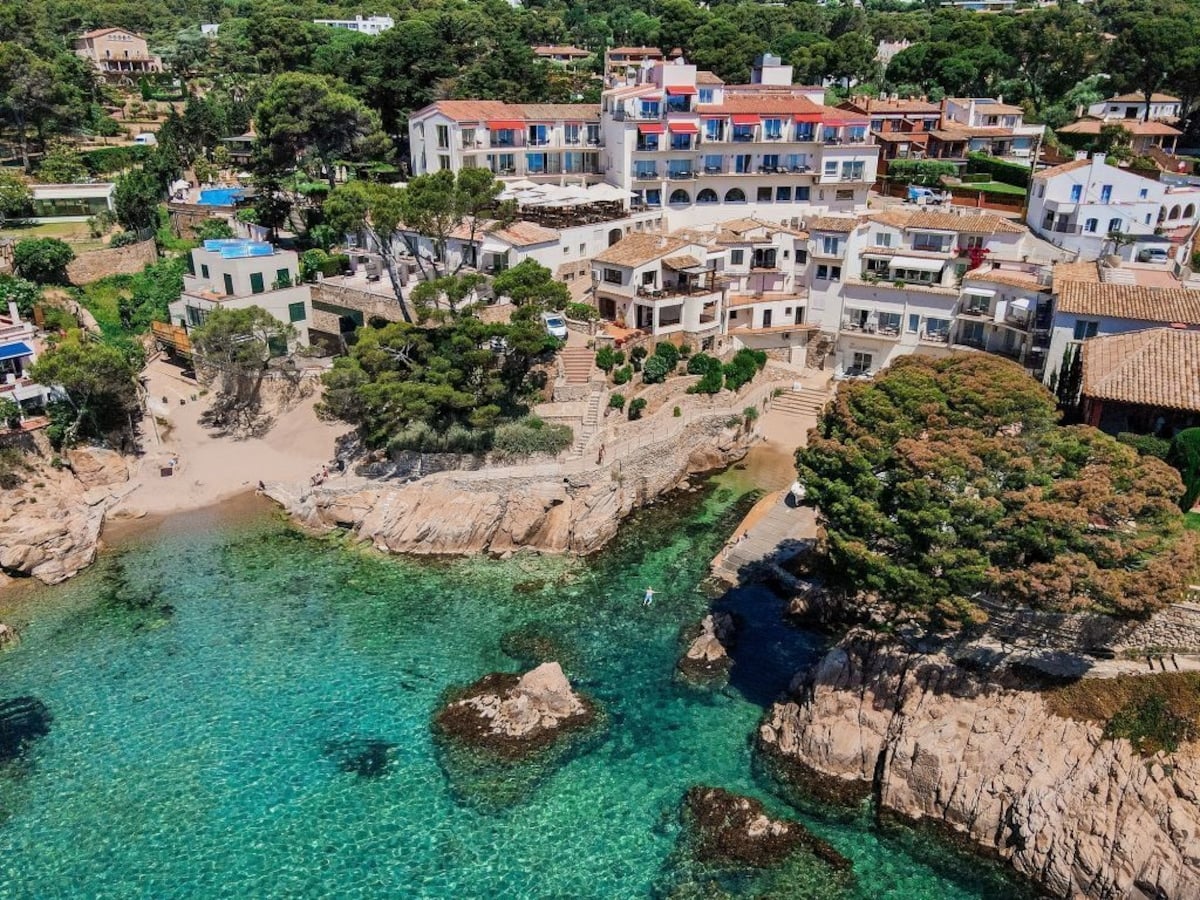
Since 1934, one and the same family has kept watch over the bay of Aiguablava — four generations of continuity in a landscape that rarely compromises.
THE BACKSTORY
Clara Capellà — known as 'la Clareta' — founded a small lodging house in 1934 on Finca El Paradís at the bay of Aiguablava. It was son-in-law 'Xiquet' Sabater who transformed Clareta Hostal into the proper hotel now run by the third and fourth generation. The historical weight is not retrospective: in 1908 the newspaper La Veu de Catalunya coined the term 'Costa Brava' with a direct reference to 'the estate at the Fornells inlet known as Paradís.'
WHY NOW
In summer 2026, the restaurant received a Travelers' Choice award on TripAdvisor, and head chef Lluís Ferrés — with nearly twenty years in the same kitchen — is at the peak of his powers with a creative Catalan menu rooted in Empordà produce.
THE ROOM
Rooms facing Aiguablava bay deliver a direct view of the water; choosing the garden side gains you greater tranquillity but sacrifices the sea frame.
WELLNESS
The hotel does not have a standalone spa facility; the focus rests on the pool — a heated seawater pool of 25 metres maintained at 30°C — and the beach at Aiguablava, accessible directly from the property.
THE TABLE
Seasonal Catalan menu featuring Empordà produce — Restaurant Aiguablava. Head chef Lluís Ferrés has led the kitchen for nearly twenty years and applies classical Catalan technique to local ingredients — half-board is recommended by reviewers as the most worthwhile option.
THE SERVICE
Head chef Lluís Ferrés leads the restaurant with nearly twenty years in the house and a menu that sources its ingredients directly from Empordà producers. Alongside the main restaurant with panoramic views sits La Rocalla — the pool restaurant in the garden for those who prefer a lighter lunch in the shade.
THE NEIGHBORHOOD
The hotel is situated at Carrer Francesc Sabater 12 on the bay of Aiguablava, within the municipality of Begur. The Camino de Ronda coastal path is accessible directly from the hotel.
HONEST CAVEAT
The room interiors are functional rather than contemporary — it is the setting and the family spirit, not design-hotel aesthetics, that justify the stay.
THE VERDICT
Hotel Aigua Blava is not a design hotel — it is one of Catalonia's few remaining family-run coastal hotels with sufficient history to justify every return.
THE FULL PICTURE
The drive down from Begur’s medieval core is a winding overture. The road narrows, flanked by dry-stone walls and umbrella pines that canopy the Catalan sun. The air changes here; the scent of dusty earth and wild fennel gives way to a sharper note of salt and resin. Then, around a final hairpin bend, the bay reveals itself. Aiguablava, the blue water, is a cliché made real, a shock of almost impossible turquoise. The hotel does not announce itself with grand gates or a garish sign. It unfolds organically, a cascade of whitewashed walls, terracotta tiles, and flowering bougainvillea clinging to the cliffside. Stepping out of the car, the first sound is the relentless, high-frequency hum of cicadas—a sonic signature of the heat. The reception is cool, tiled, and hushed; it murmurs mid-century grace rather than shouting 21st-century luxury. This is not an arrival; it’s a homecoming to a place you have never been.
The hotel's very geography is its narrative. Terraces descend towards the sea like paddies, each offering a new, thoughtfully composed perspective on the bay and the small port of Fornells. The saltwater pool, cantilevered over the rocks, is the central stage, the social theatre. It is here you observe the hotel’s archetypes. These are not the transient, self-aware guests of Ibiza or Mykonos. They are dynasties of discretion from Barcelona, Madrid, and Northern Europe. You see three generations on a single set of sun loungers: the patriarch reading La Vanguardia in the shade, his daughter patiently applying sunscreen to a squirming child, the grandson perfecting his dive from the pool's edge. Conversations are a low melody of Catalan, Castilian, and French, a soundtrack of contented familiarity. Their attire is a uniform of quiet quality: faded Vilebrequin shorts, well-worn Castañer espadrilles, crisp linen shirts that have witnessed countless summers. This is a private club whose membership is simply loyalty, passed down from one generation to the next.
Here, on one of the lower terraces overlooking the hotel’s private concrete-and-rock bathing platform, the crucial sensory detail asserts itself. It is not a smell, nor a sound, but the quality of the light. As the afternoon wanes, the sun slants across the bay, igniting the water from within and backlighting the sails of the small boats. This light filters through the dense canopies of the ancient pines that shade the terrace, creating a kinetic mosaic of light and shadow on the stone floor. It is a warm, syrupy light that seems to slow time itself. And it’s here that an honest caveat must be made. My room, while impeccably clean and boasting a balcony that hangs directly over this spectacle, speaks a different design language. The dark wood furniture, the tiled floors, the slightly compact bathroom—they are perfectly functional but lack the sleek, impersonal polish of a contemporary luxury brand. For those who equate luxury with the latest Philippe Starck tapware or automated blackout blinds, it might register as a flaw. But to see it that way is to miss the point entirely. The room is not the destination; it is a simple, comfortable perch from which to witness it. You trade cutting-edge design for a soul that cannot be manufactured.
The temptation to never leave the hotel's perimeter is strong, but the Costa Brava beckons. One morning, I take the Camí de Ronda, the coastal path that runs directly below the hotel, heading north. The trail winds past hidden coves—Platja Fonda with its dramatic, dark sand, and the tiny fishing hamlet of Sa Tuna. The scent of sea salt and wild fennel is intoxicating. Lunch is not at the hotel's perfectly fine restaurant, but a short drive to the beach at Sa Riera for grilled *navajas* (razor clams) and *pa amb tomàquet* at a simple *chiringuito*, feet in the sand. Another evening is spent wandering the stone-paved alleys of Begur’s hilltop castle, its Cuban-style *cases d'indians* a reminder of a different kind of seafaring history. Returning to the Aigua Blava’s terrace for a final glass of local Empordà wine feels like coming home. The hotel is not an isolation chamber from Catalonia; it is the perfect key to unlocking it.
The final morning, I watch the sunrise from my balcony. The bay is mercury-smooth, the water a pale, luminous blue. The first fishing boats are heading out from the small port below. There’s a quiet industry to the hotel waking up—the clatter of plates being set for breakfast, the soft sweeping of the terrace. Checking out is efficient and warm, familial. Driving back up the winding road, the rearview mirror holds a final frame of that impossible water and deep green pine. The feeling is not of leaving a hotel, but of leaving a family’s summer home where you were a welcome guest. The Aigua Blava does not sell manufactured experiences or fleeting trends. It offers something far more rare: a sense of continuity. It is a reminder that the most profound luxury is a place that remains, reassuringly and beautifully, itself. It is a benchmark against which the character of other hotels, and perhaps other summers, will be measured.
FACTS
- Neighbourhood: Begur / Aiguablava
- Stars: 4
- From 200 EUR per night
- Tripadvisor: 4.5/5 (1307)
- 41.9405, 3.2183
FAQ
When is the best time to visit?
In summer 2026, the restaurant received a Travelers' Choice award on TripAdvisor, and head chef Lluís Ferrés — with nearly twenty years in the same kitchen — is at the peak of his powers with a creative Catalan menu rooted in Empordà produce.
Anything I should know before booking?
The room interiors are functional rather than contemporary — it is the setting and the family spirit, not design-hotel aesthetics, that justify the stay.
What is the neighbourhood like around Hotel Aigua Blava?
The hotel is situated at Carrer Francesc Sabater 12 on the bay of Aiguablava, within the municipality of Begur. The Camino de Ronda coastal path is accessible directly from the hotel.
MORE HOTELS IN Costa Brava
- Almadraba Park Hotel — Roses
- Boutique Hotel Can Pico — Empordà Interior
- Can Mascort Eco Hotel — Palafrugell
- Casa Vincke — Baix Empordà
- Finca Victoria — Begur
- Gran Hotel Reymar & Spa — Tossa de Mar