Hotel Nord 1901
Girona, Costa Brava · flagship
THE VIBE
Family-run boutique hotel in a storied 19th-century building at the medieval heart of Girona.
THE BACKSTORY
The building at Carrer Nord 7–9 has been owned by the same family for over a hundred years. A full restoration was carried out in 2009, preserving the 19th-century façade while modernising the entire interior. The hotel carries the year 1901 in its name as a reference to the family's long presence in the neighbourhood.
WHY NOW
Girona is having its moment: El Celler de Can Roca draws food travellers from around the world, and hotels with genuine local history are difficult to find at this price.
THE ROOM
The Junior Suite at 35 m² offers noticeably more freedom of movement without crossing into suite pricing — book well in advance.
WELLNESS
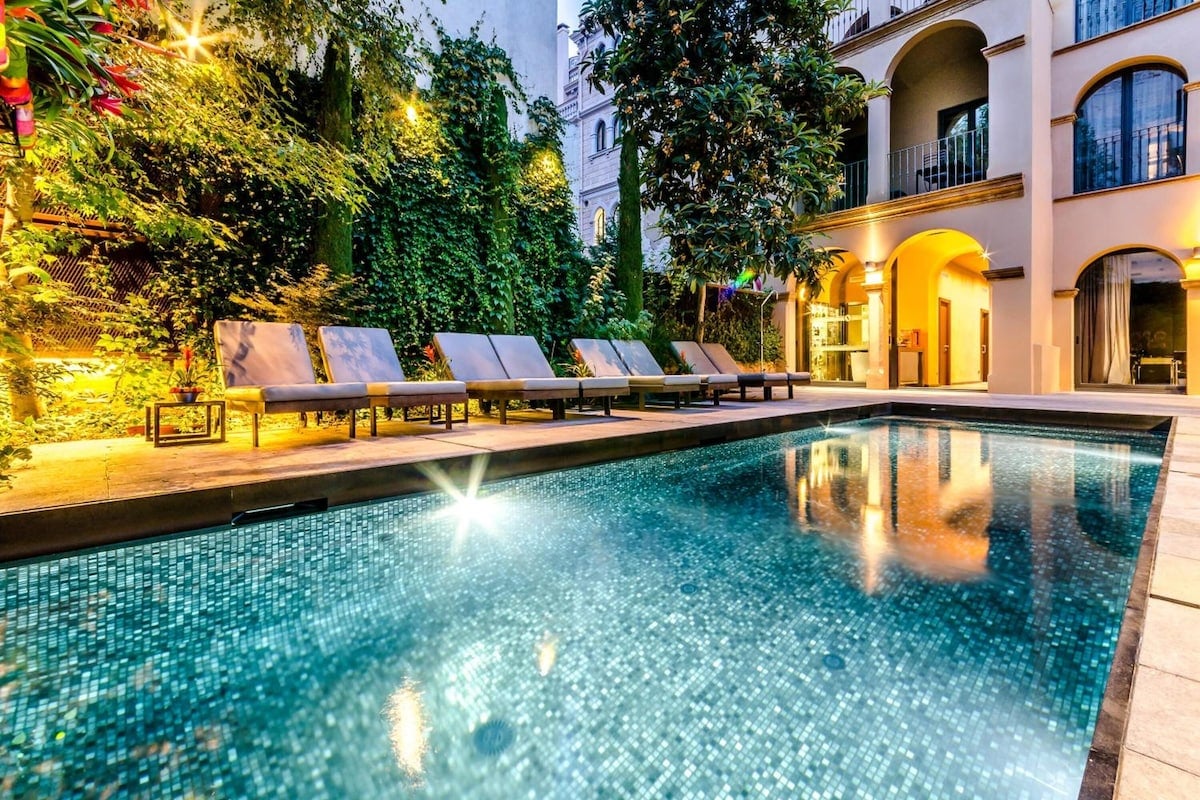
The hotel offers massage on request and yoga on request in the garden. The seasonally open outdoor pool (June–September) is presented by the hotel itself as the only garden pool in the city centre.
THE TABLE
Seasonal lunch with local produce from the Costa Brava region — L'Assaig 1901. The hotel's own restaurant kitchen serves traditional Catalan cuisine with contemporary technique; lunch daily, dinner Wednesday–Saturday.
THE SERVICE
The staff is small and personal — the chances of being remembered rather than merely checked in are real. Breakfast is served in the dining room or on the garden veranda.
THE NEIGHBORHOOD
The hotel sits at Mercadal, the commercial and historic heart of Girona, within walking distance of the cathedral, the Onyar bridge, and the colourful façades along the river.
HONEST CAVEAT
Parking in the historic centre is a real headache; take the train from Barcelona and walk in on foot.
THE VERDICT
Hotel Nord 1901 delivers exactly what a food traveller heading to El Celler de Can Roca actually needs: location, credibility, and a kitchen of its own without arrogance.
THE FULL PICTURE
One arrives at Hotel Nord 1901 not with a grand entrance, but through a slow, dawning realization. Turning off the leafy Rambla de la Llibertat, where plane tree leaves dapple the light over the hum of café life, you find yourself on Carrer Nou. The street is a narrow stone channel, worn smooth by centuries of footfalls. The hotel’s facade doesn’t announce itself with the clamor of luxury, but with the quiet confidence of a beautifully restored Modernista building. It blends into the urban fabric, its sinuous ironwork balconies and carved stone details a soft counterpoint to the medieval severity surrounding it. To step across the threshold is to cross a membrane. The glare of the Catalan sun is instantly exchanged for a cool, hushed interior. There is no cavernous lobby, no impersonal slab of a reception desk. Instead, you enter an intimate space where a single staff member greets you less as a guest and more as a principal in a private residence. The first sensory hit isn't visual, but tactile and aural: the sudden quiet, punctuated only by the soft report of your own shoes on the geometric encaustic tiles—original, worn to a gentle patina by a century of lives lived.
My second-floor room is a dissertation on restraint and texture. It is here the hotel’s character truly reveals itself, in the dialogue between the inherited and the introduced. The eye is drawn upward, first, to the painstakingly restored Noucentista coffered ceiling, its intricate geometries lending a sense of historic gravity to the space. Underfoot, the iconic encaustic tiles, cool and solid, create a hypnotic pattern that pulls the gaze toward the tall windows overlooking a quiet interior courtyard. The furniture is deliberately recessive—a clean-lined dark wood headboard, a spare armchair, lighting that is both functional and sculptural. These are choices made not to compete with the architecture, but to frame it. It’s a design ethos that understands true luxury is not about addition, but amplification of what is already there. What is most palpable is the light. In the late afternoon, it pours in, laying long, golden rectangles across the floor, making the tiles’ colors—ochre, sage, terracotta—glow from within. It’s a light that feels both ancient and alive, a silent performance staged daily. There's a tangible absence of clutter; no superfluous pamphlets or promotional bric-a-brac, just carefully selected elements that contribute to a sense of calm and order. The bed linens have a noticeable weight, and the bathroom, clad in neutral stone, is fitted with fixtures whose precision feels engineered.
The crowd at Nord 1901 is as discreet as the hotel itself. You do not see the ostentatious, the chasers of scenes. You see a couple from Zurich quietly debating the details of the Cathedral’s Romanesque cloister over breakfast; a food writer from San Francisco making notes in a Moleskine by the small garden pool; an architect from Copenhagen photographing the cast-iron staircase. These are travelers who do not need their taste validated. They are here for Girona—to walk the Passeig de la Muralla at dawn, to get lost in the labyrinthine Call, the ancient Jewish Quarter, to eat a *xuixo*, the city’s signature pastry, from an unassuming bakery like Can Castelló. The hotel is their sanctuary, a perfectly calibrated base of operations, not the destination itself. Its location is a strategic masterstroke: central enough that you can be at the painted houses of the Onyar river in three minutes, yet just far enough off the main tourist thoroughfares to feel like a discovery. The staff understands this. Their recommendations are not generic, but suggest a lesser-known tapas spot like Bubbles Gastrobar for its local cheeses and craft vermouth, or the best time to visit the Arab Baths to have the chambers almost to yourself.
Divinum, the hotel’s gastronomic heart, is an extension of this same philosophy. It is not a grand dining room, but an intimate space that champions the local terroir. The focus is on the biodynamic and organic wines of the nearby Empordà region; a tasting here is a lesson in Catalan geography. The food is precise, modern, and unpretentious, deeply rooted in the region’s *mar i muntanya* (sea and mountain) tradition. Yet, honesty demands a caveat, a small admission. The hotel's position on the narrow but central Carrer Nou is a double-edged sword. While it places you in the vibrant heart of the city, it means the sounds of that city can, and do, filter in. On a Saturday night, the muted strains of a distant classical guitarist or the convivial chatter of late-night diners may find their way to your window. It is not intrusive, not jarringly so, but it is a subtle reminder that you are in a living, breathing urban core, not an isolated ivory tower. For those in search of absolute, monastic silence, this might be a consideration. For me, it was part of the texture, a faint soundtrack to the stay that reinforced the feeling of being a temporary resident, not just a visitor.
Leaving Hotel Nord 1901 does not feel like checking out. It feels like locking the door to an apartment that was, for a short while, yours. The memory I carry away is not of opulent service or extravagant amenities, but of a quieter, more fundamental quality. It is the memory of the way the sun patterned itself across the century-old floor, of the cool, solid feel of the iron balustrade beneath my hand, of the stillness that permeated every space. The hotel doesn't impose an experience on you; it provides the conditions for you to have your own. It acts as a lens, focusing and enhancing the best of Girona—its history, its artistic soul, its understated elegance. As I step back out onto Carrer Nou and rejoin the city's current, it is with the understanding that Nord 1901 is not just a hotel in Girona. It is a hotel *of* Girona, a distillation of the city’s very spirit, captured within four beautifully restored walls.
FACTS
- Neighbourhood: Girona
- Stars: 4
- From 210 EUR per night
- Tripadvisor: 4.5/5 (721)
- 41.9828, 2.8238
FAQ
When is the best time to visit?
Girona is having its moment: El Celler de Can Roca draws food travellers from around the world, and hotels with genuine local history are difficult to find at this price.
Anything I should know before booking?
Parking in the historic centre is a real headache; take the train from Barcelona and walk in on foot.
What is the neighbourhood like around Hotel Nord 1901?
The hotel sits at Mercadal, the commercial and historic heart of Girona, within walking distance of the cathedral, the Onyar bridge, and the colourful façades along the river.
MORE HOTELS IN Costa Brava
- Almadraba Park Hotel — Roses
- Boutique Hotel Can Pico — Empordà Interior
- Can Mascort Eco Hotel — Palafrugell
- Casa Vincke — Baix Empordà
- Finca Victoria — Begur
- Gran Hotel Reymar & Spa — Tossa de Mar