Hotel Viura
Villabuena de Álava, Basque Country · discovery
THE VIBE
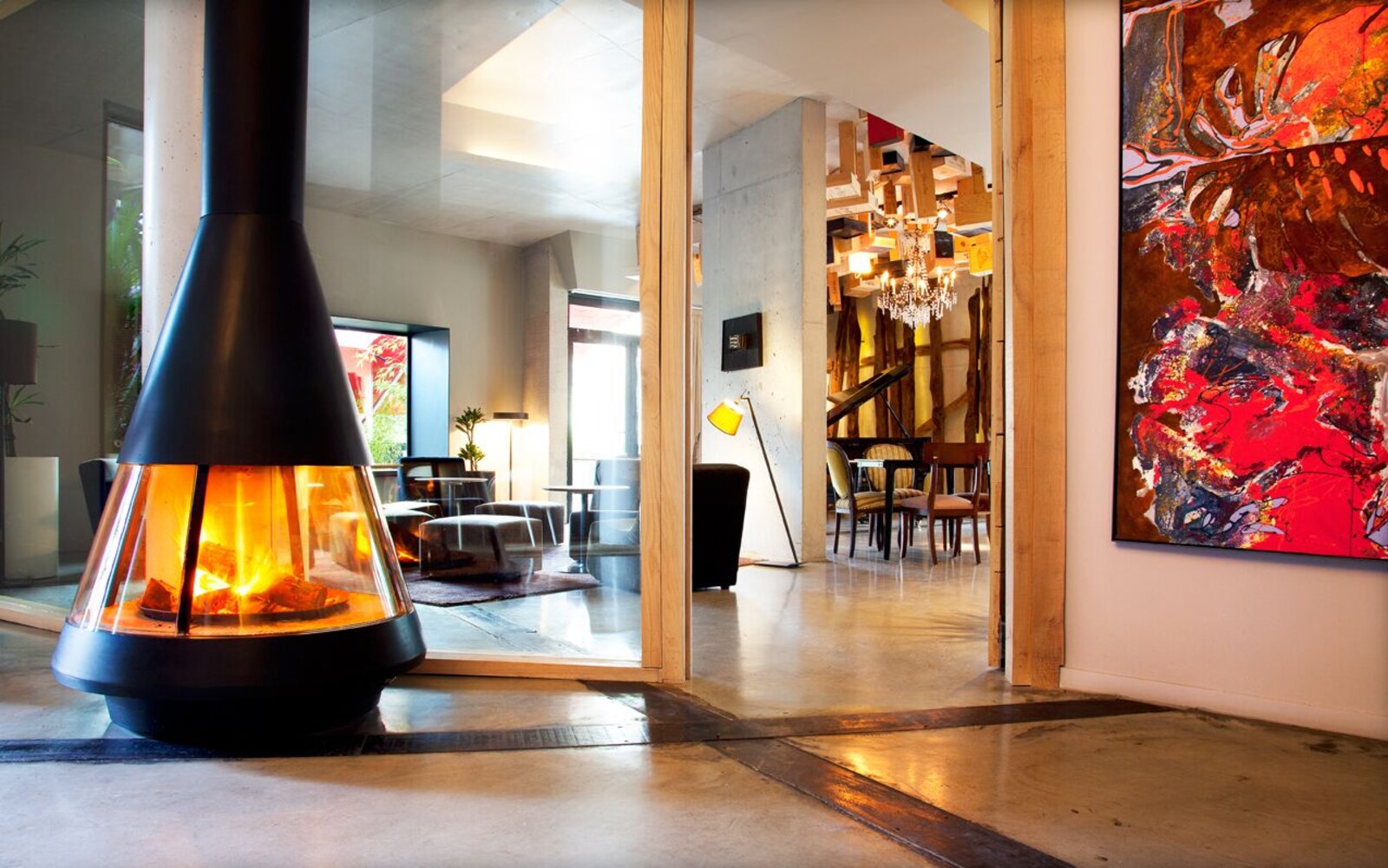
Opened in 2010 as a stack of concrete cubes wedged into the village hill beside Villabuena's church — sculpture more than hotel.
THE BACKSTORY
Designed by the local architecture studio Mup-Arq and completed in 2010 after just under two years of construction, Viura rises as rectangular volumes clad in concrete and Corten steel, wedged into the hill's stone beside the church and the Plaza Mayor of Villabuena de Álava. The material choice — brutalist concrete against Basque wood — mirrors the region's tension between bodega modernism and village stone.
WHY NOW
Rioja Alavesa's harvest peaks in September, and from 1 January 2027 Euskadi adds a per-night tourist tax across the whole region — book ahead of that for today's rate.
THE ROOM
Ask for one of the upper cubes with a terrace facing the vineyards and the Sierra de Cantabria — the lower volumes look onto the village lane.
THE NEIGHBORHOOD
Villabuena de Álava sits in Rioja Alavesa, Álava's wine district roughly two hours inland from the Basque coast — administratively Basque but not coastal. This is Tempranillo country, not the coast's txakoli. The hotel stands beside the village church and Plaza Mayor; Gehry's Marqués de Riscal in Elciego and the medieval walled town of Laguardia are a short drive away.
HONEST CAVEAT
With 35 rooms in a village of some 300 residents, this is no city hotel: the nearest airport (Bilbao) is a little over an hour away and a car is effectively essential.
THE VERDICT
The strength is the architecture and the vineyard setting — a design hotel set among Rioja Alavesa's bodegas at a fraction of Marqués de Riscal's rate. The weakness is the isolation and the reliance on a car. It suits the wine traveller and design-minded couples, not anyone wanting coast or city pulse at the door.
THE FULL PICTURE
You arrive at Viura the way you arrive at most things worth finding in Rioja Alavesa — down a road you're half-convinced is wrong. The village of Villabuena de Álava, population roughly three hundred, offers no sign to confirm it. Then the church tower appears, and beside it, stacked against the hillside like a construction game abandoned by a brutalist, a cluster of concrete cubes and weathered Corten steel that is, improbably, your hotel.
Designed by local studio Mup-Arq and completed in 2010, Viura photographs better from a drone than from the plaza — which is fine, because you'll spend most of your time inside it or among the vineyards that begin where the village lane ends. Thirty-five rooms occupy rectangular volumes cantilevered at competing angles, so from the Plaza Mayor the place reads less as hospitality and more as a sculptural argument about what belongs beside a medieval church. The argument is not yet settled.
Check in late afternoon. The lobby is compact — poured concrete, dark timber, a reception desk that doesn't try too hard. Take the lift to one of the upper cubes: this is the room to insist on. The lower volumes face the village lane, meaning you'll wake to a neighbor's diesel and a view of stone walls. The upper cubes open onto terraces confronting the Sierra de Cantabria across a carpet of Tempranillo vines, their rows running toward the mountains with the rigor of ruled lines. At six in the evening, with a glass of crianza and the sun at your back, the silence makes you aware of your own breathing.
This is Tempranillo country — not the coast's txakoli, not the cider houses of Gipuzkoa, but inland Basque wine territory where conversation turns on soil and oak and the argument between American and French barrels. The guests who land here know the difference. You'll share breakfast with winemakers from surrounding bodegas, couples who drove from Bilbao with a vineyard visit already booked, the occasional architect who's made the pilgrimage to Gehry's Marqués de Riscal in neighboring Elciego and wants to sleep somewhere less operatic. Viura is the foil to Riscal's titanium fireworks — quieter, more restrained, priced to let you spend the savings on cases of wine.
Be honest with yourself before booking. Villabuena has no taxi rank, no bar worth lingering in past ten, and no public transit that respects your schedule. You need a car. Bilbao's airport is a little over an hour north, and the drive through Álava's wine plain earns the effort — but if you want a neighborhood to walk at midnight, this is the wrong hotel. The medieval walled town of Laguardia offers more evening life, which amounts to a handful of restaurants and a plaza where teenagers circle on scooters. Calibrate accordingly.
Dinner is the pivot. Bistro Barica, the hotel's own restaurant, stocks a deep Rioja Alavesa cellar and draws from local producers — the kind of room where the menu follows what the valley delivers. For something with more smoke, drive to Area for the txuletika de corzo al sarmiento, venison seared over vine cuttings in a way that makes you resent every steak you've ordered in a capital. Push further and Asador Etxebari is the region's great altar of fire — grilled Palamós prawns arriving with a char that tastes like the sea conceding to flame. Book weeks ahead.
Mornings here are slow by design. Open the terrace door at seven and the air carries vine dust, the mineral chill that rolls off the sierra before the sun arrives, and — if you've timed September's harvest — the faint sweetness of grape must fermenting somewhere nearby. Breakfast is served in a ground-floor room where concrete walls hold the cool. Adequate, not revelatory. Take your coffee to the terrace instead.
By the third morning you stop reaching for your phone at the table. By checkout you've memorized the ridgeline of the Sierra de Cantabria and bought two cases you don't need from a bodega whose owner poured a barrel sample in a dim cellar that smelled of damp oak and patience. The drive back toward Bilbao feels like re-entering a frequency you'd briefly forgotten — the Guggenheim's titanium catching afternoon light along the river, the Casco Viejo's compressed energy, the Mercado de la Ribera reminding you the coast was only an hour north all along.
Viura doesn't compete with that. It offers the counter-program: a concrete cube on a vine-covered hill, a glass of Tempranillo you didn't have to explain to anyone, and the sound of nothing worth interrupting. For the wine-literate traveller who doesn't need a concierge's itinerary, it remains one of Rioja Alavesa's sharpest propositions — architecture with a vineyard attached, priced like the region hasn't fully noticed what it has.
FACTS
- Neighbourhood: Villabuena de Álava
- Stars: 4
- From 170 EUR per night
- Tripadvisor: 4.4/5 (844)
- 42.54809, -2.6649
FAQ
When is the best time to visit?
Rioja Alavesa's harvest peaks in September, and from 1 January 2027 Euskadi adds a per-night tourist tax across the whole region — book ahead of that for today's rate.
Anything I should know before booking?
With 35 rooms in a village of some 300 residents, this is no city hotel: the nearest airport (Bilbao) is a little over an hour away and a car is effectively essential.
What is the neighbourhood like around Hotel Viura?
Villabuena de Álava sits in Rioja Alavesa, Álava's wine district roughly two hours inland from the Basque coast — administratively Basque but not coastal. This is Tempranillo country, not the coast's txakoli. The hotel stands beside the village church and Plaza Mayor; Gehry's Marqués de Riscal in Elciego and the medieval walled town of Laguardia are a short drive away.
MORE HOTELS IN Basque Country
- Akelarre — San Sebastián
- The Artist Grand Hotel of Art (formerly Gran Hotel Domine) — Bilbao
- Hotel de Londres y de Inglaterra — San Sebastián
- Hotel María Cristina — San Sebastián
- Hotel Marqués de Riscal — Elciego
- Lasala Plaza Hotel — San Sebastián