Lasala Plaza Hotel
San Sebastián, Basque Country · curated
THE VIBE
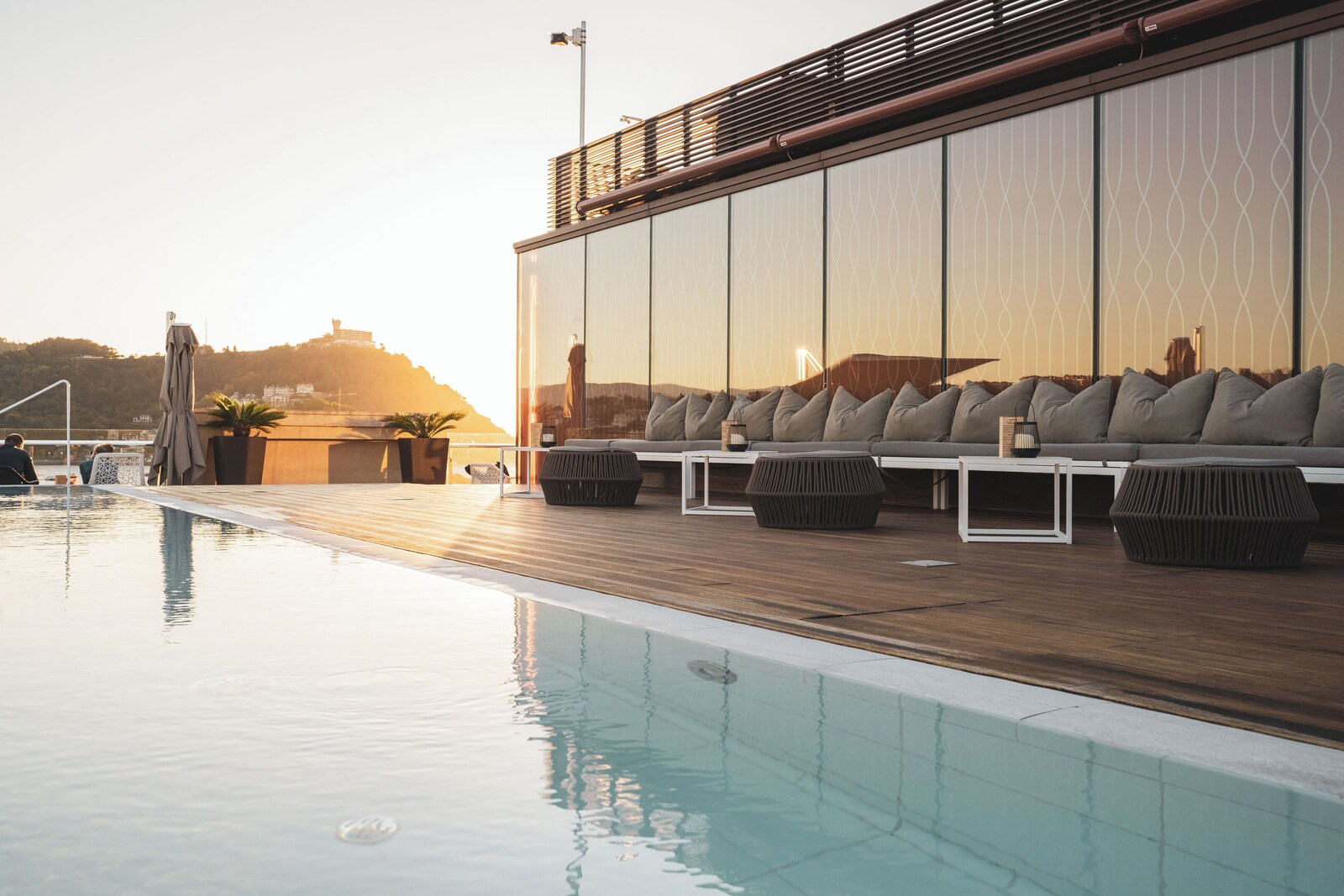
A 1917 palace façade at the harbour's edge of Parte Vieja, where the rooftop takes in La Concha, the port and the old town at once.
THE BACKSTORY
The building went up in 1917 in the Belle Époque spirit of the decades when the Spanish crown had made San Sebastián fashionable. It served for years as an office palace on the harbour before a thorough renovation turned its six floors into a hotel in 2018, the façades preserved and the floors hung as a walk-through art gallery. It is a curated four-star, not one of the city's grandes dames — that role belongs to the 1912 María Cristina.
WHY NOW
Since its 2018 conversion this is one of the few additions to the old-town core — a district where, after the January 2026 PGOU freeze, San Sebastián no longer permits new hotels.
THE ROOM
The standard rooms run European-small; pay up to a Sea View or Historical room for space and a view over the harbour rather than the courtyard.
THE NEIGHBORHOOD
The hotel sits at Plaza Lasala 2, on the edge of Parte Vieja beside the fishing harbour and a few minutes' walk from La Concha beach. Casa Vallés, the bar where the gilda was born in the 1940s, and the Mercado de la Bretxa are minutes away on foot; the three 3-star kitchens — Arzak, Akelarre and Martín Berasategui in Lasarte-Oria — call for a car or taxi instead.
HONEST CAVEAT
Parte Vieja is Europe's densest pintxo grid — charming by day, loud on weekend nights; light sleepers should ask for a room off the lane.
THE VERDICT
The strength is the address: a 58-room four-star adults-only inside the pintxo grid, with a rooftop that is the old town's only combined view of both La Concha and the harbour. The weakness is that this is not a gran-lujo house — the rooms are consistent but not grand, and the night noise comes with the location. It suits the couple who want to sleep in the middle of the food rush and walk home, not the one after a spa resort and silence.
THE FULL PICTURE
You arrive in the late afternoon — the right hour to arrive in San Sebastián — when the fishing harbour throws golden light off the water and the first pintxo crowds begin to thicken the lanes of Parte Vieja. The taxi drops you at Plaza Lasala, where a 1917 façade — Belle Époque bones, all symmetry and civic confidence from the decades when the Spanish crown summered here — announces something more handsome than most four-stars dare to be. Inside, the lobby is a corridor of curated art, the kind of pieces that European hotels hang when someone on the team actually collects rather than decorates. This continues up six floors: each hallway a minor gallery, each turn a reason to slow down.
The check-in is unhurried, the staff Basque-warm rather than corporate-polished. You're handed a key, and unless you've paid up to a Sea View or Historical room, what you get is well-designed European-small — the kind of room where the suitcase lives on the floor because the luggage rack was designed for a cabin bag, and you learn to unpack into the closet or trip over your own decisions. The finishes are consistent, the beds made with pressed white linen, the bathrooms tiled in a palette that doesn't try to compete with the view you haven't earned yet. If you want the harbour — its salt-crusted fishing boats, the green flank of Monte Urgull rising five minutes away on foot — you spend more. This is not a place that pretends every room is equal.
But the rooftop is the equalizer, and it may be the sharpest decision the 2018 renovation made. From up there, La Concha curves to your left — that crescent of grey-blue Cantabrian water, a six-minute walk on foot but consuming the entire western sky from this perch — while the harbour opens below and Parte Vieja's terracotta roofline fills the middle ground. It is the old town's only combined view of both, and that fact alone justifies the address. On a July evening, with the sun dropping behind Monte Igueldo and the air carrying the mineral sharpness of txakoli, this is the kind of vantage that rearranges your understanding of the city. You stop thinking of San Sebastián as a beach town. You see it as a port town that happens to have one of Europe's great beaches.
The crowd is adults-only and grateful for it — couples in their forties and fifties who have done their research, who know the difference between a three-Michelin-star city and a three-Michelin-star dinner. Food writers between assignments. The pair of architects from Lyon arguing about whether the Catedral del Buen Pastor, a nine-minute walk away, is underrated or simply dull. The retired publisher from Milan who has eaten at Arzak three times and now wants to understand the pintxo bars that made it all possible. These are people who came for the food and stayed for the geography.
And the food is the reason Parte Vieja exists as a destination rather than a neighbourhood. Step out the front door and within minutes you're at Casa Vallés, the bar where the gilda — that anchovy-olive-pepper skewer — was born in the 1940s, or threading through the Mercado de la Bretxa for whatever the season demands. Kokotxa, where the kokotxas arrive in their classic preparation — a dish that teaches you what Basque minimalism actually means when applied to hake jowls — is an old-town fixture. Amelia by Paulo Airaudo runs an Italian-omakase tasting menu that shouldn't work in this city and does. For Arzak and its huevo a la inversa, or Akelarre and Martín Berasategui out in Lasarte-Oria, you'll need a taxi, but that's a problem only if you haven't planned.
Here is what you need to know about the noise: Parte Vieja is Europe's densest pintxo grid, and on Friday and Saturday nights the lanes below your window become a block party that nobody asked your permission for. By midnight, the sound of a hundred conversations and clinking glass will reach even the upper floors. Light sleepers should request a room facing the courtyard rather than the lane — and even then, bring earplugs as insurance. This is the honest trade-off of sleeping inside the food rush: you walk home from dinner in three minutes, and the city follows you back.
By the third morning you've developed a rhythm. Coffee early, before the lanes wake up. A walk along La Concha when the tide is low and the beach belongs to the swimmers and the dog walkers. Monte Urgull in the late morning for the kind of earned perspective that a rooftop gives you for free. Then the long, slow crawl through the pintxo bars that begins at one in the afternoon and ends whenever your willpower does.
When you leave — pulling your bag across the lobby's gallery one last time, past the harbour light cutting through the entrance — you understand what this hotel is and is not. It is not the María Cristina, with its 1912 grand-dame weight and its sense of occasion. It is not a spa retreat. It is a 58-room base camp positioned at the exact centre of the reason you came to San Sebastián in the first place. Since the January 2026 planning freeze, the city will not permit another hotel in this district. The door you just walked through may be one of the last ones that opened.
FACTS
- Neighbourhood: San Sebastián
- Stars: 4
- From 280 EUR per night
- Tripadvisor: 4.7/5 (794)
- 43.32229, -1.98661
FAQ
When is the best time to visit?
Since its 2018 conversion this is one of the few additions to the old-town core — a district where, after the January 2026 PGOU freeze, San Sebastián no longer permits new hotels.
Anything I should know before booking?
Parte Vieja is Europe's densest pintxo grid — charming by day, loud on weekend nights; light sleepers should ask for a room off the lane.
What is the neighbourhood like around Lasala Plaza Hotel?
The hotel sits at Plaza Lasala 2, on the edge of Parte Vieja beside the fishing harbour and a few minutes' walk from La Concha beach. Casa Vallés, the bar where the gilda was born in the 1940s, and the Mercado de la Bretxa are minutes away on foot; the three 3-star kitchens — Arzak, Akelarre and Martín Berasategui in Lasarte-Oria — call for a car or taxi instead.
MORE HOTELS IN Basque Country
- Akelarre — San Sebastián
- The Artist Grand Hotel of Art (formerly Gran Hotel Domine) — Bilbao
- Hotel de Londres y de Inglaterra — San Sebastián
- Hotel María Cristina — San Sebastián
- Hotel Marqués de Riscal — Elciego
- Hotel Viura — Villabuena de Álava