Tayko Bilbao
Bilbao, Basque Country · curated
THE VIBE
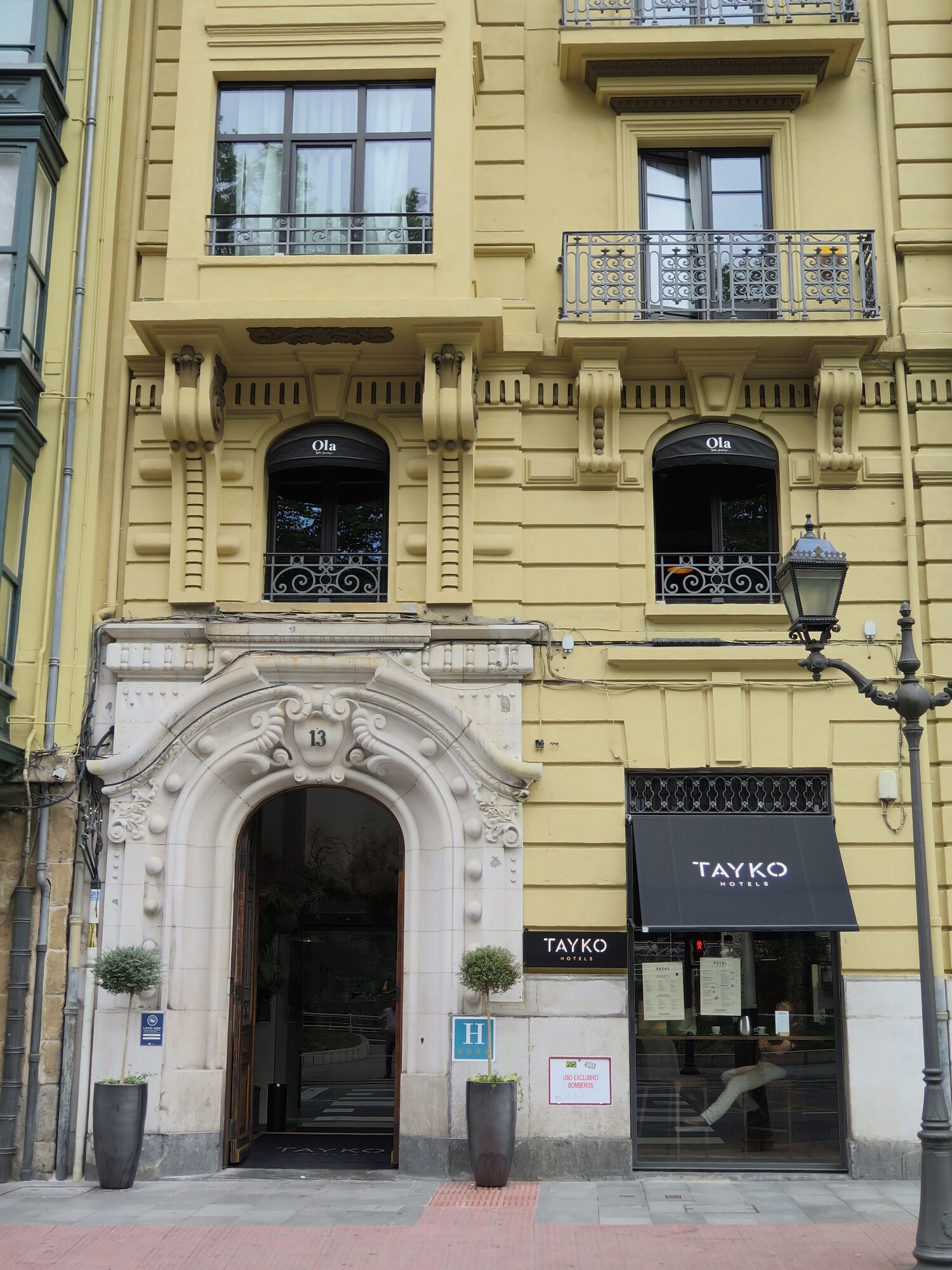
Behind a 1924 riverside facade in Casco Viejo — exposed brick and concrete beams, two blocks from the Teatro Arriaga.
THE BACKSTORY
The building went up in 1924 and, per the Michelin guide, was the first in Bilbao's historic quarter built with brick and visible concrete beams — a structure the restaurant Ola now leaves exposed in its dining room. After a full renovation, Tayko opened as a four-star city hotel with Martín Berasategui's Ola and the gastrobar Patri on the ground floor.
WHY NOW
In-house Ola Martín Berasategui held its Michelin star in the 2026 guide, and the hotel sits within walking distance of the Guggenheim's 2027 thirtieth anniversary — the reason Bilbao is in the spotlight right now.
THE ROOM
Ask for a room facing the Nervión rather than the courtyard; the river side brings light and a view over the Ribera market, while the courtyard is quieter but darker.
THE NEIGHBORHOOD
The hotel stands at Calle Ribera 13, wall-to-wall with the Mercado de la Ribera and a couple of minutes from the Teatro Arriaga and Siete Calles, Bilbao's seven founding streets. The Guggenheim is a short half-hour walk along the river, or a few minutes by metro from the Casco Viejo station.
HONEST CAVEAT
With just over fifty rooms and four stars this is a compact city hotel, not a resort — no pool, no spa, and the lanes of Casco Viejo carry noise on weekend nights.
THE VERDICT
The strength is the location and the table: a Michelin star on the ground floor and Bilbao's medieval core at the door. The weakness is that it remains a compact four-star city hotel with no spa or river terrace. It suits the food-and-culture traveller who wants to stay in the old town, not the one after resort comforts.
THE FULL PICTURE
You arrive in the wrong century, which is the point. The taxi drops you at Calle Ribera 13, and before the lobby door swings shut behind you, the smell hits — river damp layered with something warmer, the residual perfume of olive oil and seared cod drifting from the ground-floor kitchen. The building went up in 1924, the first in Bilbao's medieval quarter to flaunt exposed brick and concrete beams rather than hide them behind plaster, and the hotel that now occupies it — Tayko — has had the good sense to leave those bones visible. The lobby is narrow. The elevator is narrower. This is not a place that pretends to be larger than it is, and that honesty is its currency.
Check in on a Friday afternoon and the receptionist will warn you, half-apologetically, about weekend noise from the lanes below. Take the warning seriously. The Siete Calles — Bilbao's seven founding streets, laid out when this was still a medieval trading port — funnel sound the way old stone corridors do, and by midnight on a Saturday the pintxo-bar crowds turn the neighborhood into a genial, wine-fueled echo chamber. Ask for a room facing the Nervión rather than the courtyard. The river side brings morning light and a sightline over the Mercado de la Ribera, a four-minute walk and the market where vendors stack peppers and hang bundles of guindilla chillies like red punctuation marks. The courtyard rooms are quieter but darker — a trade-off that depends on whether you prize sleep or the sight of mist lifting off the river at seven in the morning.
This is a compact four-star city hotel. Just over fifty rooms, no spa, no pool, no terrace cantilevered over the water. If you need a robe and a plunge pool, Bilbao has other addresses. What Tayko offers instead is a Michelin star on the ground floor and the old town at the door — a bargain that only works if those are the things you came for.
And Ola, the restaurant Martín Berasategui operates downstairs, is precisely what you came for. The dining room keeps the building's original brick and raw concrete overhead, which gives the space the feeling of eating inside a carefully lit archaeological dig. The star held in the 2026 Michelin guide, and the cooking justifies the survival: this is Basque technique with the volume turned up, the kind of table where conversation stalls because someone has just tasted something they need a moment to process. The gastrobar Patri, also on the ground floor, handles the nights when you want the same kitchen's instincts without the ceremony — a seat at the bar, a glass of txakoli, and whatever the cook is assembling from the day's market haul.
Step outside and Casco Viejo unfolds like a controlled argument between preservation and appetite. The Teatro Arriaga sits a two-minute walk away, holding down the edge of the old town with the quiet authority of a building this city refuses to let go. Walk the other direction and Victor Montes will serve you bacalao pil-pil and classic pintxos in a tiled room that has not changed its mind about anything in decades. Gure Toki does an egg with mushrooms and Idiazabal cream that makes the case, wordlessly, that Basque cooking needs no imported complexity. And if you want white tablecloths and theatrical gravity, Zortziko seats you in what feels like a Versailles room and runs a tasting menu through it — the dissonance between the surroundings and the rigor of the food is half the point.
The Guggenheim is a half-hour walk along the river, or a few metro stops from Casco Viejo station if the weather turns. With the museum's thirtieth anniversary arriving in 2027, Bilbao is pulling fresh attention — a city that spent three decades earning its way out of post-industrial decline and now has the confidence to celebrate the gamble that started the recovery. But the riverside walk itself is the better argument: the Nervión narrows and widens, the bridges multiply, and by the time the museum catches the late-afternoon Basque light you have understood that this is a city that treats infrastructure as a form of self-respect.
The people who book Tayko tend to know this already. They are the architects and curators passing through for the anniversary programming, the food writers retracing Berasategui's empire across the Basque Country, the couples who chose Bilbao over San Sebastián because they wanted grit with their gastronomy. They do not ask about the spa. They ask which pintxo bar stays open latest on the Siete Calles and whether the Mercado de la Ribera sells the smoked Idiazabal they tasted at dinner.
You will leave on a Monday morning, probably, with a suitcase heavier than it arrived — wedges of cheese wrapped in wax paper, a bottle of txakoli bought from a market vendor who insisted you try two before choosing. The taxi will take the river road, and as the old town shrinks in the rear window you will feel the particular pang of a city that gave you exactly what it promised and nothing it didn't. Tayko is not the hotel that changes your life. It is the hotel that puts you in the right neighborhood, at the right table, at the right moment — and trusts you to do the rest.
FACTS
- Neighbourhood: Bilbao
- Stars: 4
- From 180 EUR per night
- Tripadvisor: 4.8/5 (1086)
- 43.25802, -2.92628
FAQ
When is the best time to visit?
In-house Ola Martín Berasategui held its Michelin star in the 2026 guide, and the hotel sits within walking distance of the Guggenheim's 2027 thirtieth anniversary — the reason Bilbao is in the spotlight right now.
Anything I should know before booking?
With just over fifty rooms and four stars this is a compact city hotel, not a resort — no pool, no spa, and the lanes of Casco Viejo carry noise on weekend nights.
What is the neighbourhood like around Tayko Bilbao?
The hotel stands at Calle Ribera 13, wall-to-wall with the Mercado de la Ribera and a couple of minutes from the Teatro Arriaga and Siete Calles, Bilbao's seven founding streets. The Guggenheim is a short half-hour walk along the river, or a few minutes by metro from the Casco Viejo station.
MORE HOTELS IN Basque Country
- Akelarre — San Sebastián
- The Artist Grand Hotel of Art (formerly Gran Hotel Domine) — Bilbao
- Hotel de Londres y de Inglaterra — San Sebastián
- Hotel María Cristina — San Sebastián
- Hotel Marqués de Riscal — Elciego
- Hotel Viura — Villabuena de Álava