25hours Hotel Indre By
Indre By, Copenhagen · curated
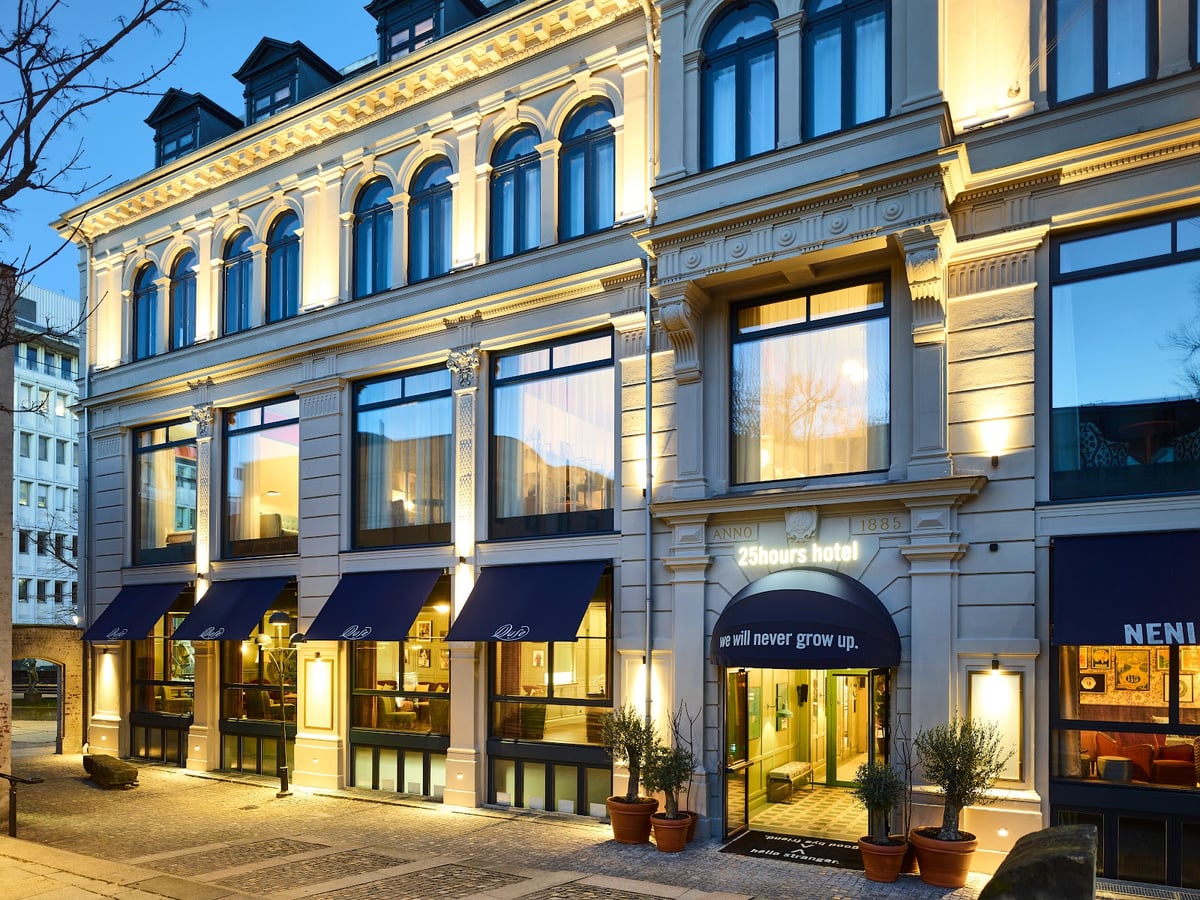
THE VIBE
243 rooms, a century-old porcelain factory and a London design team that chose aubergine, mustard and cobalt blue over every neutral tone the industry otherwise reaches for without thinking.
THE BACKSTORY
The building complex at Pilestræde 65 consists of four interconnected buildings erected during the 19th century. The site originally housed a porcelain factory, was subsequently converted into a paper factory during the latter part of the 1800s, and then served as the University of Copenhagen's theology and law faculties until 2017. It is this layered history — craft, science, ideas — that Martin Brudnizki Design Studio (London) distilled into the hotel's overarching theme: Coming of Age. 25hours Hotels opened its first hotel in Hamburg in 2003; Indre By became the chain's Scandinavian entry nineteen years later.
WHY NOW
Opened 15 March 2022 — 25hours' Scandinavian debut — and has established itself as one of Copenhagen's most consistent design hotels without compromising its edge. NENI's sharing plates and Boilerman Bar's basement speakeasy atmosphere function as a system: the kitchen and the bar reinforce each other, and it shows most clearly during the weeks before the summer season's tourist wave has arrived.
THE ROOM
The Gigantic rooms offer a separate bedroom and living room plus a bathtub — book one with a terrace for direct access to the enclosed Secret Garden, one of the few inner courtyards of this size that is genuinely private in central Copenhagen.
WELLNESS
The wellness area is on the same level as the Secret Garden and houses a Technogym-equipped fitness studio with yoga mats, a power shower for early check-in or late check-out, and an outdoor sauna with both indoor and outdoor lounging areas.
THE TABLE
Sabich — NENI. Sabich — pitta with fried aubergine, egg and tahini, sharp with zhoug and tart with amba — is the dish that most clearly communicates what NENI actually is: an Israeli-Austrian-Mediterranean culinary meeting that functions as street food rather than restaurant theatre. Shared with the table, eaten immediately.
THE SERVICE
Every room comes with STOP THE WATER toiletries, a complimentary minibar stocked with fritz-kola and local craft beer, a Bluetooth speaker and a FREITAG bag to take out into the city — none of these details are accidental, and together they set the tone for an offer that prioritises character over neutral hotel standard.
THE NEIGHBORHOOD
Pilestræde 65 sits between Rundetårn — Europe's oldest functioning observatory, built in 1642 — and the shopping street Købmagergade. Nørreport station, with direct connections to Kastrup and Christianshavn, is reachable on foot.
HONEST CAVEAT
The design ambitions are consistent but not always ergonomic: guests return repeatedly in reviews with complaints that light switches are positioned illogically and that power outlets are difficult to find. The hotel's stated anti-convention stance also manifests in the lobby's noise level, which on evenings seeps into rooms on the lower floors.
THE VERDICT
Martin Brudnizki Design Studio's Coming of Age interpretation of a 19th-century university is among the more considered design narratives in Copenhagen — neither reduced to a mood café nor inflated into a showroom. NENI's sharing plates and Boilerman Bar hold the operational level. The weakness is the same one many design hotels share: the concept is stronger than the execution of the functional basics.
THE FULL PICTURE
You arrive on Pilestræde, a lane so quiet the only sound is the wet hiss of bicycle tires over ancient cobblestones. You push through an unmarked, heavy door and the silence doesn't just break, it shatters. The air inside is a delicious assault: the bitter punch of dark-roast coffee from Café Duse, the warm, dusty spice of cardamom drifting from the kitchen of NENI, and the expensive musk of perfume clinging to the coats of passing guests. Your eyes adjust to a deliberate, cinematic gloom, a world of jewel-toned velvet sofas, raw concrete columns, and the amber glow of dozens of mismatched lamps casting shadows that dance to a soundtrack of 70s Italo-disco. This is the first test. If the thrumming bassline feels like an intrusion rather than an invitation, you’ve come to the wrong place.
The crowd confirms it. These aren’t tourists ticking off a list. They are freelance scenographers arguing about the Royal Danish Theatre’s latest set design, architects in austere black turtlenecks, and podcast producers from Vesterbro who’ve booked a staycation because their own minimalist apartments suddenly feel sterile. They are here because the hotel’s studied nonchalance mirrors their own. This tribe thrives on the hotel’s central, glorious flaw: its unwavering commitment to vibe over function. The check-in desk doubles as a bar, and you’ll wait, patiently, while a staff member finishes shaking a cocktail before acknowledging your existence. The process feels less like hospitality and more like trying to get the bartender’s attention at a crowded music festival. For the pragmatic, this is infuriating. For the intended guest, it’s part of the performance.
The elevator ride is a brief reprieve before the next critical decision. Your entire stay hinges on securing the right room, and you must be merciless in your request. Ask for one of the larger rooms on an upper floor. Anything below the fourth floor risks inheriting the lobby’s relentless soundtrack, and the smaller rooms overlooking the internal courtyard can be monastic cells of brick-wall views and perpetual twilight. Success, however, is transcendent. You open the door and the city unfolds. At 7 a.m., the low winter sun illuminates a panorama of twisted copper spires and terracotta rooftops, a scene so perfectly composed it feels like a lost Vilhelm Hammershøi painting. The iconic Rundetårn stands sentinel nearby, a constant, reassuring presence in your periphery. This view is the hotel’s quiet apology for the chaos downstairs.
As the Nordic afternoon fades to black by 3 p.m., the hotel transforms into the city’s most coveted bunker. You leave for a brisk, head-clearing walk through the nearby Kongens Have, the frozen ground crunching underfoot, only to feel the magnetic pull of the hotel’s warmth. The basement sauna, an afterthought in summer, becomes an essential daily ritual, a place to sweat out the damp chill before descending into the evening’s festivities. Back in the lobby, now packed, the energy is kinetic. You could join the queue at the Boilerman Bar for a complex, herb-infused cocktail, but the real soul of this establishment resides at NENI.
Here, under the guidance of Haya Molcho, the philosophy is ‘balagan’—beautiful chaos. You bypass the more elaborate sharing plates and order the dish that encapsulates the entire experience: The Sabich. It arrives not as a tidy sandwich but as a glorious, delicious mess. A warm, pillowy pita is overstuffed with slices of perfectly fried aubergine, a jammy, slow-cooked egg, and cascading rivers of hummus and tahini. The genius is in the sharp counterpoints: the fierce, herbal punch of zhoug, the tangy sweetness of amba mango pickle, and the clean crunch of fresh tomato. It’s a plate of food so vibrant and soulful it feels like a direct transmission from a Tel Aviv street corner. In a hotel that trades so heavily on performance, this dish is a moment of profound, unvarnished truth.
Checking out, you step back onto the silent cobblestones of Pilestræde. The quiet feels alien. Your ears are still ringing with the phantom Italo-disco, and the taste of zhoug lingers on your tongue. The stay wasn't seamless. You spent five minutes hunting for the light switch hidden behind a curtain, and you could never find a conveniently placed power outlet. But you leave knowing you haven’t just visited Copenhagen; you’ve been admitted into a very specific, artfully curated version of it, a high-fidelity bubble of beautiful, maddening, singular chaos.
FACTS
- Neighbourhood: Indre By
- Stars: 4
- From 2550 DKK per night
- Tripadvisor: 4.2/5 (367)
- 55.68261, 12.57813
FAQ
When is the best time to visit?
Opened 15 March 2022 — 25hours' Scandinavian debut — and has established itself as one of Copenhagen's most consistent design hotels without compromising its edge. NENI's sharing plates and Boilerman Bar's basement speakeasy atmosphere function as a system: the kitchen and the bar reinforce each other, and it shows most clearly during the weeks before the summer season's tourist wave has arrived.
Anything I should know before booking?
The design ambitions are consistent but not always ergonomic: guests return repeatedly in reviews with complaints that light switches are positioned illogically and that power outlets are difficult to find. The hotel's stated anti-convention stance also manifests in the lobby's noise level, which on evenings seeps into rooms on the lower floors.
What is the neighbourhood like around 25hours Hotel Indre By?
Pilestræde 65 sits between Rundetårn — Europe's oldest functioning observatory, built in 1642 — and the shopping street Købmagergade. Nørreport station, with direct connections to Kastrup and Christianshavn, is reachable on foot.
MORE HOTELS IN Copenhagen
- 71 Nyhavn Hotel — Indre By
- Absalon Hotel — Vesterbro
- AC Hotel by Marriott Bella Sky Copenhagen — Ørestad
- Andersen Boutique Hotel — Vesterbro
- Boutique Hotel Hans (formerly Avenue Hotel) — Frederiksberg
- Axel Guldsmeden — Vesterbro