AC Hotel by Marriott Bella Sky Copenhagen
Ørestad, Copenhagen · curated
THE VIBE
Scandinavia's largest hotel doesn't sound like a hotel — it sounds like an airport during working hours: methodical, cool, satisfyingly impersonal.
THE BACKSTORY
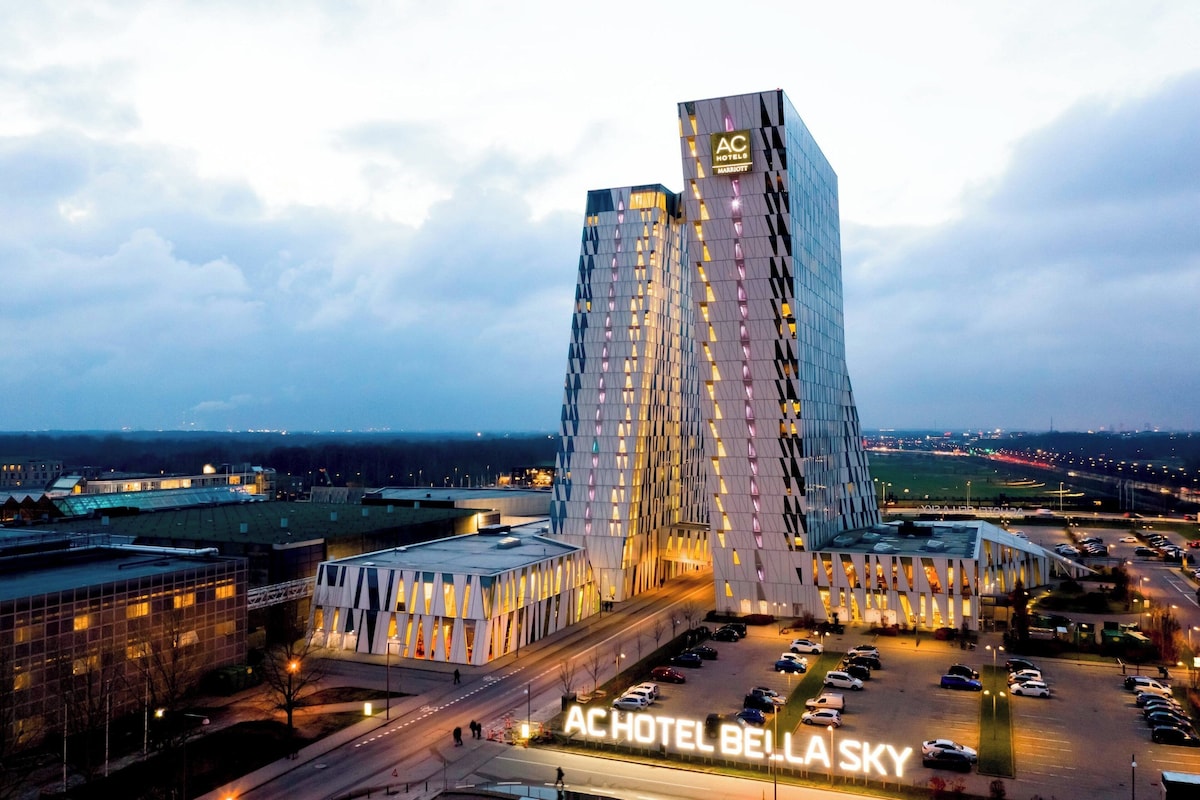
The hotel was designed by the Danish architecture firm 3XN — founded by Kim Herforth Nielsen — and opened on 16 May 2011 under the name Bella Sky Comwell Hotel. The two towers, each 76.5 metres tall and tilted 15 degrees in opposite directions from a shared base, placed 3XN on the international architecture map. The concept was practically driven: the tilt ensures that almost all 814 rooms have views of Amager Fælled or Copenhagen's rooftops. On 15 December 2014 the hotel entered Marriott's AC Hotels portfolio and received its current name.
WHY NOW
SUKAIBA on the 23rd floor won the title of Denmark's best hotel restaurant at the World Culinary Awards 2025. That alone is reason enough to book a room above the cloud line and eat well. The winter half of the year also delivers a quality of light over Amager Fælled and Øresund that summer never manages.
THE ROOM
The north-east-facing tower delivers the panorama that justifies the price: Amager Fælled in the foreground, Copenhagen's spires and the silhouette of the Øresund Bridge on the horizon. Corner rooms on the upper floors provide a double aspect and the sensation of floating above one's view — a geometric trick that 3XN's 15-degree tilt deliberately constructs.
WELLNESS
Sky Spa (operated by Sky Spa ApS, a separate operator within the hotel's premises) offers heated pools, cold-water baths, sauna, aroma steam bath and rainfall showers. A day fee applies in addition to the room rate.
THE TABLE
Asian-Nordic à la carte — ask the staff to guide you to the evening's produce-driven selection — SUKAIBA. SUKAIBA is operated by the Norrlyst group on the 23rd floor, 76 metres above Copenhagen. Denmark's best hotel restaurant 2025 (World Culinary Awards, also won in 2023) with a kitchen that moves between Asian technique and Nordic ingredients. The menu is season-driven — no single dish is fixed enough to name with honesty.
THE SERVICE
Green Key-certified since opening in 2011. Bella Center metro station is within walking distance, with a direct M2 connection to Kastrup in approximately six minutes — a fact that transforms an early-morning departure from a stressful moment into a logistical triviality.
THE NEIGHBORHOOD
The hotel is located in Ørestad, Copenhagen's planned southern district, integrated with the Bella Center congress facility. Metro M2 at Bella Center station connects guests to Kastrup in approximately six minutes and to the city centre in under ten. Fields shopping centre and Amager Fælled nature park are within the neighbourhood. DR Concert Hall with Danmarks Radio's stages is in the district, though a precise distance cannot be given without a map to hand.
HONEST CAVEAT
Ørestad is a district built around function, not the stroll. Cobblestone streets and spontaneous neighbourhood bars don't exist here — they're a ten-minute metro ride away. The hotel's scale also means that the service, however efficient, never feels personal. You are a room number here, and that's fine as long as you know it in advance.
THE VERDICT
Bella Sky is the right choice when a flight's departure time, a conference agenda's density, or the need for a late evening at SUKAIBA outweighs the texture of the city. Those who want Copenhagen on their doorstep should look at Indre By. Those who want Scandinavia's most recognisable hotel towers, with the finest view in Ørestad and an award-winning restaurant at the top, have the right address.
THE FULL PICTURE
You don't arrive here by accident. A taxi from Kastrup glides off the E20 onto roads with the wide, confident emptiness of a business park, depositing you before a structure that doesn't charm so much as command. With 811 rooms, this is not a hotel; it’s a sovereign state of Scandinavian efficiency, a hub for the kind of people who measure their time in cleared inboxes and non-stop flights. The lobby is a vast atrium of poured concrete and diffuse light, the air conditioned to a precise, neutral temperature. The sound is a low, polyglot hum from clutches of German engineers and Danish life-science executives discussing intellectual property on low-slung sofas. This is not the Copenhagen of worn cobblestones and leaning canal houses. This is the city’s modern engine room, and you are here because you have business with the future.
The journey to your room is a silent, carpeted glide through corridors so long they seem to bend with the earth’s curvature. Inside, the aesthetic is one of rigorous subtraction. There are no superfluous cushions, no distracting art. It is a space designed for focus: a firm bed, a functional desk, and a floor-to-ceiling window framing the flat, windswept plains of Amager. You are insulated from the city, a spectator to its low-slung sprawl under a vast, expressive sky. At 6 PM, as the sun begins its slow summer descent, the AC Lounge begins to fill. The crowd is a mix of conference attendees still wearing their lanyards and local architects who come to argue about urban planning over gin and tonics that are poured with unnerving precision.
The evening’s critical decision is one of altitude and intent. Do you stay grounded at Restaurant BASALT for something elemental and direct, or do you make the ascent? You make the ascent. SUKAIBA Copenhagen is the hotel’s justification, its narrative climax. The elevator doors open to a panorama of the Øresund Bridge stitching Denmark to Sweden in the distance. Here, under the guidance of head chef Adam Kallmann, the kitchen operates with the discipline of a design studio. This is where Copenhageners who treat a Tuesday dinner with the gravity of a gallery opening come to eat. The award for Denmark's Best Hotel Restaurant feels less like a prize and more like a statement of fact. Each plate is an exercise in control, a composition of textures and temperatures that demands your full attention. The experience is sharp, intelligent, and utterly memorable.
Here, however, is the brutal truth that earns your trust. The triumph of SUKAIBA makes the morning’s breakfast a more poignant disappointment. Descending to the BM Breakfast Restaurant is a return to the reality of scale. The room is a cavernous hall engineered for mass catering. The scrambled eggs taste of institutional compromise, the coffee is plentiful but generic, and the sheer volume of guests creates the ambient roar of a transit hub. It’s efficient, comprehensive, and entirely anonymous—a system designed to fuel 800-plus rooms with minimal friction. It serves its purpose, but it possesses none of the soul you found twelve floors higher the night before. This is the trade-off for staying in a machine of this size.
The hotel’s location demands a different kind of exploration. Forget a quaint stroll to see the Little Mermaid. Instead, pull on your running shoes at dawn and head out. A thirteen-minute jog brings you to the stark, functional concrete of Slusen, a water lock managing the flow between the harbor and the sea—a piece of raw, unromanticized infrastructure. Push further, for forty minutes, and you’ll reach the Islands Brygge Havnebad. To plunge into its cold, clean harbor water alongside stoic locals is to understand the city’s relationship with its environment on a cellular level. This is not tourism; it’s an immersion in the pragmatic, hardy spirit of contemporary Copenhagen. This is the hotel's gift: it forces you out of the storybook center and into the city as it is lived, a place of bridges, water, and forward momentum. You check out feeling clear-headed and strangely invigorated, as if you’ve spent two days inside a perfectly calibrated organism. You weren’t coddled; you were optimized. And for a certain kind of traveler, that is its own form of perfection.
FACTS
- Neighbourhood: Ørestad
- Stars: 4
- From 2100 DKK per night
- Tripadvisor: 4/5 (4951)
- 55.63973, 12.5779
FAQ
When is the best time to visit?
SUKAIBA on the 23rd floor won the title of Denmark's best hotel restaurant at the World Culinary Awards 2025. That alone is reason enough to book a room above the cloud line and eat well. The winter half of the year also delivers a quality of light over Amager Fælled and Øresund that summer never manages.
Anything I should know before booking?
Ørestad is a district built around function, not the stroll. Cobblestone streets and spontaneous neighbourhood bars don't exist here — they're a ten-minute metro ride away. The hotel's scale also means that the service, however efficient, never feels personal. You are a room number here, and that's fine as long as you know it in advance.
What is the neighbourhood like around AC Hotel by Marriott Bella Sky Copenhagen?
The hotel is located in Ørestad, Copenhagen's planned southern district, integrated with the Bella Center congress facility. Metro M2 at Bella Center station connects guests to Kastrup in approximately six minutes and to the city centre in under ten. Fields shopping centre and Amager Fælled nature park are within the neighbourhood. DR Concert Hall with Danmarks Radio's stages is in the district, though a precise distance cannot be given without a map to hand.
MORE HOTELS IN Copenhagen
- 25hours Hotel Indre By — Indre By
- 71 Nyhavn Hotel — Indre By
- Absalon Hotel — Vesterbro
- Andersen Boutique Hotel — Vesterbro
- Boutique Hotel Hans (formerly Avenue Hotel) — Frederiksberg
- Axel Guldsmeden — Vesterbro