71 Nyhavn Hotel
Indre By, Copenhagen · flagship
THE VIBE
Pomeranian pine timber from 1805 holds up the ceiling. Nyhavn's street life does not follow you in.
THE BACKSTORY
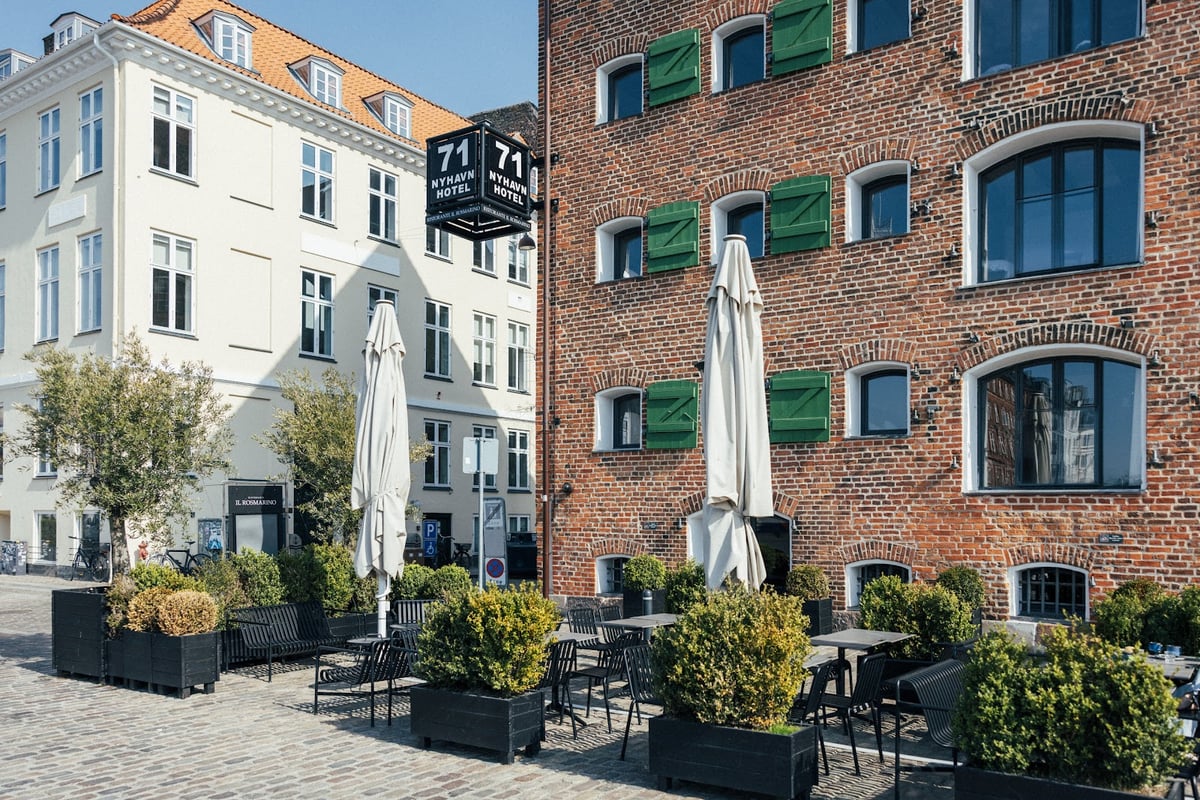
Ole Berendt Suhr and his partner Ludvigsen erected the Red Warehouse in 1805 to store spices from Indochina. Alf Arp-Hansen purchased the property in 1970; architects Flemming Hertz and O. Ramsgaard Thomsen carried out the conversion, and the hotel opened in 1971. In 2000 the Yellow Warehouse (Puggaards Pakhus, c. 1850) was integrated. In 2016 the Red Warehouse was renovated — 64 rooms in place of 84, with the load-bearing beams retained.
WHY NOW
The COBRA collection hangs permanently in the lobby and restaurant — works by Asger Jorn and Karel Appel from the owner's private collection, not a loan exhibition. In a city that chases brand partnerships, this is an unusual form of artistic responsibility.
THE ROOM
The Red Warehouse contains suites and Executive Doubles with canal views — request a high floor facing Nyhavn for the perspective that lifts you above the quayside movement. Courtyard-facing rooms are quieter but surrender the address.
THE TABLE
Ravioli with turbot — Il Molo. Hotel-operated Italian restaurant on the lower-ground floor — the Arp-Hansen kitchen group runs it, and the canal position gives the terrace one of Nyhavn's better summer tables. The ravioli with turbot is one of the house signature options.
THE SERVICE
Breakfast in the warehouse vault with a live kitchen: omelettes, pancakes, and Danish specialities against exposed brick. The hotel holds Green Key certification and sources organic produce for the breakfast buffet.
THE NEIGHBORHOOD
Nyhavn 71, 1051 Copenhagen. Kongens Nytorv with metro stations M1/M2 is approximately 200 metres west along the quay. Designmuseum Danmark runs north along Bredgade. The Opera House is visible across the harbour basin.
HONEST CAVEAT
130 rooms is not a large hotel, but the Nyhavn canal is Copenhagen's most photographed address — in summer that means constant crowds directly outside. The most compact Executive Double starts at 14 sqm, which registers with luggage for two.
THE VERDICT
Converted 19th-century warehouses with COBRA art and Pomeranian pine — an address that requires no explanation. Four-star price, four-star delivery.
THE FULL PICTURE
You do not check into 71 Nyhavn. You retreat into it. The first act is pushing through the thick, ancient door, a portal that separates the 21st-century din of Copenhagen’s most photographed canal from a silence scented with centuries of Pomeranian pine, sea salt, and wax. The air inside the converted warehouse is cool and still, the temperature of stone and history. Light is rationed here, filtering through deep-set windows in buttery shafts that catch dust motes and illuminate the rugged grain of the original brickwork. Your footsteps, muffled on a modern rug, find their echo on worn wooden floorboards that creak with the weight of stories—of spice and sailcloth, of fortunes made and lost on the water just outside. This is less a hotel and more a time capsule with impeccable room service, a place for architects arguing the merits of Utzon over dinner and maritime historians who come to feel the ghosts in the colossal timber beams overhead.
The stay is a negotiation with the past, and it begins with securing the right territory. The canal view is non-negotiable, but know that not all are created equal. Ask for a canal-facing room in the old warehouse itself for the purest experience. Aim for the third or fourth floor, where the perspective lifts you above the perpetual throng on the quay, offering a cinematic vista of the gabled houses opposite and the tall ships clinking at their moorings. If you can, secure a corner room, where dual-aspect windows draw in that specific, magical Copenhagen light that has launched a thousand design movements. Waking at 7 a.m. and opening the shutters feels less like observing a view and more like unveiling a Vermeer. The alternative, a room facing the courtyard, is a failure of purpose. You’ve come all this way to be inside the postcard, not to look at the back of it.
Let’s be brutally honest: this immersion comes at a cost. The hotel’s prime position is at the epicenter of Copenhagen’s most relentless tourist trap. From 10 a.m. onwards in the high season, the quay outside your window is a gauntlet of selfie sticks, mediocre accordion players, and queues for overpriced waffles. The hotel is a sanctuary, but there is no secret entrance; you must run that gauntlet every time. The building’s unshakeable authenticity is also a double-edged sword. Inside, those immense structural beams that look so atmospheric on Instagram dictate the layout, resulting in rooms that can be thrillingly eccentric but also surprisingly small and dark. The bathrooms often feel like they were carved out as an afterthought, compact and functional where you might expect expanse. If your definition of luxury is measured in square footage and geometric perfection, you will be frustrated here. This is a trade-off: you are exchanging acreage for atmosphere, modern convenience for a soul so thick you can practically taste it.
The hotel understands its own character. Updates to the rooms have stayed respectful of the old building rather than fighting it. The day unspools from here. You might walk for six minutes to contemplate an evening performance at the Royal Danish Theatre, or cross the water via the elegant Inderhavnsbroen bridge for a visit to the Operaen. The city is at your feet, but the hotel constantly pulls you back.
As evening descends, the character of the canal shifts. The crowds thin, the light softens, and the water reflects the flickering lamps from the houses opposite. This is the moment to return. After a day spent deciphering foraged menus and navigating the bleeding edge of New Nordic cuisine, the hotel’s own Italian restaurant offers a deliberate, radical act of comfort. To sit in its understated dining room and order from its Italian menu is to find a reliable anchor in a city of culinary storms. It’s honest, perfectly rendered, and deeply satisfying. It’s the kind of meal that respects your intelligence without demanding it. After dinner, there is only the quiet of your room, the gentle groan of the old building settling around you, and the sound of water lapping against the quay. You sleep the profound sleep of someone who has found their place. Leaving is difficult; you feel you are not just checking out of a room, but abandoning a piece of history that, for a few nights, felt entirely your own.
FACTS
- Neighbourhood: Indre By
- Stars: 4
- From 3600 DKK per night
- Tripadvisor: 4.6/5 (2090)
- 55.67841, 12.59498
FAQ
When is the best time to visit?
The COBRA collection hangs permanently in the lobby and restaurant — works by Asger Jorn and Karel Appel from the owner's private collection, not a loan exhibition. In a city that chases brand partnerships, this is an unusual form of artistic responsibility.
Anything I should know before booking?
130 rooms is not a large hotel, but the Nyhavn canal is Copenhagen's most photographed address — in summer that means constant crowds directly outside. The most compact Executive Double starts at 14 sqm, which registers with luggage for two.
What is the neighbourhood like around 71 Nyhavn Hotel?
Nyhavn 71, 1051 Copenhagen. Kongens Nytorv with metro stations M1/M2 is approximately 200 metres west along the quay. Designmuseum Danmark runs north along Bredgade. The Opera House is visible across the harbour basin.
MORE HOTELS IN Copenhagen
- 25hours Hotel Indre By — Indre By
- Absalon Hotel — Vesterbro
- AC Hotel by Marriott Bella Sky Copenhagen — Ørestad
- Andersen Boutique Hotel — Vesterbro
- Boutique Hotel Hans (formerly Avenue Hotel) — Frederiksberg
- Axel Guldsmeden — Vesterbro