Copenhagen Admiral Hotel
Indre By, Copenhagen · flagship
THE VIBE
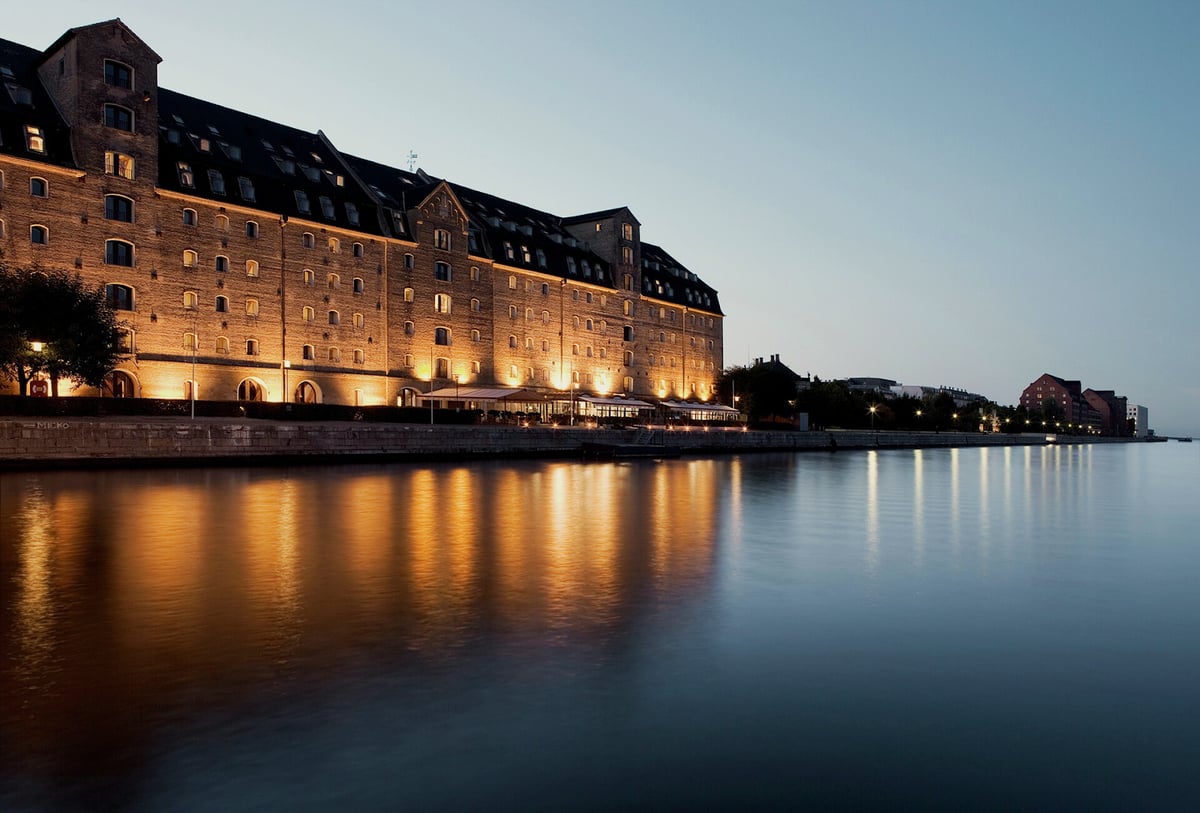
A grain silo from 1787 on Copenhagen's inner harbour — raw brick, Pomeranian pine timber and an address precisely between Nyhavn and Amalienborg.
THE BACKSTORY
The buildings were erected in 1787 for the trading company Pingel, Meyer, Prætorius and Co., designed by the military engineer Ernst Peymann. The two warehouses were merged in 1885 into a single, elongated building. Conversion to a hotel began in 1973 by private investors; the hotel opened in January 1978 and the restoration — carried out by architects Flemming Hertz and Ole Ramsgaard Thomsen — was awarded a Europa Nostra diploma for its contribution to the preservation of European architectural heritage. Since January 2024 the hotel has been operated by Strawberry Hotels (formerly Nordic Choice). The owner is the property group Midstar Hotels AB.
WHY NOW
The heated outdoor pool opened in July 2026 and closes a phased $20 million renovation begun in January 2024 — the same programme that gave all 366 rooms a SPACE Copenhagen interior and put the fire kitchen aye aye on the quay. Outdoor pools are rare in Copenhagen, and this one faces the harbour with a relaxation area beside it, open to hotel guests daily from 08:00 to 20:00.
THE ROOM
Ask for a room with a direct harbour view on the upper floors — that is where the Pomeranian pine beams are most visible and Henning Larsen's Opera House (inaugurated 2005) dominates the view across the water.
THE TABLE
Sharing plates from open fire — seasonal, Mediterranean-influenced — aye aye. The hotel's own signature restaurant opened 27 February 2025. Head chef Andreas Tancula Møller (ex-Alchemist, Søllerød Kro, Falsled Kro) runs a fire kitchen with Mediterranean technique and Nordic produce along the quayside.
THE SERVICE
Strawberry Hotels operates a four-star city hotel with Scandinavian efficiency — professional and correct, without the more personal touch that characterises independent boutique hotels.
THE NEIGHBORHOOD
The hotel is located at Toldbodgade 24–28 — on Copenhagen's harbour front, with the Nyhavn canal to the south and Amalienborg Palace to the north. Wikipedia describes the position as 'between the mouth of the Nyhavn canal and the royal residence Amalienborg Palace.' The Opera House on Holmen is visible from the facade and reachable by ferry from Nyhavn.
HONEST CAVEAT
The original load-bearing walls from 1787 set a hard limit on bathroom area. Even in renovated rooms the bathrooms are compact — do not expect freestanding bathtubs or double vanities.
THE VERDICT
The raw material — a listed 18th-century warehouse with a Europa Nostra diploma and 366 rooms — delivers an atmosphere most Copenhagen hotels simply cannot buy. Expect compact bathrooms: the original load-bearing walls do not give.
THE FULL PICTURE
The taxi drops you on Toldbodgade, and for a moment, you think you’ve been brought to the wrong address. This isn’t a hotel entrance so much as a portal into Copenhagen’s maritime soul. The building, a monumental brick warehouse from the 18th century, still smells faintly of sea salt and old timber, a scent that sinks into your clothes and stays with you. This is a place that earned its Europa Nostra Diploma back in 1979 for its preservation, a fact that feels less like a historical footnote and more like a statement of intent. The lobby isn’t a lobby; it's a vast, timbered hall where the weight of massive Pomeranian pine beams seems to slow time itself. Conversations are hushed here, not by rule, but by a shared reverence for the space. You won’t find venture capitalists taking loud calls. Instead, you’ll see a pair of architects from Oslo, their sketchbooks open, quietly arguing the merits of the Henning Larsen-designed Operaen, its glass façade glittering just across the harbor. You’ll see a historian from Cambridge, sunk deep into a worn leather armchair, who seems to have been here since the hotel first opened its doors in 1978.
Your journey to the room is a lesson in industrial honesty. The corridors are long, the lighting is low, and the original structure dictates the flow. Inside, the recent 2025 renovation has done its work with a light touch, refusing to erase the building's character. The rooms are studies in texture: the rough brick of an exposed wall against the cool, crisp linen on the bed; the smooth, dark wood of the floorboards underfoot. This is not a place of sprawling suites. Space is a commodity, bartered from the building’s unyielding historical blueprint. The real asset is the window. Insist on a harbor-facing room, fourth floor or higher. At 7 AM, you don’t draw a curtain; you raise a sail on the day. The view is a living tableau: the low thrum of the harbor bus making its first crossing, the sharp white sails of a yacht catching the morning light, and the monolithic presence of the Royal Danish Opera House directly opposite. The sounds are real. The mournful call of a foghorn isn't a curated soundscape; it’s a genuine, sometimes startling, intrusion from a working port, a reminder that Copenhagen is a city that still earns its living from the water. Light sleepers, be warned: this is sensory immersion, not sensory deprivation.
This isn’t a hotel you use as a basecamp for frantic sightseeing; it’s a place that reshapes your itinerary. The three-minute walk to Amalienborg Slot becomes a daily pilgrimage, a quiet constitutional to watch the unflappable Royal Life Guards, their bearskin hats stark against the pale sky. You’re steps from Ofelia Plads, where you can watch the entire city exhale after work, its residents dangling their feet over the water’s edge. You begin to absorb the city’s rhythm through proximity, not through a tour bus window. The desire to tick off every museum fades, replaced by the urge to simply sit by your window with a book and watch the harbor traffic navigate the narrow channel. This is the hotel’s quiet triumph: it makes staying in feel like a deeply cultural act.
As evening descends, the city’s lights ripple across the water towards your window. The decision to dine in feels less like a compromise and more like a logical conclusion to the day. At aye aye, chef Andreas Tancula Møller doesn’t compete with the view; he translates it onto the plate. The menu is a conversation with the surrounding sea, focused and confident. The flavors are clean, briny, and elemental, a form of culinary modernism that feels perfectly aligned with the Danish aesthetic. The crowd is a mix of locals who know this is one of the city’s most commanding dining rooms and guests who have wisely surrendered their evening to the hotel. It’s a place for a third glass of wine and a conversation that lasts long after the plates have been cleared.
There is, of course, a necessary caveat. With 366 rooms, the hotel is far from a boutique hideaway. Its scale can, at times, feel impersonal, especially during the morning rush for coffee. The lower-level rooms, particularly those facing the internal courtyards, lack the transformative power of their waterfront counterparts. Their windows, constrained by the original granary architecture, can feel more like apertures than frames, offering glimpses of brick instead of water. To stay here and not see the harbor is to have missed the point entirely. It’s a crucial distinction, the difference between a good hotel room in Copenhagen and an experience that will fundamentally alter your memory of the city. Leaving feels like being discharged from a vessel. You step back out onto Toldbodgade, your ears still faintly ringing with the sound of halyards clinking against masts, the scent of old wood and seawater clinging to you like a memory. You haven’t just stayed somewhere; you’ve inhabited a piece of the city’s history.
FACTS
- Neighbourhood: Indre By
- Stars: 4
- From 3350 DKK per night
- Tripadvisor: 4.1/5 (6889)
- 55.68233, 12.59574
FAQ
When is the best time to visit?
The heated outdoor pool opened in July 2026 and closes a phased $20 million renovation begun in January 2024 — the same programme that gave all 366 rooms a SPACE Copenhagen interior and put the fire kitchen aye aye on the quay. Outdoor pools are rare in Copenhagen, and this one faces the harbour with a relaxation area beside it, open to hotel guests daily from 08:00 to 20:00.
Anything I should know before booking?
The original load-bearing walls from 1787 set a hard limit on bathroom area. Even in renovated rooms the bathrooms are compact — do not expect freestanding bathtubs or double vanities.
What is the neighbourhood like around Copenhagen Admiral Hotel?
The hotel is located at Toldbodgade 24–28 — on Copenhagen's harbour front, with the Nyhavn canal to the south and Amalienborg Palace to the north. Wikipedia describes the position as 'between the mouth of the Nyhavn canal and the royal residence Amalienborg Palace.' The Opera House on Holmen is visible from the facade and reachable by ferry from Nyhavn.
MORE HOTELS IN Copenhagen
- 25hours Hotel Indre By — Indre By
- 71 Nyhavn Hotel — Indre By
- Absalon Hotel — Vesterbro
- AC Hotel by Marriott Bella Sky Copenhagen — Ørestad
- Andersen Boutique Hotel — Vesterbro
- Boutique Hotel Hans (formerly Avenue Hotel) — Frederiksberg