Phoenix Copenhagen
Indre By, Copenhagen · heritage
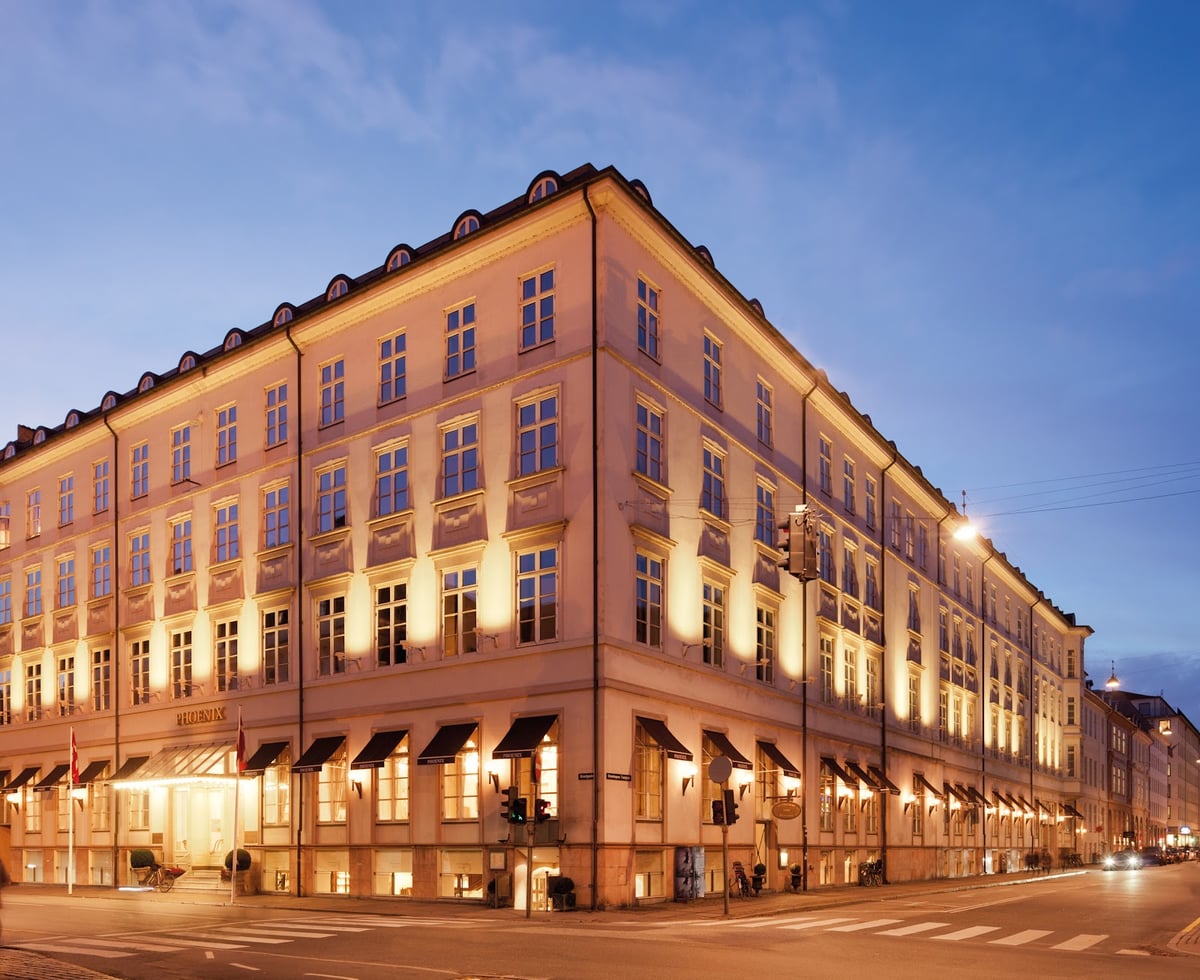
THE VIBE
Four floors in Bredgade's ambassadorial quarter — historic rooms, marble, and the verdigris dome of Frederiks Kirke as a backdrop.
THE BACKSTORY
The plot at Bredgade 37 has been owned by noblemen and apothecaries since the 17th century. William Murdoch — son of the Scottish steam-engine pioneer of the same name — ran the property as Hotel Stadt Hamburg in the 1840s. Hotel Phønix opened in 1848 in a newly erected building. During the Second World War the hotel was confiscated by German occupation forces and used as naval headquarters; in 1945 it was taken over by the Communist Party of Denmark. Arp-Hansen Hotel Group acquired the property in 1990 and architect Robert Grünberger renovated it in 1990–91 ahead of the reopening in 1991.
WHY NOW
Brasserie Hugo, the hotel's new restaurant with a Mediterranean kitchen and Nordic undertone, gives Phoenix a current culinary reason to visit beyond the history. Frederiksstaden is the city's quietest and most heavily curated district — the right anchor during Copenhagen's autumn season.
THE ROOM
Executive rooms facing Bredgade have a direct view of Frederiks Kirke's verdigris dome. Rooms facing the inner courtyard offer the quietest sleep — the hotel's own materials confirm the courtyard view as a separate room category.
THE TABLE
Seasonal Mediterranean cuisine with Italian and French undertones — Brasserie Hugo. The hotel's own restaurant concept, run by Arp-Hansen, open for lunch and dinner with a kitchen that combines classical craft with a Nordic twist. No specific signature dishes confirmed by the official menu.
THE SERVICE
Round-the-clock reception, a concierge with local knowledge, bicycle rental and running maps are included. An Executive Lounge with access to the inner courtyard terrace is reserved for guests in the upper room categories.
THE NEIGHBORHOOD
The hotel is located in Frederiksstaden, Copenhagen's planned Baroque quarter from the 18th century. Amalienborg: 3 minutes on foot. Frederiks Kirke: approximately 300 metres. Nyhavn: approximately 200 metres. Designmuseum Danmark: approximately 400 metres along Bredgade. Kongens Nytorv metro station: approximately 600 metres.
HONEST CAVEAT
Standard rooms are, according to recurring guest reviews, genuinely compact — opt for the lowest category and you risk paying a four-star price for a room that feels cramped. No pool, no spa; only a fitness centre on the basement level.
THE VERDICT
213 rooms in a house with roots from the 17th century, opened as Hotel Phønix in 1848 and reopened by Arp-Hansen in 1991 — Phoenix delivers historic gravitas and a tranquil Frederiksstaden address. Room size in the standard categories is the recurring criticism; choose Executive or Junior Suite.
THE FULL PICTURE
The heavy door on Bredgade closes with a soft, weighted click, and the sound of the city is not just muffled, it is extinguished. You have crossed a boundary into a pocket of profound, academic silence, a decompression chamber from the relentless chic of Copenhagen. The air itself is a statement—cool, still, and carrying the scent of old paper, beeswax from polished wood, and the faint, almost floral dust of antiquities. Your first moments are a recalibration of the senses. Amber light pools from shaded table lamps, catching the gilt spines of leather-bound books and the dark surfaces of framed antiquarian maps. Your footsteps are swallowed by carpets thick enough to absorb a state secret as you pass the lobby's sentinel, a grandfather clock whose deliberate tick-tock is the only percussion in a space that feels less like a hotel and more like the private study of a forgotten dynasty. This is not a place for chatter; it is a sanctuary built for whispers.
The entire point of a stay here is to secure the correct vantage. You must be ruthlessly specific at booking: insist on a fourth-floor Deluxe Room facing Bredgade. Rooms 403 through 407 are the prize. Here, when you part the heavy curtains, the immense, copper-green dome of Frederiks Kirke is not a postcard view; it is an architectural roommate, filling your window with its sublime, silent geometry. In the early morning, you watch the light catch its patina; at dusk, you see it dissolve into a silhouette against the Nordic sky. Any lower and the perspective is lost to the streetscape. The alternative prize, for those who value absolute quiet over civic grandeur, is a third-floor courtyard room—312 or 314, specifically. The view is a composition of tiled rooftops and quiet chimneys that could have been painted by Vilhelm Hammershøi. Avoid, at all costs, the standard doubles on the lower floors. They offer dispiritingly intimate views of an adjacent office building and catch the early morning rumble of official cars gliding towards nearby Amalienborg Palace. A poorly chosen room here is not a minor inconvenience; it is a betrayal of the hotel's entire premise.
The Phoenix is an anchor, not a destination. Its guests are not here for a scene. They are architects who have come to debate Danish functionalism, curators from the Glyptotek taking a quiet meeting, and principal dancers from the Royal Danish Theatre, just a four-minute walk away, seeking monastic refuge after a final curtain. They choose this location for its gravitas, set between the royal residence and the city's grandest stage on Kongens Nytorv. After a day spent navigating the crowded showrooms of the 3daysofdesign festival or the intellectual onslaught of a new gallery opening, the retreat to this weighted silence is a necessary act of sensory preservation. This is where you come to process the city, not to consume it. But let's be brutally honest: the hotel's greatest strength is its most significant liability. After two days, the profound, museum-like silence can begin to feel less like a peaceful escape and more like a beautifully appointed mausoleum. The service, while impeccably professional, carries a Nordic formality that can read as distant. There are no spontaneous, warm interactions here. The lobby bar, Murdoch's Books & Ale, is often a hushed and sparsely populated library of bottles, a place for a solitary nightcap, not a conspiratorial pre-dinner cocktail. If you are looking for energy, for the vibrant pulse that defines so many modern hotels, you will be profoundly disappointed. The Phoenix trades buzz for tranquility, and for some, the silence is deafening.
You don't eat at Murdoch's for culinary pyrotechnics; you eat there for intellectual honesty on a plate. In a city obsessed with the disciples of New Nordic foraging, the kitchen offers a quiet, confident classicism. Order the pan-fried plaice with brown butter, horseradish, and hand-peeled shrimp. It is the hotel's thesis statement. The fish is impossibly fresh, the butter browned to a perfect nutty noisette, the sharp bite of freshly grated horseradish cutting through the richness with a clarifying intelligence. It's a dish that respects its Danish heritage without being entombed by it—the perfect edible metaphor for the building you're in. You eat it surrounded by books you'll never read, feeling both nourished and, somehow, a little bit smarter. It's a meal of quiet contemplation, a stark contrast to the performative dining that dominates the rest of the city.
On the morning of your departure, the return to the street feels like a physical shock. The door opens and the sounds of Bredgade—the bicycle bells, the murmur of Danish, the distant sirens—rush in to fill the vacuum. You realize the hotel's most potent offering is not its location or its comfort, but the profound quiet it has instilled in you. The memory of that stillness is the souvenir you carry back into the world, a new baseline against which all other noise will be measured. You haven't just stayed somewhere; you have briefly inhabited an idea.
FACTS
- Neighbourhood: Indre By
- Stars: 4
- From 2300 DKK per night
- Tripadvisor: 4.1/5 (1061)
- 55.68212, 12.58913
FAQ
When is the best time to visit?
Brasserie Hugo, the hotel's new restaurant with a Mediterranean kitchen and Nordic undertone, gives Phoenix a current culinary reason to visit beyond the history. Frederiksstaden is the city's quietest and most heavily curated district — the right anchor during Copenhagen's autumn season.
Anything I should know before booking?
Standard rooms are, according to recurring guest reviews, genuinely compact — opt for the lowest category and you risk paying a four-star price for a room that feels cramped. No pool, no spa; only a fitness centre on the basement level.
What is the neighbourhood like around Phoenix Copenhagen?
The hotel is located in Frederiksstaden, Copenhagen's planned Baroque quarter from the 18th century. Amalienborg: 3 minutes on foot. Frederiks Kirke: approximately 300 metres. Nyhavn: approximately 200 metres. Designmuseum Danmark: approximately 400 metres along Bredgade. Kongens Nytorv metro station: approximately 600 metres.
MORE HOTELS IN Copenhagen
- 25hours Hotel Indre By — Indre By
- 71 Nyhavn Hotel — Indre By
- Absalon Hotel — Vesterbro
- AC Hotel by Marriott Bella Sky Copenhagen — Ørestad
- Andersen Boutique Hotel — Vesterbro
- Boutique Hotel Hans (formerly Avenue Hotel) — Frederiksberg